
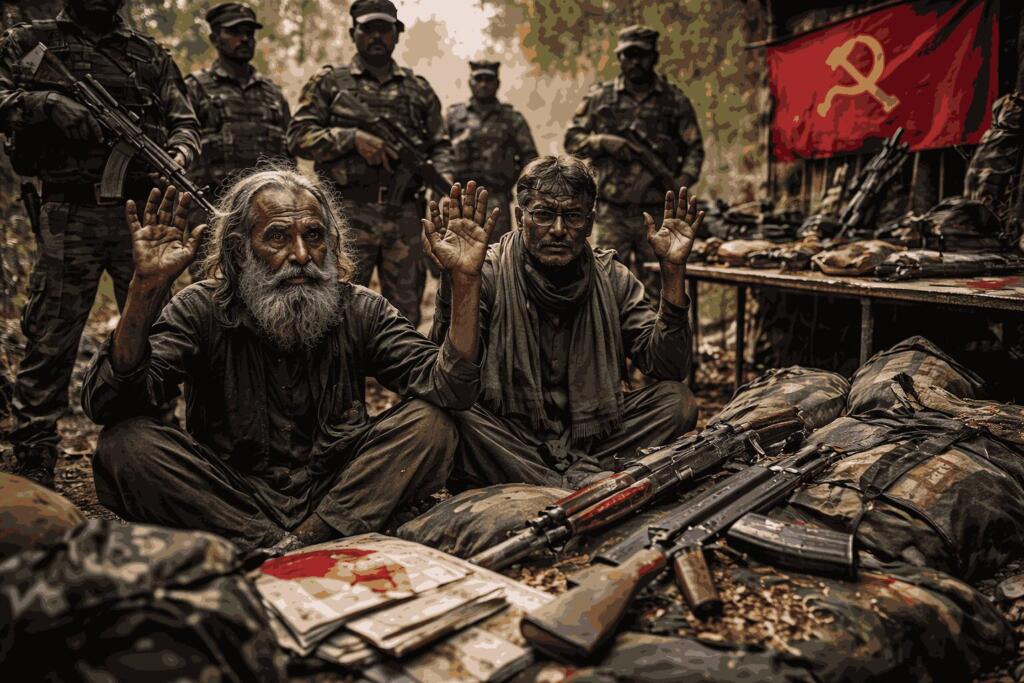
In a dramatic turn of events that could mark the beginning of the end for the long-running Maoist insurgency in India, senior Maoist commanders Thippiri Tirupathi, widely known as Devuji, and Malla Raji Reddy, alias Sangharam, have surrendered to the Telangana Police, delivering a severe blow to the now-dwindling leadership structure of the banned Communist Party of India (Maoist). This development comes well ahead of the Indian government’s 31 March 2026 deadline to dismantle left-wing extremism across the country — a deadline that Home Ministry officials had set as a target for a decisive reduction in insurgent activity.
The surrender of Devuji — a figure who took over key responsibilities within the Maoist hierarchy after the death of former general secretary Nambala Keshava Rao alias Basavaraju last year — is seen by security experts as a significant collapse of the organisation’s operational backbone. Devuji was considered one of the principal strategists within the Maoist leadership, ascending through the ranks from early guerrilla units to become a central figure in the People’s Liberation Guerrilla Army (PLGA) and central committee. His choice to lay down arms recently, along with several other cadres, marks a pivotal moment in the Maoist movement’s decline.
For decades, the Maoist insurgency, rooted in left-wing extremist ideology, operated across vast swathes of central and eastern India, particularly in the so-called Red Corridor stretching from Jharkhand, Chhattisgarh, and Odisha to parts of Telangana and Maharashtra. While at its peak the movement commanded tens of thousands of armed cadres, decades of sustained counter-insurgency operations, intelligence campaigns, and internal fractures have severely weakened its ranks. Security forces have killed hundreds of alleged Maoists in past years, and many others have already surrendered, weakening the organisational coherence that once made the movement a formidable internal security challenge.
The recent surrenders are not isolated events. Over the past several months, top Maoist commanders have either been neutralised in encounters or persuaded to abandon armed struggle. For instance, the death of the notorious commander Madvi Hidma in 2025 was widely reported to have significantly impacted the Maoists’ military structure, dealing another major blow to the insurgent movement. In addition, other high-ranking figures — such as ideologue Mallojula Venugopal Rao — had already defected and publicly called for surrender and integration with legal frameworks rather than continued violence.
The surrender of Devuji and Sangharam has reduced the Maoist central committee and politburo to a shadow of its former strength. Recent security estimates suggest that only a handful of active leaders now remain, and the number of armed cadres has shrunk dramatically compared with earlier years. This organisational implosion has emboldened state security forces and shifting policy approaches in former conflict zones, where rehabilitation schemes and development initiatives have complemented traditional enforcement to draw away support from insurgents.
Telangana’s Director General of Police has actively encouraged such surrenders by assuring safe rehabilitation for those who choose to lay down arms, a strategy that appears to have gained traction in recent months. The comprehensive surrender of high-profile Maoist figures in this context has been hailed by officials as a milestone, while analysts argue it reflects not just battlefield attrition but also deepening ideological fragmentation within the movement. Some commanders, including Devuji, had previously resisted surrender, even threatening internal factions that favored capitulation. Their eventual decision to surrender indicates that the insurgents’ internal cohesion is under severe strain.
Across several affected states, the broader pattern of surrenders over the past two years demonstrates a persistent trend: more cadres have chosen rehabilitation and reintegration than have been killed or captured. For instance, in Telangana alone, nearly 600 Maoist cadres and leaders have rejoined the mainstream since 2024 under government-backed schemes that provide financial incentives and support for education, employment, and land distribution. These efforts have not only weakened the insurgents militarily but also chipped away at the appeal of armed struggle among younger generations in tribal and rural areas.
However, experts caution that the surrender of leaders like Devuji should not lead to complacency. Though greatly diminished, remnants of Maoist groups still operate in remote forest regions, and without sustained development, governance, and community engagement, there remains a risk of resurgence. The government’s stated goal to neutralise left-wing extremism by March 2026 may yet be achieved, but it will require continued commitment to address underlying socio-economic grievances that initially fueled the movement.
In many ways, the surrender of Devuji and Sangharam marks a symbolic end to an era of internal conflict that has profoundly shaped India’s rural heartlands for decades. Whether it translates into lasting peace will depend on how effectively democratic institutions and local governance systems fill the vacuum left behind — ensuring that those who once took up arms find genuine opportunities within the nation’s broader development story.