
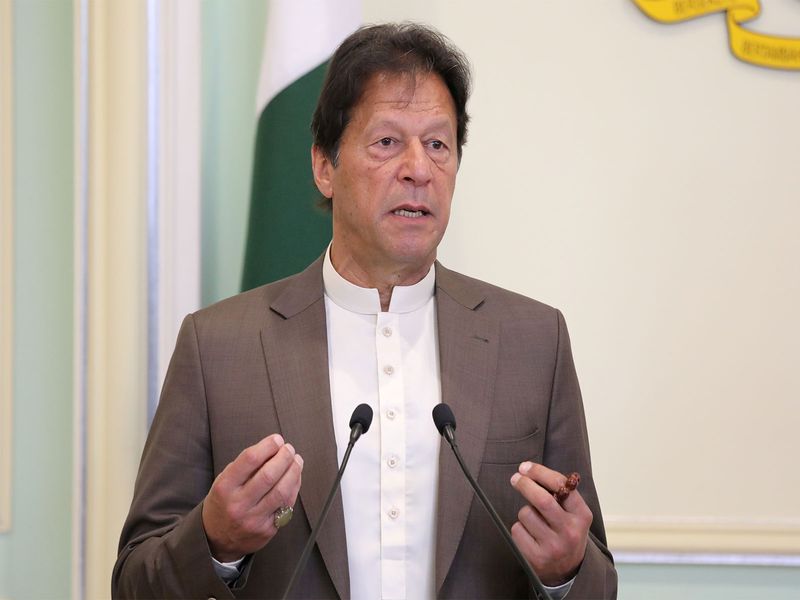
Pakistan’s jailed former Prime Minister Imran Khan has been left with only 15 per cent vision in his right eye, according to a court-appointed lawyer’s report, intensifying concerns over his health and the standard of medical care inside prison.
The findings emerged after Salman Safdar, appointed as amicus curiae by the Supreme Court of Pakistan, visited Khan at Adiala Jail in Rawalpindi on February 10. Safdar submitted an eight-page report detailing Khan’s physical condition, daily routine and living environment.
In his account, the lawyer described the 73-year-old former leader as “visibly perturbed and deeply distressed” by the loss of vision and by what he termed the absence of timely and specialised medical intervention. Throughout their meeting, Safdar noted, Khan’s eyes were watery and he repeatedly used a tissue, reflecting persistent discomfort.
Complaints Ignored for Months
According to the report, Khan told the lawyer that his eyesight began deteriorating rapidly from October 2025. He complained of blurred and hazy vision for months but said jail authorities failed to act.
“His concerns were neither taken seriously nor addressed,” the report stated.
Over time, Khan suffered a sudden and near-total loss of vision in his right eye. Only then was an ophthalmologist from the Pakistan Institute of Medical Sciences in Islamabad called to examine him.
Medical records cited in the report show that Khan was diagnosed with right central retinal vein occlusion, a serious condition caused by a blood clot blocking the main vein draining the retina. Earlier this month, he was given an anti-VEGF injection directly into the eye in an operation theatre.
Despite the procedure, Khan told Safdar that his vision has improved only marginally and remains at around 15 per cent.
Supreme Court Orders Medical Board
Following the submission of the report, the Supreme Court directed authorities to constitute an independent medical board to assess Khan’s condition. The court also ordered that he be allowed to speak with his two sons, who live in the United Kingdom with his former wife, Jemima Goldsmith.
Chief Justice Yahya Afridi told the court that Khan’s health was a matter of paramount importance and that “intervention is necessary”.
Attorney General Mansoor Usman Awan acknowledged during the hearing that it was the state’s responsibility to ensure proper medical treatment for the former prime minister.
Party Raises Alarm
Khan’s party, Pakistan Tehreek-e-Insaf (PTI), has repeatedly alleged that he is being denied adequate healthcare. Last week, when Khan was briefly taken from prison to a hospital for an eye procedure without prior notice to his family, the party accused authorities of secrecy and neglect.
After the Supreme Court’s order, PTI welcomed the decision, saying it vindicated its long-standing concerns over his deteriorating health in custody.
The party has also launched a fresh political campaign demanding his release, linking his imprisonment to what it calls political victimisation.
Life Inside the Cell
Safdar’s report offers a rare glimpse into Khan’s daily life behind bars.
Khan wakes late in the morning, has breakfast around 9.45 am and spends an hour reciting the Holy Quran. He exercises with limited equipment, including an exercise bike and two nine-kilogram weights. He is allowed short walks within a secured compound in the afternoon and evening.
From around 5.30 pm until 10 am the next day, he remains confined to his cell.
His meals are largely self-financed by his family. Breakfast consists of coffee, porridge and dates. Lunch includes chicken, meat, lentils or snacks on different days. Dinner is usually limited to fruit, milk and dates. Bottled water is provided.
The cell contains a bed, chair, table and hangers, with adequate lighting and ventilation. A small heater is available in winter and hot water is supplied. However, Khan told Safdar that summers are extremely difficult due to heat, humidity and insects, which affect his sleep.
A 32-inch television is mounted on the wall but was found to be non-functional. There is no cupboard, and most clothes are hung on hooks. The chair was described as uncomfortable.
The attached toilet lacks an exhaust system, and the report noted that sanitation could be improved.
Around 100 books, prayer items, personal toiletries and fitness equipment were also observed in the cell.
Khan has been assigned a prison servant to assist with cleaning and laundry. He expressed satisfaction with cleanliness and basic amenities.
Gaps in Medical Access
While prison officials told Safdar that doctors regularly monitor Khan’s blood pressure and oxygen levels, the former prime minister complained of broader gaps in healthcare.
He said regular blood tests were not being conducted despite his age. He also claimed that his personal doctors were denied access after he raised concerns about his eyesight.
Khan further said that no dentist had examined him in two years, despite repeated requests.
Safdar recommended that Khan’s eye condition be treated as a matter of urgency, that a team of specialists be appointed, and that his personal doctors be allowed to see him. He also suggested better pest control, improved facilities and access to books and family visits.
Detention Since 2023
Khan has been in custody since August 2023 following his conviction in a corruption case. He was initially held in Attock jail before being shifted to Adiala in October that year, where he has largely remained in solitary confinement.
His last family visit before Safdar’s inspection was in December, when his sister was allowed to see him for just 20 minutes.
While some earlier statements from Safdar suggesting Khan was “fine and healthy” caused confusion, his detailed report now paints a far more troubling picture.
A Test for the State
The case has become a defining test of how Pakistan treats its most high-profile political prisoner.
With a court-mandated medical board now in place, attention has turned to whether authorities will ensure transparent and independent treatment for Khan, or whether allegations of neglect will continue to shadow his detention.
For supporters, the loss of vision symbolises more than a medical crisis. It reflects, they argue, the human cost of prolonged political conflict. For the judiciary and the state, it is a reminder that even in prison, the right to healthcare remains a constitutional obligation.