





















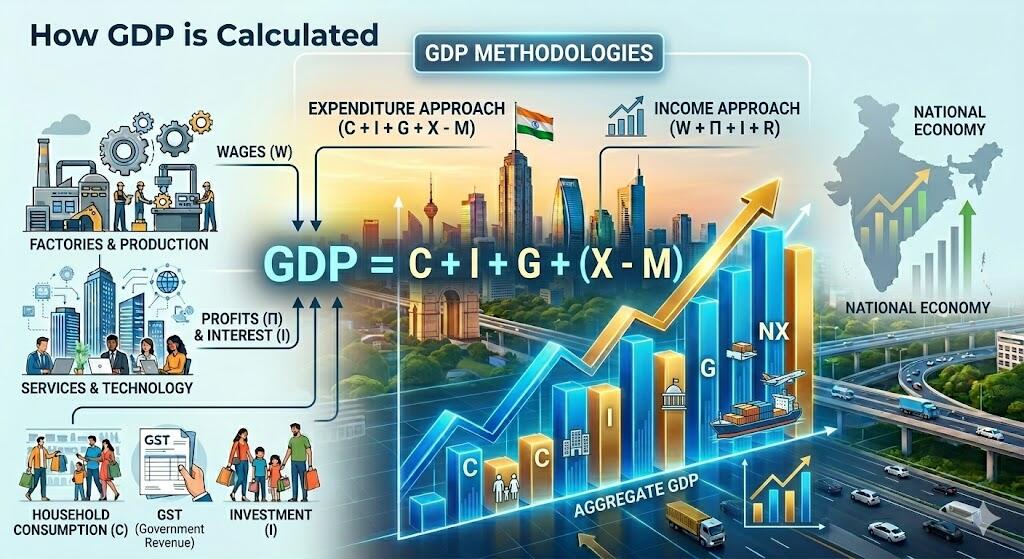
India’s economy continued to demonstrate resilience in the third quarter of the 2025-26 fiscal year, reporting a 7.8 per cent GDP growth under the newly introduced GDP series with 2022-23 as the base year. This follows an 8.4 per cent growth in the second quarter under the old 2011-12 series. Nominal GDP grew 8.9 per cent, reaching Rs 90.91 lakh crore, while real Gross Value Added expanded by 7.8 per cent to Rs 77.38 lakh crore, reflecting sustained strength across manufacturing and services.
The revised GDP series aims to capture structural changes in the economy, integrate high-frequency indicators, and enhance estimation accuracy. The methodology improvements include better deflation strategies and increased granularity, offering a more precise picture of consumption, investment, and sectoral contributions. According to Rajeev Juneja, President of PHDCCI, the updated framework strengthens India’s national accounts credibility and analytical usefulness for policymakers, businesses, and investors.
Sectoral Drivers and Domestic Consumption
Growth momentum was broad-based, led by the services and manufacturing sectors. Trade and hotels recorded an 11 per cent growth in Q3FY26, up from 6.7 per cent in Q3FY25. The financial sector maintained steady progress with 11.2 per cent growth. Manufacturing displayed resilience, posting 13.3 per cent growth compared with 10.8 per cent the previous year, bolstered by improved corporate profitability. Public administration and defence grew by 4.5 per cent, while the utilities and construction sectors also showed moderate gains. In contrast, agriculture and mining recorded slower growth, reflecting sector-specific challenges.
Economists highlighted that domestic consumption continues to drive the economy. Jahnavi Prabhakar of Bank of Baroda noted that urban consumption is picking up following GST rationalisation. Private Final Consumption Expenditure and Gross Fixed Capital Formation both grew over 7 per cent, underscoring the sustained demand across households and businesses.
Outlook for FY26 and FY27
The Second Advance Estimates project real GDP for FY26 at Rs 322.58 lakh crore, marking a 7.6 per cent growth, up from 7.1 per cent in FY25. Nominal GDP is estimated at Rs 345.47 lakh crore, a growth of 8.6 per cent. Real GVA is projected to expand by 7.7 per cent. Chief Economic Advisor V Anantha Nageswaran revised FY27 GDP projections upward to 7 to 7.4 per cent, reflecting strong underlying fundamentals. Elara Capital anticipates FY27 growth at 7.1 to 7.2 per cent, with manufacturing continuing to outperform.
Experts such as Soumya Kanti Ghosh from State Bank of India highlighted that manufacturing and services remain the pillars of India’s growth, while Ashima Goyal stressed that farmer incomes, investments, and industrial output have shown healthy gains. Analysts caution that credit growth has lagged deposits, suggesting a potential need for tax incentives on bank deposits to support senior citizens and encourage savings without disrupting financial stability.
With broad-based growth, resilient domestic demand, and structural reforms, India is positioned as one of the leading major economies, attracting investor interest and creating opportunities for businesses and first-time entrepreneurs alike.