























For decades, India was largely absent from the global semiconductor map, while the country thrived in IT and software services, the chip-making sector remained weak, heavily dependent on imports for advanced processors. Today, that scenario is changing with India transforming this once-untouched sector into a technological strength.
https://x.com/ashwinivaishnaw/status/2020148110316507288?s=48
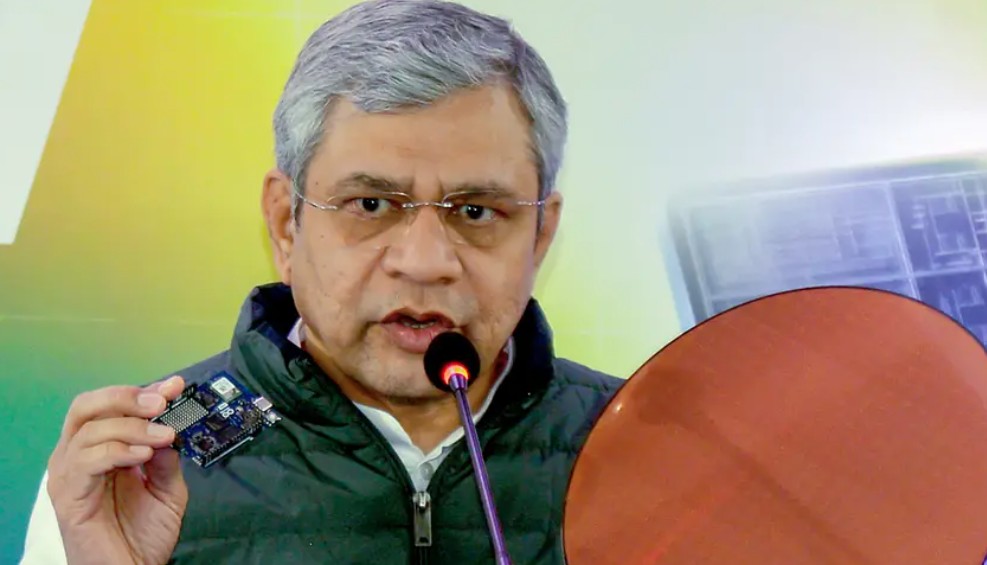
Union Minister for Railways, Electronics and Information Technology, Ashwini Vaishnaw, unveiled a cutting-edge, high-tech 2-nanometre chip manufactured by Qualcomm February 7 and called it a major milestone for India’s semiconductor and technology industry.
The Electronics and IT Minister introduced the 2-nanometre wafer and chip at Qualcomm at the inauguration of Texas Instruments’ new R&D facility in Bengaluru and underscored India’s progress in building an end-to-end semiconductor ecosystem.
https://x.com/ani/status/2020052093692965205?s=46
The Minister also displayed a silicon wafer in his hand at the event and described its capabilities as well as the precision manufacturing involved in it.
https://x.com/ani/status/2020056734929416215?s=46
Emphasising India’s semiconductor talent developed under the Semicon mission 1.0, the minister outlined that the government has set a target to have 85,000 semiconductor-trained people over a period of 10 years.
A Brief History: Chip-Making in India
India’s journey in semiconductors has been slow but steady. Initially, the country focused on assembling imported chips, with very little high-end manufacturing or design. Domestic production remained limited to basic components, and India relied on global leaders like the US., South Korea, and Taiwan for advanced technology.
The government’s push in recent years, including the Production-Linked Incentive (PLI) scheme for semiconductors, has begun to attract global companies and investment into chip design and manufacturing.
New Efforts: From Design to Production
India is no longer just a consumer of technology, it is becoming a creator. Qualcomm’s 2nm chip, designed at its Bengaluru, Chennai, and Hyderabad engineering centers, is a testament to India’s high-end design capability.
This chip, witnessed by Union Minister Ashwini Vaishnaw, is expected to power AI servers, premium smartphones, and IoT devices, with up to 45% lower energy consumption compared to older chips.
Companies like Intel, TSMC, and IBM are also expanding R&D in India, showing that global players trust Indian talent for advanced semiconductor work.
On the manufacturing side, Tata is setting up a semiconductor fabrication unit in Assam, signaling India’s first major step into chip production. This facility can help India not just design, but also manufacture chips at scale, strengthening the country’s position in the global supply chain.
Why is this a big achievement for India?
Qualcomm’s Indian engineering centers represent its largest engineering talent pool outside the US. Developing the 2nm chip in India shows that the country’s chip design ecosystem is growing strong, according to Minister Ashwini Vaishnaw.
With global competition in semiconductors heating up, this capability positions India as a serious player. The tape-out milestone indicates the chip’s design is finalized and ready for production, marking a critical step in the journey from concept to manufacturing.
How can this change India’s future?
India is emerging as a major global hub for manufacturing, and this achievement could make it a center for product design as well. Semiconductors are set to become a cornerstone of modern technology, and India’s success in this field could place it on par with the U.S. and China, enhancing the reputation of Indian talent worldwide.
This breakthrough reinforces that India is not just a market for technology but also a creator of cutting-edge tech, setting the stage for a stronger, innovation-driven economy.