
India is moving to significantly strengthen its air combat power through a major defence procurement deal from Israel, while continuing to prioritise indigenous manufacturing under its self-reliance policy.
According to Forbes India, New Delhi is close to finalising a deal worth around $8.6 billion (Rs 78,217 crore) for advanced missiles, precision-guided munitions and associated systems for the Indian Air Force (IAF).
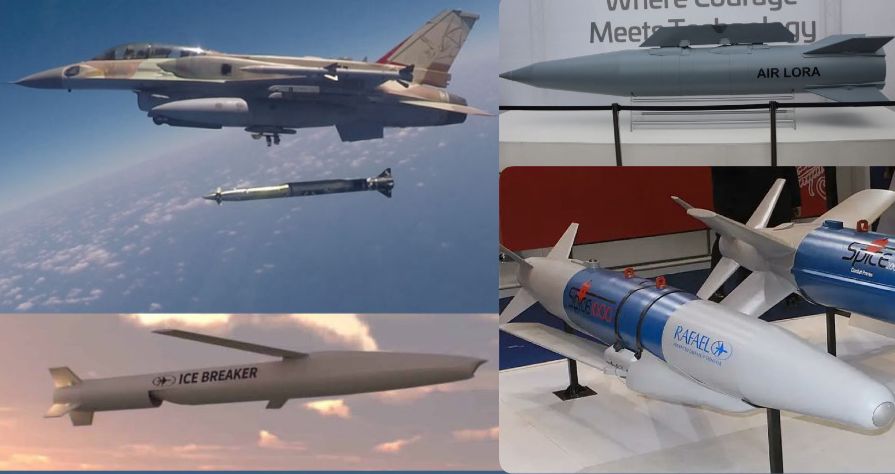
The proposed procurement from Israel is likely to include SPICE-1000 precision-guided bombs, Rampage air-to-surface missiles, Air LORA air-launched ballistic missiles, and the Ice Breaker missile system.
In addition, the package is expected to comprise air-to-air missiles, loitering munitions, advanced radar systems, simulators, and integrated network-based command-and-control platforms.
After these systems are inducted, aircraft such as the Su-30MKI and MiG-29K are expected to significantly enhance their long-range strike and deep-penetration capabilities.
The agreement is set to become India’s third-largest defence purchase to date, after the 2016 Rafale fighter jet deal with France valued at $8.7 billion, and a more recent contract for additional Rafale aircraft and associated missiles worth $39.7 billion.
The proposal has already received approval from the Defence Acquisition Council, chaired by Defence Minister Rajnath Singh, as India faces increasing security pressures on both its western and eastern fronts.
China has reinforced its air defence presence along the Line of Actual Control, while Pakistan is reported to have used GPS-jamming measures during recent military operations, including Operation Sindoor in May 2025.
How Rampage Missiles Were Used in India’s Air Offensive During Op Sindoor?
India used the Rampage air-to-surface missiles to successfully strike Pakistani bases and terrorist headquarters during Operation Sindoor. The missiles were used by the IAF to strike and damage the terrorist camps in Pakistan’s Muridke and Bahawalpur in Punjab province of Islamabad.
The Rampage, also known as the High Speed low Drag-Mark 2 missile is already in service with both the Air Force and the Navy. It can be launched from multiple aircraft platforms, including the Su-30MKI, MiG-29, Jaguar and MiG-29K. Equipped with GPS/INS guidance and anti-jamming features, the 570-kg missile is designed to strike hardened targets from stand-off distances.
It is a very high-speed air-to-ground missile, which India first acquired in 2020-21, Galwan clashes with China by the Indian Air Force. It carried out a splendid performance during Op Sindoor, where it was fired from the Su-30 MKI against Pakistani positions in their hinterland.
The successful integration of the Rampage missiles with the Su-30 MKI has significantly enhanced the Russian aircraft fleet’s firepower. This integration allows for the firing of multiple long-range air-to-ground missiles, including the BrahMos supersonic missiles with a strike range of over 400 kilometres.
The IAF had long been considering the possibility of producing the Rampage missiles under the Make in India program, potentially leading to their large-scale induction.
Manufactured by Elbit Systems, Rampage is very accurate, with a range between 150 and 250 kilometers, to protect Indian fighter jets from Pakistani defense systems made in China.
Whats are SPICE-1000 Precision Guided Bombs?
SPICE stands for “Smart, Precise Impact, Cost-Effective” and is already being used by the air forces of Brazil, Greece, South Korea, Singapore, and Colombia, apart from India.
The purchase of SPICE-1000 kits will extend the Indian Air Force’s (IAF) strike range to 100–125 kilometres while reducing the threat posed to the jets by beyond-visual-range weapons and surface-to-air missile systems.
Manufactured by Israel’s Rafael Advanced Defense Systems, SPICE weapons belong to the glide-extended munitions class, designed to rely on altitude, kinematics, and autonomous navigation rather than sheer penetration power, according to a report by Defence Security Asia.
“SPICE‑1000 provides a level of strike confidence against hardened or time-sensitive targets that is difficult to achieve with purely inertial or GPS-guided alternatives,” the report said. This makes the system especially useful against high-value targets such as airbases, shelters, and command facilities.
According to the developer brochure, SPICE‑1000 is fully autonomous and operates on a fire-and-forget principle, functioning without continuous human control after launch. The system can automatically identify and engage targets using advanced scene-matching technology.
While approaching its target, the bomb can adjust its direction and angle of attack, carry out multiple missions in a single sortie, remain effective under GPS-jamming conditions, and allow mission planning either pre-launch on the ground or in-flight onboard the aircraft.
Notably, the SPICE 2000, a heavier, more destructive variant came into the spotlight when the Indian Air Force (IAF) targeted the Jaish-e-Mohammad terror camp in Balakot in February 2019.
On February 26, 2019, six Mirage 2000 jets penetrated Pakistani airspace armed with SPICE 2000 bombs, popularly known as ‘Building Blaster’. Reports indicate that scores of militants were killed during the strike, which was India’s retaliation to the Pulwama attack. Following the Balakot operation, India ordered additional SPICE 2000 bombs to further enhance the IAF’s firepower.
SPICE 1000, however is a smaller, lighter, and designed for highly precise strikes with flexibility and easier aircraft integration.
What is India Interested in Air LORA and Ice Breaker Missiles?
Air LORA is the air-launched version of the Long Range Artillery missile, capable of engaging targets at distances of 400–430 km and reaching speeds of up to Mach 5. The missile weighs about 1,600 kilograms and measures 5.2 metres, with the capability to travel at approximately Mach 5.
It is designed to strike high-value targets such as missile installations and air defence systems. The missile is being manufactured in India through a partnership between Bharat Electronics Limited and Israeli collaborators.
Air LORA can be equipped with blast-fragmentation or deep-penetration warheads and is optimised for stand-off precision strikes.
The Ice Breaker, an advanced evolution of Rafael’s Sea Breaker, is a long-range, autonomous, precision-guided missile designed to target high-value land and sea assets.
Developed by Rafael Advanced Defence Systems, the Ice Breaker is built for electronically contested environments. It has a range of up to 300 km, follows a low-observable, terrain-hugging flight path, and uses artificial intelligence and autonomous target recognition to remain effective even in GPS-denied conditions.
The missile is designed to counter modern Integrated Air Defence System (IADS) deployments, leveraging its passive seeker, sea-skimming flight profile, and Very Low Observable (VLO) design, which delays detection and reduces enemy reaction time.
It features salvo attack capability, Automatic Target Recognition (ATR), and can engage both stationary and moving targets, including radar systems, even in complex electronic warfare environments, according to Defence Security Asia.