
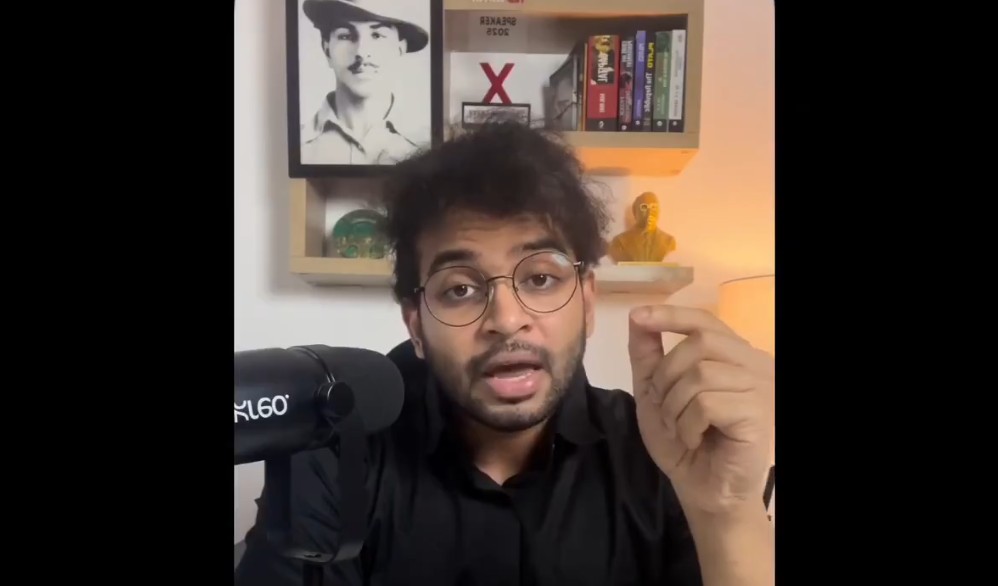
Rabid casteist, self-proclaimed educator and Ambedkarite activist Lakhshya Lakey has now come under fire after an influencer filed a cyber complaint against him alleging harassment, caste-targeted abuse toward the Brahmin community and offensive messages.
Lakhshya Lakey, a graduate of the Indian Institutes of Management (IIM) and a TEDx speaker, runs the page “Lakhshya Speaks,” with around 555K followers on instagram and over 14K subscribers on Youtube.
Apparently according to social media exchanges the instagram influencer Tulip Sharma exposed the rot behind Lakshay’s hate filled agenda and revealed how he pushes anti-Brahmin narratives under the guise of ‘activism’.
https://x.com/DikshaKandpal8/status/2021650640506958209
In a video Tulip Sharma went on to expose Lakshay’s alleged dark side, “Let us expose a social media influencer called the ‘Lakshay Speaks’. This man is known to spread hate towards the Brahmin community on the internet and I have no problem with that since you have your freedom to expression and if you spread hate, then its not a new thing on the net. But the problem arises when you cant take dissenting opinions. He is the kind of influencer who will dm you and will speak rubbish if you try post a dissenting comment on his post.”
Tulip Joshi further claimed that when she questioned him on Bharatanatyam and Devadasis, he couldn’t argue back and instead went into her DMs with caste-based abuse.

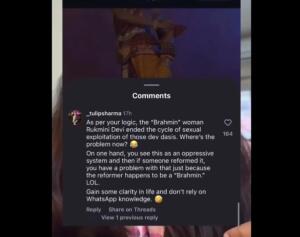
Posting screenshot of the alleged conversation Tulip claimed that Lakshay initially made personal comments like, “Holy chopped, you’re ugly for a Brahmin girl. My girlfriend is way prettier than you. You don’t even look like you have a boyfriend. 4 Brahmin exes, all prettier than you.”
But apparently Lakshay did not stop there, making a shocking statement he went on to say, ‘I’m annihilating caste by making intercaste babies’. Responding to which, the influencer Tulip Sharma said, “What kind of behaviour is it that if you can’t win an argument, you start targeting the girls of a specific community?”


She stated, “The topic was not even about Brahmin girls but Lakshay Lakey went on to flex about all of his exes being Brahmins, using the girls of a specific community to win an argument. The topic about entire community shows how big of a casteist he is.”
“His entire profession is grounded on hurling abuses to Brahmins and then he goes on to flex about his Brahmin exes. He even went on further to say he is annihilating caste by making intercaste babies,” she claimed.
Facade Under Modern Ambedkarite Activism
The unfolding controversy around influencer Lakshay Lakey exposes a troubling facet of modern Ambedkarite activism. While the movement historically championed caste equality and social justice, some interpretations on social media appear to have shifted toward coercive or performative behavior.
Lakshay Lakey’s alleged derogatory remarks targeting Brahmin girls reveal a troubling contradiction at the heart of his social media persona. While he presents himself as an Ambedkarite educator advocating for caste equality and social reform, the use of personal insults, sexually suggestive comments, and objectifying language undermines the very principles he claims to uphold.
Such behavior reflects a broader rot in his activism, where ideological messaging is co-opted to justify harassment or personal vendettas. The deployment of perverted language, particularly in direct messages to women, is incompatible with the role of an educator, raising concerns about accountability and ethics in online advocacy.
By blending caste commentary with personal attacks, Lakey risks normalizing misogyny and harassment under the guise of social justice, ultimately eroding any credibility he hopes to achieve.
Harassment Masquerading as Education
Lakshay Lakey’s persona as an educator and anti-caste activist has also drawn scrutiny after claims made by social media user Tulip Sharma and others allege that his interactions with women have included direct messages that are personal, sexually suggestive, and abusive, often framed around his ideological agenda.
This raises questions about accountability, as platforms that advocate women’s empowerment and social reform are sometimes used to propagate harassment, objectification, or caste-based targeting.
Allegations also suggest boasting about “inter-caste relationships” or “inter-caste babies” as a form of performative activism, further blurring the line between advocacy and personal vendetta.
Only recently there was a similiar case of IAS Santosh Verma who publicly called for Brahmin girls to be given to his son as some kind of a social justice move. Verma was heavily criticized for his shocking comments leading to the Madhya Pradesh Government Removing the Officer From Post, sending a Proposal To Centre Seeking His Dismissal.
However it seems this perverse mentality has now spread its roots deep with even apparently young social justice influencers using the same narrative the targeted sexualization of the women of a particular community, in turn spreading far more casteist fissures in society rather than a healing and unifying message they claim to espouse.
Social media platforms have given people like Lakshay a powerful stage to shape opinions and attitudes, particularly among impressionable youth and when such influence is used to promote provocative rhetoric, target specific communities, or normalize aggressive online behavior, it shows that the very principles of social justice he claims to represent are a pile of lies.