














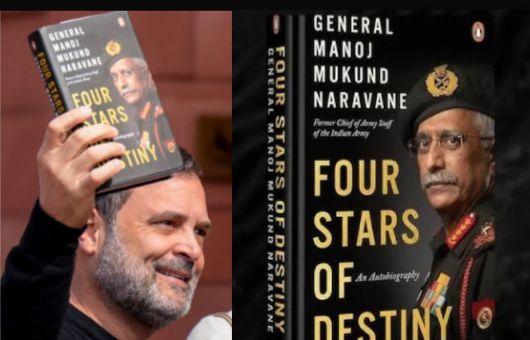
The controversy surrounding former Army chief General Manoj Mukund Naravane’s memoir, ‘Four Stars of Destiny,’ intensified after its publisher Penguin Random House India (PRHI) clarified that the book has not yet been published.
In a statement, PRHI said it holds the exclusive publishing rights to the memoir and clarified that no copies, either in print or digital form have been released to the public. The publisher also warned of legal action against any unauthorised circulation of the material.
Leader of the Opposition in the Lok Sabha and Congress leader Rahul Gandhi earlier was seen displaying a purported copy of the book in the Parliament complex while attacking the BJP government over its alleged contents.
https://x.com/penguinindia/status/2020899835663229382?s=46
“Penguin Random House India would like to clarify that we hold the sole publishing rights for the book ‘Four Stars of Destiny‘, a memoir by General Manoj Mukund Naravane, former Chief of the Indian Army. We wish to make it clear that the book has not gone into publication,” the statement said.
“No copies of the book, in print or digital form have been published, distributed, sold, or otherwise made available to the public by Penguin Random House India,” the publisher said in a written statement.
It added, “Any copies of the book currently in circulation, in whole or in part, whether in print, digital, PDF, or any other format, online or offline, on any platform, constitutes an infringement of PRHI’s copyright and must immediately be ceased,” it added.
The statement came a day after Delhi Police filed an FIR on Monday over the alleged illegal circulation of the manuscript in digital and other formats. The Special Cell said it took cognisance of information circulating on social media claiming that a soft copy of the memoir was being shared.
A parliamentary furore broke last week as Rahul Gandhi attempted to quote from the unpublished memoir, titled ‘Four Stars of Destiny’ and said that the former Army chief had accused the country’s leadership of indecision and failing to give clear instructions during the 2020 India-China standoff.
As per reports, Gandhi had sought to cite excerpts from the memoir in the Lok Sabha from February 2 onwards but was prevented from doing so on the grounds that the book had not been formally published.
Earlier, while addressing reporters in the Parliament House complex, Gandhi referred to what he described as the “unreleased memoir” of General Naravane and held up a copy of the book saying he wanted young people in India to know that the book exists.
“The Speaker has said this book does not exist, the government has said it does not exist, Defence Minister Rajnath Singh ji has said this book does not exist. Every youngster in India should see this book exists,” he was quoted saying.
Gandhi stated that the former Army chief had written a full account of events during the 2020 India-China standoff in Ladakh. He also said he had been told that he could not quote from the “memoir” in the Lok Sabha.
Where Did Rahul Gandhi Get the Book?
General Naravane’s memoir, Four Stars of Destiny, remains the only manuscript among 35 submitted to the Defence Ministry between 2020 and 2024 that has not yet been cleared for publication.
The manuscript, accessed by The Caravan magazine, was meant for review and not printing. Congress leader Rahul Gandhi brought a hard copy to Parliament after being barred from quoting the article based on it.
According to sources in the Congress, Rahul Gandhi was put in a situation where he was not allowed to say what was written in the book, and that is why he had to bring the book to Parliament that he had got from the author [or the publisher],” reported India Today.
With Penguin Random House India insisting that the book was never published, questions remain over how a bound copy surfaced. The Delhi Police has now launched a probe into the “purported leak or breach of a yet-to-be-approved” copy, saying it is crucial to understand not just how it circulated online, but how a printed copy came into existence.
Procedure for Printing Books by Military Chiefs
In India, retired armed forces personnel are generally free to publish books without prior approval, as the Army Act, 1950 and Army Rules, 1954 apply only to serving officers. However, the Official Secrets Act, 1923, remains in force for life, making it a criminal offence to reveal classified information or anything that could harm national security.
Officers who served in certain intelligence or security roles must also get prior clearance from their organisation’s head under the Central Civil Services (Pension) Rules, 2021, or risk penalties like pension reduction. Many retired officers still voluntarily send manuscripts to the Ministry of Defence or Service Headquarters as a precaution.
As per India Today, Lt Gen KJS Dhillon (Retd) explained the process in the context of Gen Naravane’s book, saying, “There is no problem in getting clearance if you are not violating any norms…” but emphasised, “Serving or retired officers writing about operational matters must submit the manuscript to Army Headquarters for approval.”
He outlined a three-tier review at Army HQ, straightforward approval, collaborative edits to remove sensitive content, or withholding permission if national security could be jeopardised.
Escalation in Lok Sabha
The controversy over General Naravane’s unpublished memoir sparked protests in the Lok Sabha last week. Eight MPs were suspended for what the House described as “unruly behaviour” after Congress leader Rahul Gandhi was barred for a second consecutive day from quoting an article that referenced the unpublished memoir in connection with the 2020 India-China standoff.
Seven of the suspended MPs were from the Congress party, and one was from the CPI(M). They will remain suspended for the rest of the Budget session, which is scheduled to end on April 2.
Following the suspension, Gandhi wrote to Lok Sabha Speaker Om Birla, lodging what he called a “strong protest” over being prevented from speaking on a matter of national security. He described the development as a “blot on our democracy” and noted that it was the first time in history that a Leader of the Opposition was not allowed to speak on the Motion of Thanks on the President’s address.