
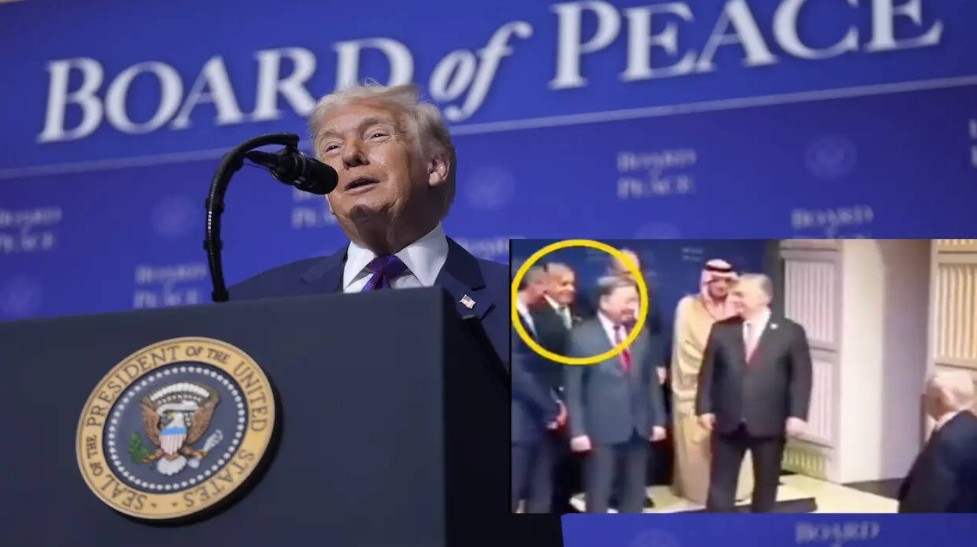
A video from a recent “Gaza Peace Board” meeting in Washington, DC, has ignited a political and ideological storm inside Pakistan, exposing tensions between the country’s Islamic identity narrative and its strategic foreign policy realities.
The footage shows Prime Minister Shehbaz Sharif rising during a formal gathering as a gesture from US President Donald Trump and offering a salute.
While such gestures are not unusual in diplomatic protocol, the optics have drawn sharp reactions back home, particularly at a time when Islamabad has been projecting itself as a vocal supporter of the Palestinian cause.
The meeting was part of a broader international engagement described by Pakistan’s Foreign Ministry as the inaugural session of a “Board of Peace,” where the prime minister was scheduled to discuss Gaza-related peace efforts with international partners.
Simultaneously, Pakistan’s Deputy Prime Minister and Foreign Minister was in New York, reiterating the country’s “principled position” on Palestine at the United Nations Security Council.
Paper Support, Practical Politics
Pakistan officially maintains consistent diplomatic support for Palestinian statehood. Public statements emphasize solidarity with Gaza and condemnation of Israeli actions. However, participation in a Western-led peace framework has prompted critics within Pakistan to question whether Islamabad’s actions align with its rhetoric.
The strongest criticism has come from an organization representing former members of the armed forces. In a sharply worded press statement, the group accused the government of aligning with what it described as “enemies of Islam” by participating in an international platform that includes Western and Israeli-linked stakeholders.
Addressing serving soldiers directly, the organization described them as “guardians of a sacred land” entrusted with defending Islam and justice. It urged the military not to support what it called a “treacherous board,” warning that history and the broader Muslim community would not forgive those who do.
The statement went further, calling on Army Chief Asim Munir to “immediately and unconditionally reject” any association with the initiative. Its tone, unusually confrontational for discourse involving the military, has drawn attention to the depth of ideological divisions surrounding the issue.
Identity vs Dependency
Pakistan’s founding narrative has long emphasized Islamic identity as a cornerstone of statehood. In recent speeches, the army chief has referred to Pakistan as a state established on the “Kalima,” a reference to Islamic testimony of faith. Yet the Gaza episode underscores a persistent tension between ideological positioning and geopolitical necessity.
Pakistan’s economy remains heavily reliant on international financial institutions and external assistance. Support from the International Monetary Fund, Gulf states and Western partners has often been critical to maintaining macroeconomic stability. In this context, engagement with US-backed or Western-led diplomatic initiatives can carry both economic and strategic implications.
Analysts note that this is not the first time Islamabad has faced criticism for balancing Islamic solidarity with pragmatic alliances. Historically, Pakistan has cooperated with Western powers in security operations, including counterterrorism efforts in Afghanistan, even while maintaining strong rhetorical support for Muslim causes globally.
Sensitive Moment for the Military
The former soldiers’ appeal is particularly sensitive because it addresses serving personnel directly — a rare move in Pakistan’s political landscape, where the military remains a central and influential institution.
While observers caution against overstating the risk of internal dissent, the episode reflects growing unease among segments of society over perceived contradictions in foreign policy. The debate now extends beyond social media, touching on deeper questions about national identity, strategic alignment and the limits of ideological diplomacy.
For Prime Minister Shehbaz Sharif, the controversy presents a delicate balancing act: maintaining international partnerships vital to Pakistan’s economic stability while managing domestic expectations rooted in religious and ideological commitments.
As the Gaza crisis continues to reverberate globally, Pakistan’s leadership finds itself navigating between symbolism and strategy — and between competing visions of what the country’s role in the Muslim world should be.