

















India is preparing for a significant transformation in the way technology shapes education, with artificial intelligence (AI) set to become a key driver across classrooms, teacher training programmes, and skilling initiatives.
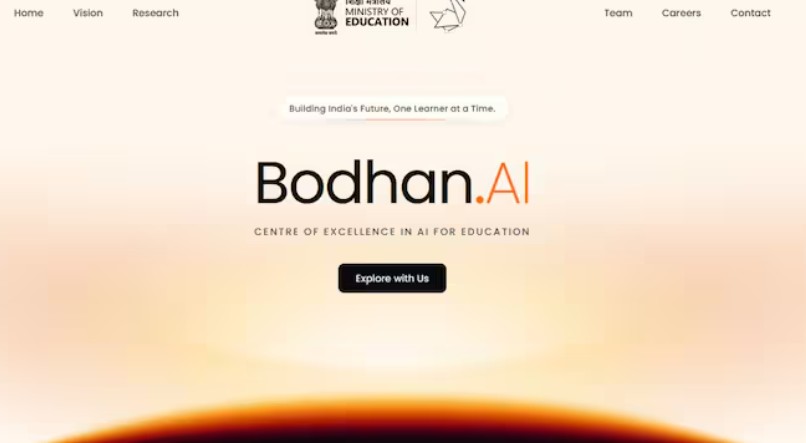
Beginning next academic session, the Centre of Excellence in Artificial Intelligence for Education at IIT Madras, known as BodhanAI will play a pivotal role in this transition.
The initiative, backed by the Ministry of Education, the initiative seeks to integrate AI tools across all levels of learning, from pre-primary education to higher studies. The broader objective is to strengthen teacher preparedness while also improving student employability in a rapidly evolving economy.
What is BodhanAI, and Why is it Important?
BodhanAI functions as the national Centre of Excellence for Artificial Intelligence in Education and operates under the IIT Madras Bodhan AI Foundation.
Its mandate is to build a strong digital public infrastructure that supports scalable, inclusive, and innovation-driven AI solutions across the education ecosystem. By developing a common architecture and offering application programming interfaces (APIs) to start-ups and institutions, BodhanAI will enable developers to create AI-powered education tools with assured accuracy and interoperability.
At the inauguration of Bodhan.ai, the AI Centre of Excellence for Education at IIT Madras, Union Education Minister Dharmendra Pradhan said, “Prime Minister Narendra Modi has given us a clarion call to make India AI-ready, while strongly emphasising the development and deployment of ethical, responsible, and inclusive AI. This conclave is a significant step towards realising that vision.”
How Will AI Strengthen Teacher Capacity?
With new textbooks and updated teaching approaches being introduced nationwide, preparing teachers has become a major challenge. Existing institutions such as State Councils of Educational Research and Training (SCERTs) and District Institutes of Education and Training (DIETs) are being utilised, but AI-driven support is now expected to accelerate the process.
BodhanAI will create structured digital modules designed to familiarise teachers with the revised curriculum and modern teaching methodologies, enabling them to adapt more efficiently.
Emphasising the importance of capacity building, Union Education Minister Dharmendra Pradhan stated that to speed up the transition, BodhanAI will develop dedicated modules for teachers’ training.
Ahead of the global AI Impact Summit, the upcoming Bharat Bodhan AI Conclave will begin work on the Bharat EduAI Stack. This stack is envisioned as a foundational framework that will allow governments, institutions, and innovators to develop AI-based education applications on a shared national platform.
The conclave will bring together policymakers, academicians, start-ups, and representatives from state governments, highlighting the collaborative approach being adopted to build this ecosystem.
Can AI Improve Employability and Skilling?
With undergraduate programmes now extended to four years and offering greater flexibility for internships and apprenticeships, improving employability remains a key priority. AI is being positioned as a force multiplier that can help bridge the gap between education and industry by mapping skills, guiding learners, and enhancing real-world readiness.
The focus is gradually shifting from simply earning degrees to building measurable competencies, in line with the country’s broader skilling objectives.
As BodhanAI moves from planning to execution, the initiative has the potential to redefine learning outcomes — creating smarter classrooms, empowering teachers, and better preparing students for the demands of a fast-changing global economy.