
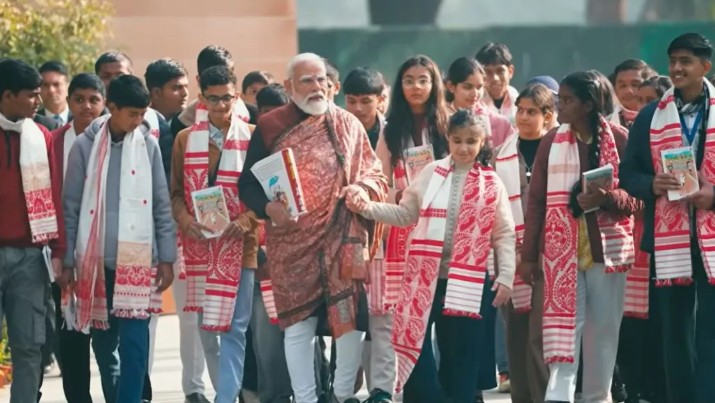
The future of a nation does not rest solely with its youth, but with how effectively it equips them for the challenges ahead. Under Prime Minister Narendra Modi’s leadership, the central government has consistently made this preparation a cornerstone of governance. Today, India stands out not for the multitude of schemes it launches, but for a results-driven culture that delivers tangible outcomes.
Budget 2026–27 embodies this vision of transformation, marking a clear shift from a consumption-driven economy to one focused on productivity and nation-building.
Billed as a “Youth-Centric Budget,” it integrates citizen-focused development with structural reforms and technological innovation. Crucially, the Modi government positions young people not merely as recipients of benefits, but as active participants in shaping the nation’s future.
A hallmark of the Modi era has been bridging the gap between policy and implementation, and this budget reflects that ethos. Through initiatives linking education with employment and entrepreneurship—such as high-powered permanent committees, targeted skill programs, and multi-skill training modules—the government is turning plans into tangible action.
This approach recognizes that in the 21st century, a degree alone is no longer enough. Relevant skills, adaptability, and innovation are the true currency of success, and students are being equipped not just with academic knowledge, but with the practical capabilities required in the modern workplace.
Educational and Technological Initiatives
The establishment of 15,000 secondary schools and 500 colleges with AVGC (Animation, Visual Effects, Gaming, Comics) Content Creator Labs, STEM-based higher education institutes, and university townships demonstrates how the government is linking education to industry, technology, and the creative economy. These initiatives go beyond academic reform—they lay the foundation for a knowledge-driven India.
Self-Reliant India and Youth Entrepreneurship
Investment in flagship sectors such as Semiconductor Mission 2.0, electronics components, textile and chemical parks, and sports equipment manufacturing, coupled with special funds and accessible finance to develop MSMEs as “champions,” reflects a policy vision where youth are not just job seekers but job creators. This is the practical realization of a self-reliant India.
Through healthcare, medical tourism, IT services, new design institutes, and the Khelo India Mission, the government recognizes the intellectual, creative, and physical potential of youth as a national asset.
New healthcare institutions, the upskilling of allied health professionals (AHPs), and the training of around 150,000 multi-skilled caregivers create fresh opportunities for medical and paramedical students. Additionally, incentives for IT, data centers, and cloud services indicate a clear roadmap for establishing India as a global digital service hub.
Decentralized Development
A notable feature of the Modi government is decentralized development. Through infrastructure, clean energy, and public investment, Tier-2 and Tier-3 cities are being brought into focus, ensuring that youth opportunities are not limited to metropolitan centers but accessible in their own districts and towns. This is a decisive step toward both economic and social balance.
The budget’s philosophy goes beyond growth. Through targeted programs for women, marginalized groups, persons with disabilities, and rural youth, inclusive development is prioritized—forming the moral foundation of Narendra Modi’s governance model.
Budget 2026–27 signals that under Prime Minister Modi, India is transforming from a “plan-driven” state to a “capability-driven” nation. It does not merely offer grants—it instills confidence; it does not provide aid—it equips with tools; it does not promise—it opens opportunities.
The responsibility now rests with the youth. If today’s students and young professionals can turn discipline into habit, skills into strength, and patriotism into principle, a developed India will not remain a distant dream but become a near-future reality. This is the essence of the Modi era—“Empowered Youth, Strong India.”