
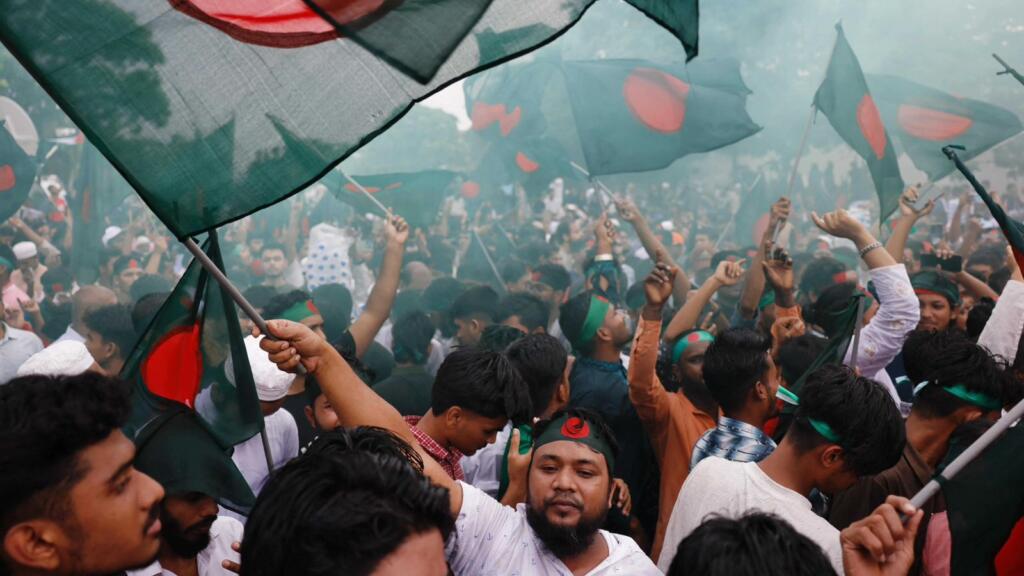
As Bangladesh prepares for its national elections on February 12, 2026, since the fall of long-time leader Sheikh Hasina and her Awami League party in 2024, the polls have drawn intense interest from neighbours India, the United States, China, and Pakistan.
At present, Bangladesh is under an interim government headed by Muhammad Yunus. The key contenders in this month’s election are the Bangladesh Nationalist Party (BNP) and Jamaat-e-Islami (JIB), both of which launched their campaigns towards the end of January.
Around 170 million voters are expected to cast ballots in what Reuters calls one of the world’s most watched polls this year.
Foreign Influence Claims and Political Denials
In the run-up to Bangladesh’s 2026 polls, there have been claims about foreign influence, with some opponents alleging that Jamaat-e-Islami may have back-channel understandings with the United States, while the BNP was being termed as “pro India” and a “US puppet.”
BNP Secretary General Mirza Fakhrul Islam Alamgir earlier alleged that Jamaat-e-Islami has a “secret entente” with the United States and warned that such an understanding could pose risks to Bangladesh’s peace, stability and sovereignty.
Former Bangladesh Prime Minister Sheikh Hasina’s son and Awami League leader Sajeeb Wazed Joy stated if the Bangladesh Nationalist Party emerges as the largest party in the upcoming election, the Islamist outfit Jamaat-e-Islami will exert influence from the outside even if it does not form the government and referred to the BNP as ‘puppet of America’.
The BNP also rejected Jamaat‑e‑Islami’s claim of a secret deal with India, calling it “complete disinformation”. BNP election steering committee spokesperson Mahdi Amin said the information has no minimum basis in reality and no truth at all.
“These statements are political tactics and disinformation meant to create controversy. BNP politics is pro‑Bangladesh, centred on sovereignty and empowerment under the leadership of Tarique Rahman,” he clarified.
The US Angle: Democracy and Trade
As per Reuters, United States has taken a keen interest in the election, framing its engagement around democratic norms and fair electoral processes. Washington has also been negotiating trade and tariff agreements with Dhaka, aiming to integrate Bangladesh more deeply into global markets and supply chains.
Such moves are part of broader US policy in Asia that seeks to strengthen democratic partners and counterbalance the influence of rivals like China. Critics of the US involvement, however, argue it could be perceived as interference in Bangladesh’s internal politics, a concern echoed by some regional experts.
Pakistan and China: Competing Interests
Since Hasina’s ousting, Pakistan’s relations with Bangladesh has grown warmer. In 2024, Pakistani Prime Minister Shehbaz Sharif met Yunus twice, seeking to strengthen military and diplomatic ties. In September last year, Pakistani Foreign Minister Ishaq Dar visited Dhaka, seeking to “reinvigorate” a relationship that had been fractured since Bangladesh’s 1971 war of independence with Pakistan.
Yunus’s interim government has been seeking to boost economic ties with Pakistan. Last February, the two nations resumed direct trade for the first time since the 1971 war under a new agreement negotiated by Yunus. In the past weeks, they resumed direct flights after 14 years. Flight services had been stopped in 2012, with Dhaka citing security concerns. The two nations have also held military and defence dialogues over the past year.
“Pakistan primarily wants to develop closer bilateral ties by extending its defence and cultural diplomacy with Bangladesh. This is because, in reality, given its own economic challenges, it has very little to offer to Bangladesh in terms of trade and investment. By doing so, it wants to heighten India’s security concerns to its east by developing close strategic ties with Dhaka,” said an analyst, according to Al Jazeera.
China’s influence in South Asia has been growing in recent years, and the country has been making efforts to boost military and economic ties with Bangladesh. Over the past year, Chinese leaders have been meeting leaders from Bangladesh’s political parties ahead of the elections.
China has steadily expanded its presence in Bangladesh over recent years through infrastructure projects, investments, and diplomatic engagement. Beijing views Dhaka as a key link in its broader Indo-Pacific strategy and a gateway to the Bay of Bengal region. China will watch the elections closely as it views Bangladesh as a key trade and investment partner.
“For China, the upcoming elections are also important since Bangladesh, for its strategic influence over South Asia, a region which has long been considered India’s sphere of influence,” said an analyst.
What’s at Stake for India
For India, Bangladesh is far more than just a neighboring country; it is a crucial partner in regional security, trade, energy, and people-to-people connections. A stable and democratic Bangladesh helps ensure peace along a long shared border and serves as a strategic buffer in South Asia.
Prior to Hasina’s ouster, India considered Bangladesh an important strategic ally, particularly in maintaining security in the region. India is also Bangladesh’s largest trading partner in Asia. Between April 2023 and March 2024, before Hasina’s departure, India exported goods worth to Bangladesh including textiles, tea, coffee, auto parts, electricity, agricultural products, iron and steel, and plastics while importing readymade garments, leather, and leather products.
Since Hasina fled to India, both countries have imposed restrictions on each other’s exports via land and sea amid ongoing tensions. Anti-India sentiment gained traction in Bangladesh following Hasina’s ousting in 2024 and India’s refusal to repatriate her.
Relations further deteriorated over the past year, particularly after the murder of Osman Hadi, a 2024 protest leader vocally opposed to India, which triggered additional anti-India protests in Bangladesh late last year. India has also raised concerns about the mistreatment of the Hindu minority under the interim Bangladeshi government.
Despite these tensions, India’s Prime Minister Narendra Modi met with interim leader Muhammad Yunus for the first time on the sidelines of a BIMSTEC summit in Bangkok, Thailand, in April last year.
India’s foreign secretary, Vikram Misri, told reporters that Modi had “reiterated India’s support for a democratic, stable, peaceful, progressive and inclusive Bangladesh.”
India is hoping that this upcoming election will produce a government that is willing to engage with India and will not be influenced by the types of actors that India feels threaten its interests.
Any government coming to power in Dhaka will find it difficult to neglect its largest neighbour and a regional power like India for the sake of mutual interest regarding nontraditional security threats, trade and food security, cultural and human ties.
Under New Delhi’s “Neighbourhood First” policy, which emphasizes maintaining friendly ties with neighboring countries to safeguard India’s security, Indian policymakers have repeatedly stressed the importance of sustaining a cordial relationship with Bangladesh.
Domestic Dynamics Still Matter
Despite the international focus, domestic issues remain central to the election. Bangladesh’s internal political landscape has changed dramatically since 2024, with traditional parties reshaped, banned groups re-entering politics, and concerns about religious minorities escalating.
Voting patterns could reflect these deep shifts and influence whether the country turns inward or toward outside powers for its future direction.
The 2026 Bangladesh election has transformed from a national event into a geopolitical flashpoint. With global powers vying for influence and India keenly assessing its strategic neighborhood, the results on February 12 are likely to have ripple effects far beyond Dhaka’s city limits.