












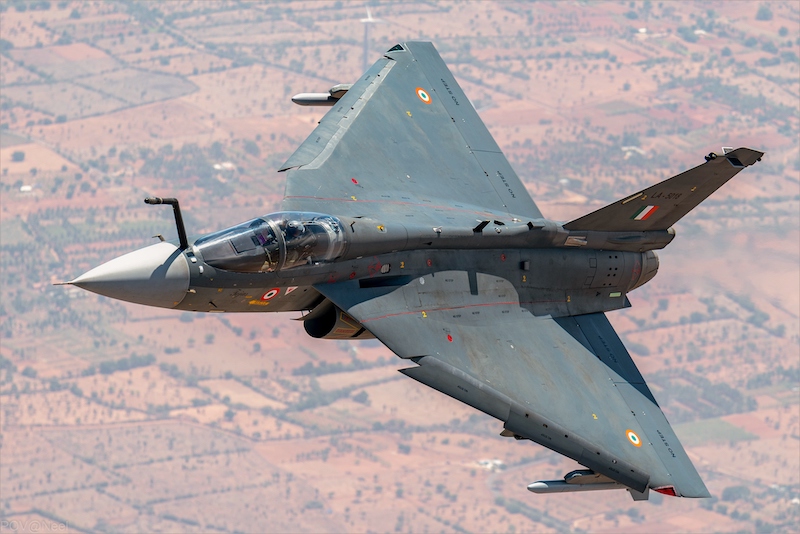
The Economic Times has published a concerning report. According to the report, the Indian Air Force has lost another Tejas Light Combat Aircraft in an accident. It is being said that the incident took place earlier this month when a single-seat Tejas was landing after a training sortie.
As per the report, the aircraft’s airframe was badly damaged in the accident and there are concerns that it may not be fit to return to service. The positive aspect is that the pilot is completely safe and did not suffer any serious injuries. HAL has so far delivered a total of 32 single-seat Tejas aircraft to the Indian Air Force, out of which three have now been involved in accidents.
Earlier, in March 2024, the first accident involving Tejas occurred during a training sortie in Jaisalmer, where the pilot safely ejected. The investigation that followed pointed to a problem in the fuel supply system reaching the engine, which led to engine seizure. Importantly, the inquiry did not confirm any design flaw or systemic weakness in the aircraft.
The second crash occurred in November 2025 during a performance at the Dubai Air Show. In that tragic accident, an Indian Air Force pilot lost his life. The investigation into that incident is still ongoing and the final report has not yet been made public.
According to the latest report, after the third accident, the Indian Air Force has begun an intensive review of the entire Tejas fleet to identify any possible technical issue.
Delay in Mk1A Deliveries and Growing Pressure on HAL
The Tejas Mark 1A has already been under scrutiny, as the project has repeatedly fallen behind its scheduled timeline. The Indian Air Force has already placed orders for 220 Tejas aircraft, which shows its serious commitment to the platform. However, repeated delays in delivery and multiple missed deadlines for the upgraded variant have increased the pressure.
It is now being reported that only after a technical review by the Indian Air Force in May will a decision be taken on inducting the Mk1A into service.
According to sources, the Air Force is not willing to compromise in any way on the declared capabilities of the aircraft. It will not accept deliveries unless the aircraft are provided in the promised configuration and with full operational capabilities. Sources also suggest that some systems and integration work are still pending on the Tejas. It is said that HAL proposed inducting the aircraft into the fleet first and completing the remaining work later, but the Air Force is reportedly not agreeable to this approach.
A Clean Record That Few Fighters in the World Can Match
As already clarified, investigations into these incidents are still ongoing. Before raising questions about the safety or capabilities of Tejas, it is important to look at its overall safety record.
Tejas made its maiden flight on January 4, 2001. From that moment, for 23 continuous years, it maintained a safety record that can be considered exceptional for a new-generation fighter aircraft. During this period, Tejas completed over 10,000 training and operational sorties, thousands of squadron missions, weapon trials, high-G combat exercises, and long-endurance deployments. For 23 years, not a single crash was recorded.
If this record is compared with other single-engine fighters of the same or even higher capability, such as Gripen, F-16 or J-10, none of them have maintained such a long spotless flying history.
After nearly 25 years and more than 10,000 combined developmental and operational sorties, only two earlier crashes and now a third incident place Tejas among fighters with a notable safety record in its class. While the recent accidents within a short span are certainly concerning, addressing shortcomings and strengthening safety measures is also part of the natural process of operating and improving advanced military aircraft.