
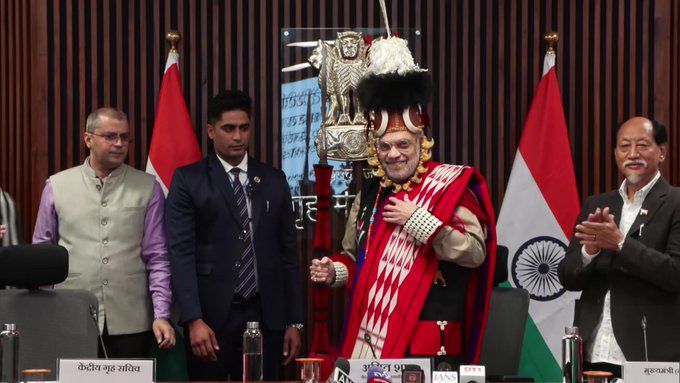
The Centre on Thursday signed an agreement with the Nagaland government and the Eastern Nagaland Peoples’ Organisation (ENPO) for the creation of the Frontier Nagaland Territorial Authority (FNTA) within the state.
The agreement was signed in the presence of Union Home Minister Amit Shah, who assured full support from the Centre for the development of eastern Nagaland.
Highlighting the government’s approach toward peace and development in the region, Amit Shah said, “Since 2019, we have done 12 important agreements in the Northeast. It has been a tradition of the Narendra Modi government that we make full effort to implement the agreements we have entered into. I want to assure the representatives of ENPO that the Centre will extend lot of help for the development of Eastern Nagaland and will also fulfill its responsibility too.”
He further said there should be no doubt regarding the commitment of both the central and Nagaland governments.
“There should be no doubt on the Nagaland and central governments and every amount will be decided and released,” Shah said, adding that the initial expenses for setting up the authority will be borne by the Union Home Ministry.
Prime Minister Narendra Modi on Friday also called the newly signed tripartite agreement for Eastern Nagaland “historic,” saying it will speed up development and create new opportunities for people in the region.
Nagaland Chief Minister Neiphiu Rio welcomed the agreement, calling it a step toward inclusive development.
“This agreement reflects mutual trust, addresses the aspirations of eastern Nagaland and the state at large, and reaches out to take development to every doorstep,” he said.
The ENPO, which represents eight tribes across six eastern districts of Nagaland, has been demanding a separate state since 2010, citing years of neglect.
However, the organisation later agreed to the Centre’s proposal for greater autonomy under the Frontier Nagaland Territorial Authority framework.
Frontier Nagaland Territorial Authority Agreement: What Does it Mean?
The newly signed agreement paves the way for the creation of the Frontier Nagaland Territorial Authority (FNTA), which will focus on improving development and governance in Eastern Nagaland.
The Eastern Nagaland Peoples’ Organisation (ENPO) had been demanding a separate Frontier Nagaland Territory for over a decade, citing concerns about development, representation, and local administration.
Under the new agreement, the FNTA will receive funding and support from the Ministry of Home Affairs, aimed at strengthening governance and ensuring better delivery of welfare schemes in the region.
The Nagaland Cabinet had earlier reviewed the issue and expressed hope that talks with the Centre would lead to a resolution. A sub-committee led by Chief Minister Neiphiu Rio was also formed to pursue discussions with the central government and address related political matters.
The signing of this agreement as a major step toward resolving a long-standing demand and boosting development in Eastern Nagaland.
Earlier Amit Shah said the security situation in India’s Northeast has seen a major turnaround, with 12 key peace agreements signed since 2019.
Sharp Decline in Insurgency and Violence
According to an earlier data from the Ministry of Home Affairs, incidents of insurgency in the Northeastern states declined by 71% in 2023 compared to 2014. Casualties among security forces dropped by 60%, while civilian deaths fell by 82%.
The Northeast region, comprising Assam, Arunachal Pradesh, Manipur, Meghalaya, Mizoram, Nagaland, Sikkim, and Tripura shares international borders with Bhutan, China, Myanmar, and Bangladesh.
It has long been considered one of India’s most sensitive regions and has struggled with insurgency and underdevelopment since Independence.
Shah said the government has also taken steps to permanently resolve decades-old inter-state disputes, which has helped build trust and unity and laid the foundation for lasting peace and development.
Major Peace Accords Signed Over the Years
As per reports, among the key agreements is the ANVC Peace Accord of 2014, signed with the A’chik National Volunteer Council and its faction ANVC/B, leading to the surrender of 751 cadres and the dissolution of the outfit.
In August 2019, a peace deal with the National Liberation Front of Tripura (NLFT-SD) resulted in 88 cadres surrendering along with 44 weapons.
The Bru Agreement of January 2020 provided for the permanent resettlement of Bru (Reang) refugees in Tripura, backed by a ₹661 crore assistance package.
Later that month, the Bodo Peace Accord was signed with Bodo groups. Following the agreement, 1,615 cadres surrendered, and the organizations were formally disbanded by March 2020.
In September 2021, a peace accord with Karbi organizations brought an end to decades of conflict in the Karbi Anglong region, with over 1,000 armed cadres joining the mainstream.
The process continued with the Adivasi Peace Accord in September 2022, under which 1,182 cadres surrendered after an agreement with eight Adivasi groups.
In April 2023, a deal was signed with the Dimasa National Liberation Army (DNLA/DPSC), followed by the surrender of 181 cadres in October.
Later in November 2023, Manipur’s United National Liberation Front (UNLF) agreed to return to the mainstream while respecting the Indian Constitution and the rule of law.
This was followed by a peace accord with the United Liberation Front of Assam (ULFA) in December 2023, under which the group agreed to abandon violence, join the democratic process, and uphold India’s unity and integrity.
Government’s Firm Stand Against Insurgency
Prime Minister Narendra Modi had earlier said that peace accords in Assam alone have encouraged more than 10,000 youths to give up violence.
Taken together, the government says these developments show that the Northeast is steadily moving away from insurgency and toward a future of peace, stability, and development.