
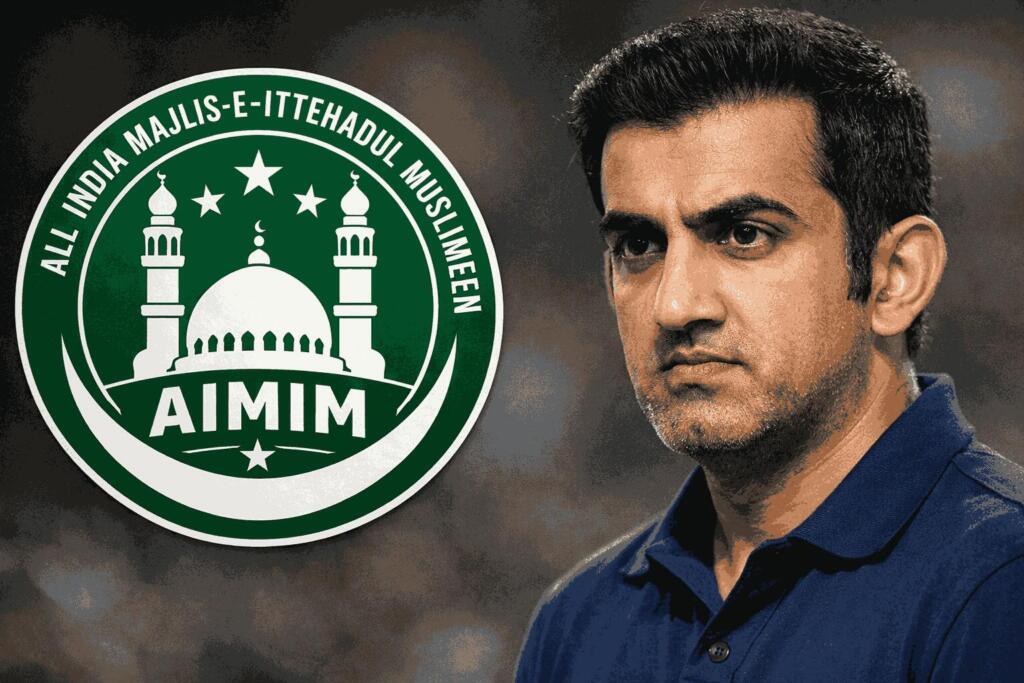
In the aftermath of India’s T20 loss to South Africa, a tweet by a senior leader of All India Majlis-e-Ittehadul Muslimeen (AMIM) has triggered controversy for what many view as a calculated attempt to communalise a sporting setback. Instead of engaging in a mature cricketing analysis, the AMIM Delhi president chose to frame the defeat through a sectarian lens, alleging that “talented and capable” cricketers were ignored in favor of so-called “parchi players.” The statement also questioned whether the Indian cricket team had become a “victim of hate politics.”
Such rhetoric does little to strengthen either cricket or public discourse. By insinuating bias without evidence, AMIM has risked injecting suspicion and communal overtones into what is fundamentally a sporting matter driven by form, fitness, and team balance.
Let us examine the specific names invoked. Mohammed Shami, undoubtedly one of India’s finest fast bowlers in recent years, is currently battling fitness concerns. He has been recovering from injury and has not been in full competitive rhythm for the shortest format. T20 cricket demands explosive pace, quick recovery between overs, and intense fielding agility. At this moment, Shami’s physical condition makes him an uncertain fit for high-intensity T20 matches. A selection committee’s decision to ease him back gradually cannot reasonably be framed as discrimination.
Similarly, Mohammed Siraj, Aqib Nabi, and Sarfaraz Khan are talented cricketers, but T20 is a highly specialized format. Siraj has excelled in Test and ODI formats, yet his T20 record has been inconsistent. Aqib Nabi remains relatively inexperienced at the highest international level. Sarfaraz Khan, though a prolific performer in domestic longer formats, has not yet cemented a role in T20 cricket where strike rates, adaptability, and fielding standards are non-negotiable. The notion that these players are automatic inclusions in a T20 squad oversimplifies the complex calculus of team composition.
Cricket selection is not an act of token representation. It is an evolving, data-driven process involving performance analytics, workload management, match conditions, and tactical requirements. To suggest that non-selection is rooted in communal bias rather than cricketing logic is a serious charge—one that demands evidence, not insinuation.
The tweet’s pointed remark directed at Gautam Gambhir, suggesting he must understand he is “now a coach, not a BJP MP,” further underlines the politicisation at play. Gautam Gambhir has indeed transitioned from politics back to cricket administration, but coaching decisions are rarely unilateral. Selection committees, team management, and performance data all factor into squad announcements. Reducing this multi-layered process to a partisan vendetta narrative distorts reality.
The attempt by AMIM to cast India’s cricket team as a casualty of “hate politics” appears designed to stoke grievance rather than foster accountability. The Indian cricket ecosystem is one of the most competitive in the world. Players from diverse religious, linguistic, and regional backgrounds have represented the country with distinction. History is replete with examples of Muslim cricketers—past and present—who have risen through merit and delivered match-winning performances. To imply systemic bias without substantiation undermines their achievements as much as it questions the integrity of selectors.
Moreover, such statements risk demoralizing the current squad. A loss in T20 cricket can hinge on a handful of deliveries, a misjudged chase, or tactical errors. South Africa played better cricket on the day. Losses must be dissected in terms of strategy, bowling variations, powerplay efficiency, and middle-order execution—not communal arithmetic.
Repeated invocations of alleged bias by AMIM also raise concerns about the broader impact on social cohesion. Cricket in India often serves as a rare unifying force, transcending political and religious divides. Introducing sectarian undertones into this arena can erode that unity. If every selection or omission becomes fodder for communal speculation, the sport’s credibility and emotional value suffer.
The argument advanced by AMIM also fails to acknowledge that team balance in T20 requires role clarity. Teams need death-over specialists, power-hitters, agile fielders, and bowlers with adaptable variations. Reputation alone does not guarantee suitability. Fitness benchmarks and match-readiness are equally decisive. In Shami’s case, prudence regarding his recovery is a professional necessity, not a political statement.
By repeating the charge of “parchi players,” AMIM risks normalizing the idea that selections are patronage-driven rather than performance-based. This can damage public trust in institutions that operate with transparent criteria. If genuine concerns exist, they should be raised with data and constructive critique—not broad allegations.
In the final analysis, sport must remain sport. AMIM’s attempt to frame a T20 defeat as evidence of communal exclusion appears less about cricketing reform and more about political signalling. The path forward lies in strengthening domestic pipelines, improving player fitness management, and supporting team morale—not in amplifying divisive narratives.
India will lose matches; that is the nature of competitive sport. But when political actors attempt to communalise those losses, the damage extends far beyond the scoreboard.