
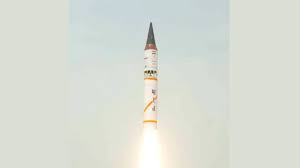
Over the past some time, India has conducted several important missile tests in quick succession. While in a previous video we discussed the successful test of DRDO’s Solid Fuel Ducted Ramjet (SFDR) technology, last Friday India carried out yet another extremely significant test. This test was of the IRBM, or Intermediate Range Ballistic Missile, Agni-3, which was successfully conducted from the Chandipur range in Odisha.
For this test, a NOTAM (Notice to Airmen) was issued for 6–7 February. In the initial notification, the maximum test range was mentioned as around 2,500 kilometers, which was later extended to approximately 3,200 kilometers.
What Does the Agni-3 Missile Test Signify?
An important point to note is that this test was conducted under the Strategic Forces Command (SFC). This clearly indicates that it was not a developmental test, but a test of a fully operational missile that has already been inducted into India’s military arsenal. In other words, the missile was taken directly from the weapons inventory and tested.
This naturally raises a key question: when Agni-3 is already operational and has been in service since 2011, why is it being tested repeatedly?
The answer lies in recent technological upgrades. In the newer versions of the Agni series, several important improvements have been made in the guidance and navigation systems. These include a Ring Laser Gyro (RLG)-based Inertial Navigation System and high specific impulse propellants. All these upgrades were validated during this test.
In addition, it is also possible that software and algorithm updates were tested, aimed at further improving the missile’s performance and accuracy.
Testing the Missile’s Efficiency and Capability
When a missile system remains in long-term storage, it becomes extremely important to verify the condition of the motor and propellant inside it. Whether the burn rate is being maintained as expected or whether any changes have occurred, such aspects are also likely to have been examined during this test.
Along with this, critical parameters such as the behaviour of the re-entry vehicle, structural performance, stage separation timing, and the heat protection system were also evaluated. It was ensured that when the missile re-enters the atmosphere, all systems including heat protection function exactly as intended.
Overall, this test was essentially a reliability check, which is part of standard operational procedures. Such tests are conducted regularly to ensure that inducted missile systems remain fully reliable and ready for operational deployment at any time.
Why Is Agni-3 Important, and How Is It Different from Other Agni Missiles?
This brings us to the question of why so much emphasis is placed on Agni-3 and what makes it strategically significant.
From a technical standpoint, Agni-1 and Agni-2 are considered tactical or regional missiles. They are designed for comparatively shorter ranges and limited target sets, and have primarily been developed keeping Pakistan in mind.
In contrast, Agni-3 is a fully strategic missile, specifically designed for second-strike capability. This means that even if India is attacked first, the missile provides the capability to carry out an effective retaliatory strike against the enemy’s critical infrastructure and high-value targets.
It has been developed with China as the primary consideration. The missile is nuclear-warhead capable, with a reported maximum range of around 3,500 kilometers, allowing it to cover almost the entire Chinese mainland, including Beijing and Shanghai.
Although India also possesses a longer-range and more capable strategic missile like Agni-5, it is not only larger and more expensive, but also involves higher strategic risks in terms of deployment and use. Compared to this, Agni-3 is relatively cost-effective while still being capable of carrying a heavier warhead.
When compared with Agni Prime, the roles of the two missiles are clearly different. Agni Prime is essentially a tactical missile system, designed for rapid deployment and selective response. In situations where retaliation is necessary but escalation needs to be kept limited, such a missile can prove to be an effective option.
Agni-3 Is Always Ready to Fire for Retaliation
Overall, Agni-3 is a mature and fully ready missile system. It has been tested multiple times and is backed by several years of operational data. The recent test once again confirms that the system is completely ready and reliable.
Deployed on a canister-based, mobile platform, Agni-3 is maintained in a ready-to-fire mode. It can be launched within a very short time from road-based or rail-based launchers, significantly improving both its survivability and response time.
Within its category, Agni-3 is considered among the most accurate ballistic missiles. Its CEP (Circular Error Probable) is reported to be around 40 meters, making it highly precise.
This missile is a crucial pillar of India’s “No First Use” nuclear policy, providing the capability for effective retaliation in the event of any serious threat. Therefore, this test not only demonstrates India’s ability to maintain a credible minimum deterrence, but also showcases the country’s technological maturity in the field of intermediate-range ballistic missiles.