
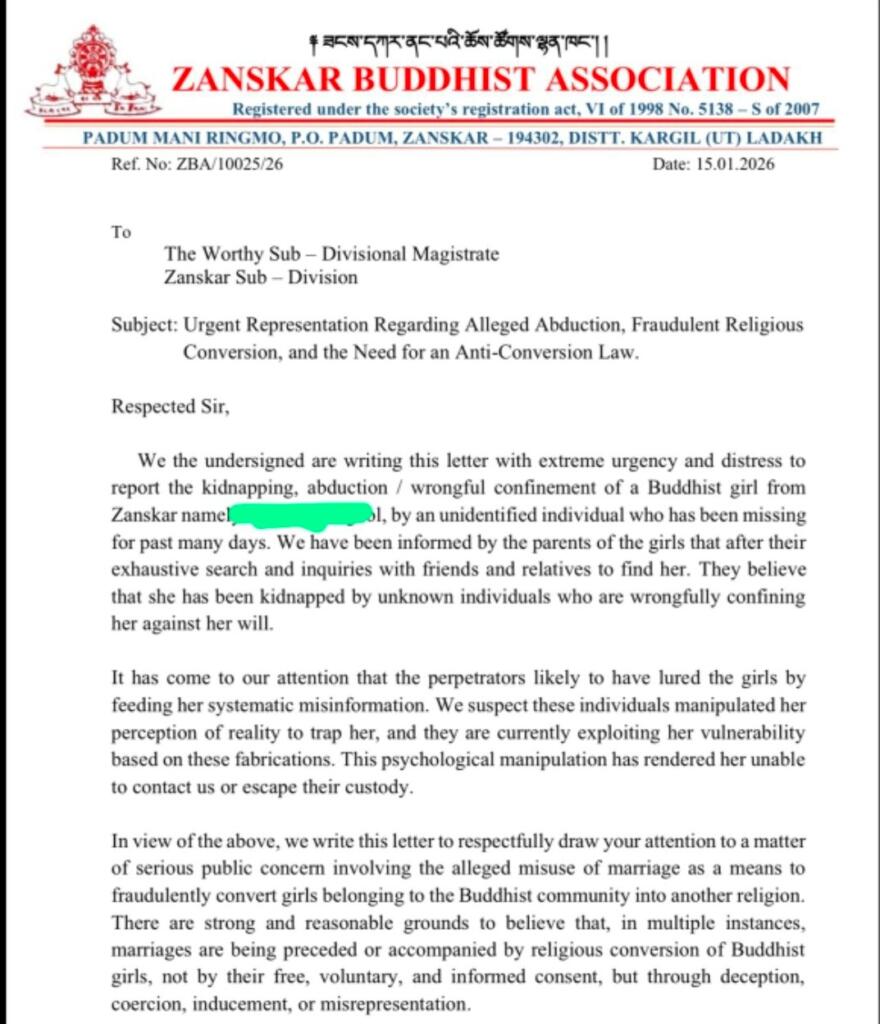
In the remote Himalayan region of Zanskar in the Union Territory of Ladakh, the Zanskar Buddhist Association (ZBA) has called for urgent government intervention following the reported disappearance of a young Buddhist woman. In a strongly worded representation to the Sub-Divisional Magistrate of Zanskar, the association said that the woman had been missing for several days and that initial inquiries by her family and community had yielded no information about her whereabouts. The association fears she may have been abducted and is being held against her will by unidentified individuals, a situation that it describes as deeply troubling and a matter of serious public concern.
According to the representation submitted on January 15, 2026, the Zanskar Buddhist Association believes there are strong reasons to suspect that this incident is not isolated, but may be part of a broader pattern involving the misuse of marriage as a means for fraudulent religious conversion. The ZBA’s letter alleges that in several cases, young women from the Buddhist community have been married and subsequently pressured or deceived into changing their religion without their free, voluntary, and informed consent. This, the association maintains, raises serious questions about intent and legality that demand immediate scrutiny from authorities.
The Zanskar association’s concerns go beyond the disappearance itself. It points to instances in which only the woman’s religion appears to have changed in the context of interfaith marriages, without equivalent changes by their partners. Citing the Special Marriage Act of 1954, which allows interfaith marriages without necessitating conversion to a different faith, the ZBA said that if marriages are genuinely based on mutual consent and respect for individual choice, they should be facilitated under this law rather than through conversion. In their view, the repeated pattern of religion changing only on one side suggests deception, coercion, inducement, or misrepresentation.
The representation describes the alleged trend as deeply disturbing and warns that if such practices continue unchecked, they could seriously undermine communal harmony in the region. Zanskar, a predominantly Buddhist area within the largely peaceful social fabric of Ladakh, is also home to several other communities, and the association emphasises the need for swift, transparent action to prevent escalation of tensions and maintain peace.
To address these concerns, the Zanskar Buddhist Association has demanded an immediate and impartial inquiry into the disappearance of the young woman and similar cases. It has also called on the administration to ensure that she is safely returned to her family as soon as possible. The representation was sent not only to the local magistrate, but also copied to high-ranking officials, including the Lieutenant Governor of Ladakh, the Deputy Commissioner and Chief Executive Officer of the Ladakh Autonomous Hill Development Council in Kargil, senior police officials, and leaders within the Buddhist community.
In addition to urging a thorough investigation and her safe recovery, the Zanskar Buddhist Association is pushing for strict legal action against those allegedly involved in abductions and forced conversions. The association advocates for the enactment of a stringent anti-conversion law in Ladakh to deter “forcible or fraudulent religious conversions” carried out under the guise of marriage or other inducements. According to the ZBA, such a law would provide clearer legal protections and help safeguard individual rights while maintaining communal harmony in the Union Territory.
The plea from the Zanskar Buddhist Association reflects deeper anxieties in the region about interfaith relationships and perceived threats to cultural and religious identity. Similar concerns have been echoed elsewhere in Ladakh by groups such as the Ladakh Buddhist Association, which have described instances of interfaith incidents as potentially harmful to the region’s delicate social balance. These groups have also urged the adoption of anti-conversion laws in Ladakh, noting that several Indian states have already enacted such legislation to regulate religious conversions and uphold communal peace.
Critics and analysts note that the term “forced conversion” carries significant political and social weight and is often contested in public discourse. In many cases involving interfaith marriage or conversion, legal frameworks already exist to protect the rights of adults to make their own choices. At the same time, allegations of deception, manipulation or coercion are taken seriously by authorities and can form the basis of criminal investigations if evidence supports such claims. The demand of Zanskar Buddhist Association for an impartial inquiry underscores the importance of evidence-based investigation in addressing these sensitive matters.
The urgency expressed by the Zanskar Buddhist Association comes at a time when issues related to interfaith relationships and alleged conversion activities have become politically charged topics in India. Several other regions and communities have reported disputes and public debates over conversion and marriage, sometimes resulting in legal action or policy discussions about whether stricter laws are needed to protect vulnerable communities. These debates often balance individual rights to freedom of religion and personal choice against concerns about coercion, exploitation, and social harmony.
While the investigation into the woman’s disappearance and the alleged pattern of forced conversions continues, authorities in Ladakh face the challenging task of addressing the concerns of Zanskar Buddhists without inflaming communal tensions. The administration must navigate legal, social, and cultural sensitivities to ensure that the rule of law is upheld and that all citizens feel secure and protected within the region. The ZBA’s appeal for action highlights how local organisations can play a key role in bringing community concerns to the attention of governance structures and in shaping policy discussions that affect social cohesion.
In the coming weeks, the outcomes of official investigations and any legislative responses will be closely watched by residents of Ladakh and observers of communal relations in India. What remains clear is that the case has touched on fundamental questions about personal liberty, community identity, and the balance between legal protection and social harmony in a pluralistic society.