










As pilots across the US report a steady rise in sightings of Unidentified Anomalous Phenomena (UAPs), often called UFOs, attention has returned to one of the most dramatic episodes in American history, the 1952 Washington Flap.
More than seven decades later, the mystery surrounding that summer still echoes in today’s debates about national security, advanced technology, and unexplained objects in the sky.
Cold War Fears and a Sky on Edge
The early 1950s were tense years for the US. The Korean War was raging, and the Cold War with the Soviet Union had begun. Fear of a Soviet air attack dominated military planning.
US fighter pilots remained on constant alert. They were trained to scramble within minutes if radar detected unknown aircraft. The threat of nuclear bombers crossing the Atlantic felt real and urgent.
At the same time, the country was witnessing an unprecedented wave of UFO sightings. Reports flooded newspapers, radio shows, and police stations. As a result, pilots sent to intercept hostile aircraft sometimes found themselves chasing objects they could not identify or explain.
This volatile mix of fear, technology, and mystery set the stage for what followed in Washington, DC, in July 1952.
The Night the Capital’s Radars Lit Up
On the night of July 19–20, 1952, radar operators at Washington National Airport and Andrews Air Force Base noticed something strange. Multiple radar screens showed unidentified objects moving erratically over the capital region.
The blips did not behave like planes. They hovered, dipped suddenly, changed direction, and vanished before reappearing elsewhere. Controllers tracked these objects across a wide area, including airspace near the White House and the Pentagon.

A commercial airline pilot flying nearby also reported seeing bright lights pacing his aircraft. This visual sighting added to the alarm.
Officials initially downplayed the incident. They blamed temperature inversions, a weather condition that can distort radar signals. However, the explanation failed to calm concerns.
A Second Weekend and a Fighter Intercept
One week later, on July 26, 1952, the mystery returned — and this time, it was even more intense.
Radar operators tracked more than a dozen solid targets across a 100-mile area. The objects again showed unusual movement patterns. They stopped suddenly, reversed course, and accelerated at speeds beyond known aircraft.
Controllers at Washington National Airport confirmed that Andrews Air Force Base was tracking the same objects. The Air Force scrambled interceptors.
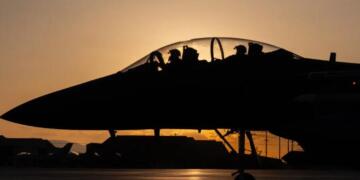
Lieutenant William L. Patterson and Captain John McHugo took off in F-94 fighter jets to investigate.
At 20,000 feet, Patterson saw four bright lights ahead. They did not blink or drift like stars. As he moved closer, the lights broke formation and appeared to rush toward his aircraft.
Radar operators watched the targets close in on Patterson. His cockpit filled with dazzling light. When he radioed for instructions, the controllers fell silent.
Moments later, the lights vanished.
Patterson chased other targets, but they disappeared before he could intercept them. Low on fuel, he returned to base after nearly an hour at full throttle. McHugo, sent to another sector, saw nothing.

Panic, Headlines, and Public Fear
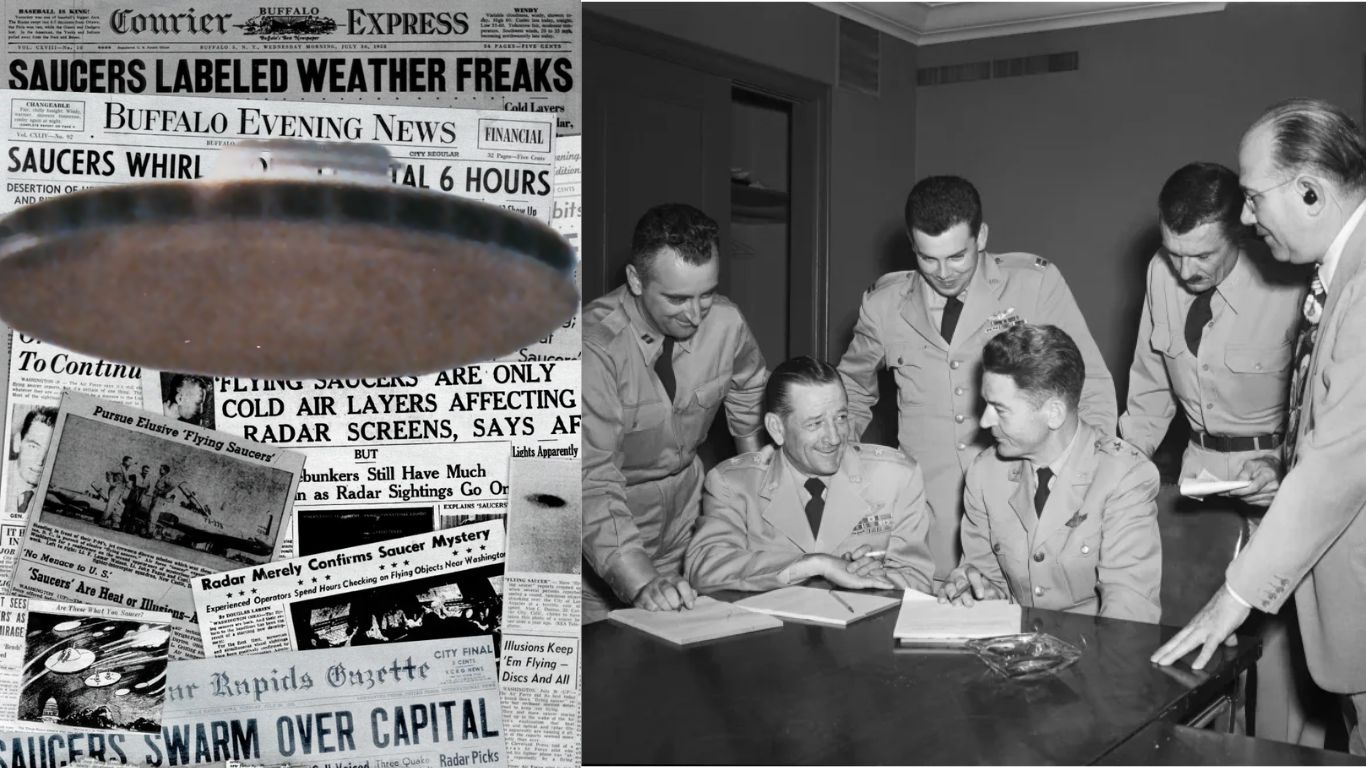
The events triggered widespread panic. Newspapers ran sensational headlines. On July 29, The Cedar Rapids Gazettedeclared: “SAUCERS SWARM OVER CAPITAL.”
Public fear spilled into daily life. The sightings overshadowed the presidential election and even the Olympic Games. Stories about flying saucers flooded the media.
Captain Edward Ruppelt, head of the Air Force’s UFO investigation program Project Blue Book, rushed investigators to Washington. Radar specialists confirmed that the targets had appeared clearly on multiple systems.
Within six months, nearly 16,000 stories about UFOs appeared in major newspapers. Even Albert Einstein commented cautiously, saying, “Those people have seen something.”
The Air Force Responds — Carefully
Facing growing pressure, the Air Force held its largest press conference since World War II. Major General John Samford, Director of Intelligence, addressed reporters.

He suggested that temperature inversions might explain about half of the sightings. However, he avoided detailed follow-up questions. He denied hostile reconnaissance and dismissed claims of a cover-up.
Despite this, conspiracy theories persisted.
Declassified records later revealed that several sightings involved coordinated radar and visual confirmations, which did not fit simple explanations. Project Blue Book officially labeled the Washington incidents as “unknown.”
That classification still stands today.
From Flying Saucers to UAPs
The modern UFO era began in 1947, when pilot Kenneth Arnold reported seeing strange flying objects near Mount Rainier. However, the Washington Flap marked a turning point.
It showed that unidentified objects could appear over the most protected airspace in the country. It also exposed limits in military detection and explanation.
Over time, the term “UFO” gave way to UAP, reflecting a broader focus on unexplained phenomena across air, sea, and space.
Also Read: Did China fake probe’s landing on the far side of Moon?
New Sightings in Modern Skies
Today, reports continue to rise.
A recent example involved a pilot flying over Rhode Island who spotted a small silver object hovering near his wing. He ruled out drones and balloons. Air traffic control recordings captured the exchange.
Former Navy pilot Ryan Graves has also spoken publicly. He described seeing objects shaped like a dark cube inside a clear sphere. These objects sometimes stayed motionless and then moved suddenly.
Perhaps the most famous modern case is the 2004 Tic Tac incident involving the USS Nimitz.
Radar operators tracked objects dropping from 80,000 feet to sea level in seconds. Commander David Fravor visually observed a white, wingless object hovering above disturbed water. It mirrored his movements and then shot away at incredible speed.
Infrared footage later confirmed the encounter.
Government Investigations and New Questions
In 2022, the Pentagon established the All-domain Anomaly Resolution Office (AARO) to investigate UAPs.
According to AARO, the US now receives 50 to 100 UAP reports every month. Most cases involve drones, balloons, weather effects, or sensor errors. Some, however, remain unexplained.
A major Pentagon report released in 2024 revealed a different truth. During the Cold War, the US military intentionally spread UFO stories to hide classified weapons programs. Area 51 myths helped conceal tests of aircraft like the U-2, SR-71, and F-117 stealth fighter.
Still, officials admit that not every sighting fits this explanation.
Mystery Without Easy Answers
Skeptics argue that UAPs pose little threat. They point to radar glitches, human error, and natural phenomena.
Others remain concerned. “These are highly credible observers,” Ryan Graves said. “Some objects appear to show capabilities beyond known technology.”
Seventy-three years after the Washington Flap, the question remains unanswered. Are UAPs misunderstood technology, foreign surveillance, or something else entirely?
For now, the skies keep their secrets — just as they did over Washington in the summer of 1952.





