
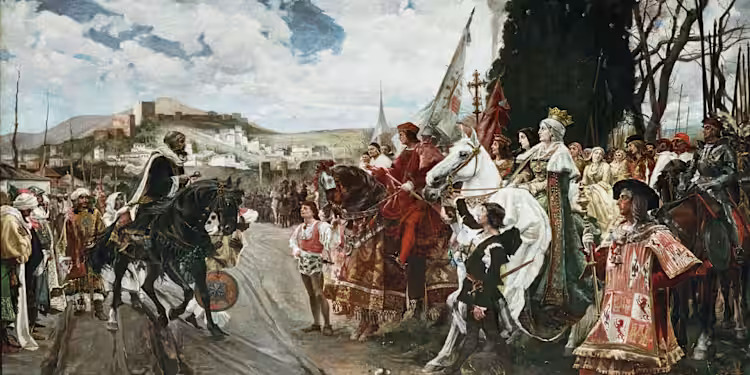
The Reconquista stands as one of the most consequential transformations in European history, a centuries long process that reshaped the Iberian Peninsula and redefined Spain’s political and cultural identity. Often symbolized by the fall of Granada in 1492, the Reconquista was not a single battle or day, but the culmination of a prolonged struggle through which Christian kingdoms gradually dismantled Muslim rule that had once flourished as part of the Islamic caliphate in Al Andalus. The so called Day of Reconquista represents the moment when this long contest reached its decisive conclusion.
Islamic rule in Spain began in 711 when Umayyad forces crossed the Strait of Gibraltar and rapidly defeated the Visigothic kingdom. Within a few years, most of the peninsula came under Muslim control, eventually forming Al Andalus, one of the most advanced societies of medieval Europe. Cities such as Cordoba, Seville, and Toledo became centers of learning, architecture, science, and philosophy. For centuries, Muslim rulers governed alongside Christian and Jewish communities, producing periods of coexistence as well as tension.
However, Muslim political unity in Iberia proved fragile. The collapse of the Umayyad Caliphate of Cordoba in the early eleventh century fractured Al Andalus into smaller taifa kingdoms. These rival states often competed against one another, weakening their collective ability to resist external pressure. This internal division would become a decisive factor in their eventual downfall.
Meanwhile, in the mountainous north of the peninsula, small Christian kingdoms such as Asturias, León, Castile, Aragon, and Navarre survived and slowly expanded for Reconquista. These kingdoms framed their territorial ambitions in religious language, presenting their campaigns as a reconquest of lands once ruled by Christian ancestors. Over time, military expansion became intertwined with political consolidation, economic incentives, and papal support.
The Reconquista advanced unevenly, marked by alliances, truces, and shifting loyalties. Christian rulers sometimes allied with Muslim powers against rival Christians, while Muslim leaders hired Christian mercenaries. Despite these complexities, the overall balance of power gradually shifted. Key victories such as the capture of Toledo in 1085 and the decisive Battle of Las Navas de Tolosa in 1212 broke Muslim dominance and opened central Iberia to Christian control.
By the thirteenth century, most of the peninsula through Reconquista had fallen to Christian kingdoms. Only the Emirate of Granada remained under Muslim rule, surviving as a tributary state. Granada endured through diplomacy, internal administration, and the payment of tribute to Castile. Its impressive architectural legacy, including the Alhambra, testified to the resilience and sophistication of the last Muslim stronghold in Spain.
The final phase of the Reconquista began with the marriage of Ferdinand of Aragon and Isabella of Castile. Their union created a powerful political alliance that unified resources, armies, and strategy. Determined to complete the reconquest, the Catholic Monarchs launched a sustained campaign against Granada in the late fifteenth century. Unlike earlier phases, this war benefited from centralized authority, improved military organization, and the use of artillery.
On January 2, 1492, after a prolonged siege, Granada surrendered. The last Muslim ruler, Boabdil, handed over the keys of the city, marking the end of nearly eight centuries of Islamic political rule in Iberia. This event has often been framed as the Day of Reconquista, a symbolic turning point when Spain emerged as a unified Christian kingdom.
The fall of Granada had consequences far beyond the battlefield. It accelerated the transformation of Spain into a centralized state under royal authority. Soon after, policies of religious uniformity were imposed. Muslims and Jews faced forced conversion, exile, or persecution, reshaping the social fabric of the country. What had once been a region of cultural pluralism increasingly became defined by rigid religious boundaries.
Historically, the Reconquista cannot be understood simply as a clash of civilizations. It was a complex process driven by political ambition, economic gain, dynastic rivalry, and religious ideology. While it ended Islamic rule in Spain, it also transmitted Islamic knowledge, art, and science into Christian Europe, influencing the Renaissance and shaping Spanish culture in lasting ways.
The Day of Reconquista remains a powerful and controversial symbol. For some, it represents national unification and sovereignty. For others, it marks the loss of a rich multicultural society. What is undeniable is that the dismantling of the Islamic caliphate in Spain was a defining moment that altered the course of European and Mediterranean history, leaving legacies that continue to be debated and reinterpreted today.