
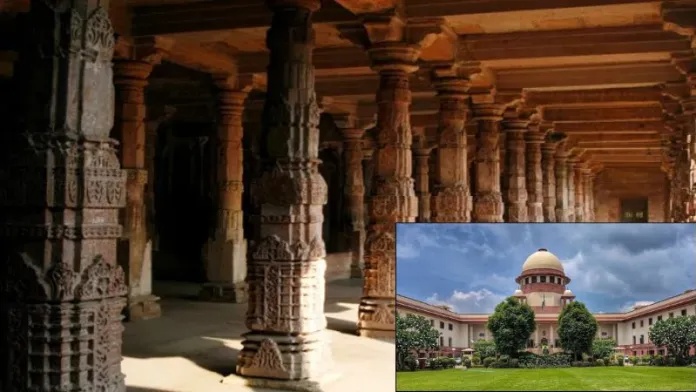
The Supreme Court’s recent observations on the long standing dispute surrounding Bhojshala have once again placed the spotlight on how India’s constitutional system engages with matters of faith, history, and public order. While hearing petitions related to worship practices at the disputed complex, the Court indicated that Hindu prayers could be conducted until noon, after which Muslim namaz would take place. It further clarified that once namaz is completed, Hindu devotees would be free to resume worship. At the same time, the Court reserved its final decision on the plea seeking uninterrupted or akhand puja, signaling that the issue requires deeper legal examination.
This arrangement is not entirely new, but its reiteration by the apex court carries significant weight. The dispute linked to Bhojshala has persisted for decades, with competing religious claims and strong emotional investments from different communities. Over the years, administrative mechanisms attempted to regulate access through fixed timings to prevent conflict. However, repeated petitions seeking exclusive or uninterrupted rights ultimately brought the matter before the judiciary, which now faces the complex task of balancing religious freedom with social harmony.
In its remarks, the Supreme Court appeared guided by a principle of equilibrium rather than absolutism. By allowing worship before and after namaz, the Court conveyed that religious rights need not be viewed as mutually exclusive. This approach recognizes the plural nature of Indian society and the constitutional mandate to ensure equal respect for all faiths. In the context of Bhojshala, the emphasis was clearly on coexistence under the rule of law, rather than on asserting dominance by any single group.
Equally important is the Court’s decision to withhold a final ruling on the demand for akhand puja. This restraint underscores judicial caution in cases that have the potential to affect communal peace. Rather than issuing an immediate verdict that could have far reaching social implications, the Court chose to hear arguments in detail and assess historical records, legal precedents, and constitutional principles. Such an approach reflects the judiciary’s awareness that disputes involving sites like Bhojshala extend beyond legal texts and touch deeply held beliefs.
Supporters of the regulated worship model argue that the Court’s stance reinforces India’s secular framework, which does not favor one religion over another but seeks fair accommodation. They believe that structured timings prevent confrontation and allow both communities to practice their faith without fear. From this viewpoint, the direction that worship may resume after namaz reassures Hindu devotees that access is preserved, while also protecting the right of Muslims to offer prayers at the allotted time.
At the same time, proponents of uninterrupted Hindu worship maintain that historical and archaeological evidence supports their claim for continuous puja. For them, the plea for akhand worship is an assertion of cultural heritage and religious continuity. They see the ongoing hearings related to Bhojshala as a critical moment that could shape how historical grievances are addressed within a constitutional framework. The Court’s willingness to consider these arguments indicates recognition of the depth and seriousness of such claims.
Beyond the immediate dispute, the case raises broader questions about how India manages religiously contested spaces. The Constitution guarantees freedom of religion, but it also places limits in the interest of public order and social stability. Navigating this balance is one of the judiciary’s most challenging responsibilities. By emphasizing regulated access while deferring a final verdict on uninterrupted worship, the Supreme Court appears intent on preventing escalation while preserving the possibility of a definitive and reasoned judgment.
Public reactions to the Court’s observations have been mixed. Some have welcomed the clarity on worship timings as a pragmatic solution that reduces uncertainty. Others remain focused on the pending decision regarding akhand puja, viewing it as the core issue. Regardless of differing opinions, there is widespread recognition that the judiciary’s handling of the Bhojshala matter could set an important precedent for similar disputes across the country.
As the hearings continue, attention will remain fixed on whether the Supreme Court can deliver a verdict that is legally robust and socially sustainable. The dispute is not merely about one site, but about the principles that define religious coexistence in a diverse democracy. By choosing caution, balance, and constitutional reasoning, the Court has signaled that enduring solutions require patience and dialogue. The eventual outcome will likely shape how contested religious spaces like Bhojshala are governed in the future, reinforcing the idea that the rule of law must remain the final arbiter.