
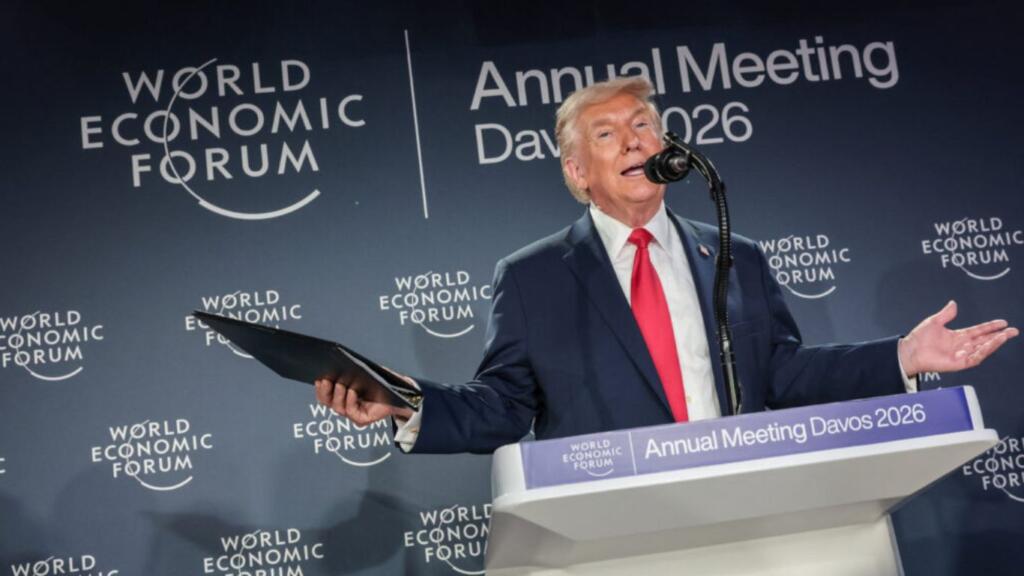
In Davos, US President Donald Trump showed the world his current approach to foreign policy: he starts with conflict, then shifts to negotiation once pressure mounts. This pattern played out most clearly in his push over Greenland and his dealings with NATO allies and Europe at the World Economic Forum.
For weeks, Trump has said control of Greenland is a strategic priority for the US and will go to any length to get it. The military option was also on the table. He repeated this at Davos, calling Greenland vital for US national security and Arctic defense. He argued that the US is uniquely positioned to secure Greenland against rivals like Russia and China. In doing so, he attacked Denmark, a NATO ally, and other European states, at times casting their response as ungrateful and weak. European leaders, including Denmark’s government, repeatedly insisted the Arctic territory is not for sale and will remain sovereign.
To build leverage, Trump threatened economic pressure. He floated tariffs on imports from several European NATO members that pushed back on his Greenland ambitions and suggested that without US leadership, Arctic security would suffer. This approach is consistent with his larger worldview: apply pressure first, then use fear or uncertainty to bring other actors into a negotiation on his terms.
This is diplomacy by disruption, not consensus. Trump’s rhetoric was aggressive and at times confusing, including multiple public mix-ups between Greenland and Iceland during speeches at Davos. His tone and tactics unsettled allies and raised questions on the future of the Trans-Atlantic alliance.
It was not just rhetoric. European officials made clear they saw Trump’s stance as a direct challenge to norms within NATO and the alliance’s core principle of mutual defense. Even within NATO’s leadership, there were calls for “thoughtful diplomacy” and caution over any brinkmanship that could fracture the alliance.
Yet Trump’s strategy appears to intentionally create divisions or anxiety among allies so that he can claim stronger terms.
Aslo Read: Greenland PM Warns of Possible Invasion as Trump Says ‘You’ll Find Out’ on Acquiring Island
Panic, Pressure, and the “Framework” Deal
After days of tension, the latest chapter of this drama unfolded in the past 24 hours. Trump met with NATO Secretary General Mark Rutte on the sidelines of the World Economic Forum. Following that meeting, he announced that the US and NATO had agreed on a “framework of a future deal” regarding Greenland and Arctic security. As a result, he abruptly dropped his threat to impose tariffs on European allies in response to their rejection of his territorial claims.
This shift looks like a deliberate sequence. First, Trump created a threat: tariffs and a claim over Greenland’s strategic control. Then, as European pushback intensified and worries about wider political and economic fallout grew, he pivoted to a negotiated outcome, portraying the result as a win for both the United States and allied security interests.
What is striking about this deal is how little detail exists in public. The announced “framework” offers broad language about Arctic cooperation and security but no clear change in Greenland’s political status. Denmark and Greenland leaders continue to affirm that sovereignty rests with the island’s people and government. Yet Trump presented the framework as evidence that he “got what he wanted.”
This sequence — threat, backlash, retreat — may look like a concession. But in terms of Trump’s calculus, it reads differently. The initial attack created fear and uncertainty. It reverberated through markets and political capitals. And when the United States backed off tariffs in exchange for an agreement that allows continued negotiation, Trump claimed momentum.
In his own framing, Trump turned what many saw as a diplomatic crisis into a narrative of strength. By forcing allies into high-stakes negotiation and then dropping overt coercion, he presented himself as both tough and flexible. This is a pressure tactic — create a fault line, use it, and then adjust when pushback is strong enough. Whether this approach builds lasting trust among allies is another question.
In short, Trump’s Davos diplomacy was neither traditional carrot-and-stick nor pure collaboration. It was stick first, deal later. It may benefit him politically at home. But in the process, it amplified fractures among long-standing partners and left questions about the stability of Western alliances.