
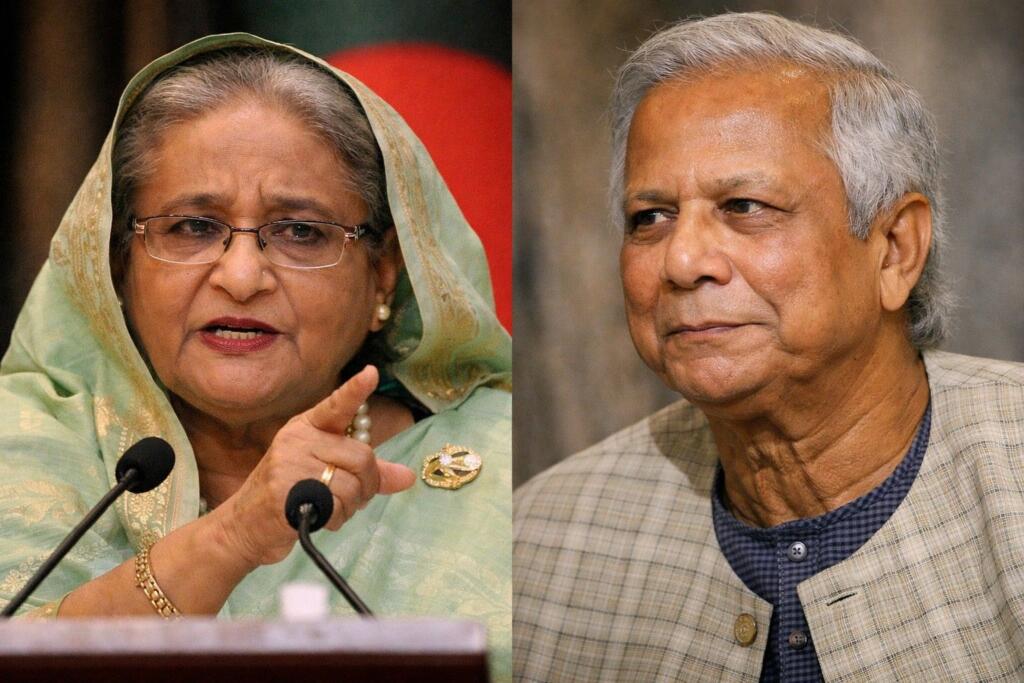
In a powerful and emotionally charged public address delivered from India, former Bangladesh Prime Minister Sheikh Hasina launched a sweeping attack on the interim government in Dhaka, warning that the country stands at a dangerous crossroads. Speaking at a gathering focused on democracy and human rights, Hasina framed her speech as a message of alarm not just for Bangladeshis, but for the international community. According to her, the policies and actions of the current dispensation threaten the very foundations of the nation and place Bangladesh’s future in serious jeopardy.
Hasina began by recalling Bangladesh’s long struggle for independence and democratic self determination, invoking the legacy of the Liberation War to underline what she described as a betrayal of those ideals. She accused the interim administration of dismantling constitutional norms and silencing political opposition. In her telling, the present crisis is not a routine political transition but a structural breakdown that could permanently alter Bangladesh’s future if left unchecked.
A central focus of her address was the deteriorating human rights situation inside the country. Hasina alleged that incidents of torture, arbitrary detention, and sexual violence have increased dramatically under the interim regime. She claimed that women and children are bearing the brunt of lawlessness, while state institutions that should protect citizens have either failed or been weaponised. Such conditions, she argued, signal a descent into fear and instability that directly imperils Bangladesh’s future as a democratic and humane society.
The former prime minister placed particular emphasis on the plight of religious and social minorities. She asserted that minority persecution has intensified amid weak governance and political opportunism. According to Hasina, attacks on minorities are not isolated incidents but part of a broader climate of impunity. She warned that minority persecution corrodes social harmony and undermines national unity, making minority persecution a defining moral test for the country. In her view, continued minority persecution will leave deep scars and further darken Bangladesh’s future.
Hasina also accused the interim leadership of allowing extremist elements to gain influence, either through negligence or tacit support. She claimed that radical forces are exploiting political uncertainty to spread fear and intolerance, worsening minority persecution and shrinking civic space. Journalists, activists, and opposition voices, she said, are facing intimidation and censorship. This environment of repression, Hasina argued, is incompatible with democratic values and threatens to derail Bangladesh’s future for an entire generation.
In a direct appeal to the global community, Hasina called for stronger international scrutiny of developments in Bangladesh. She urged global institutions to take allegations of minority persecution and human rights abuses seriously and not treat the crisis as an internal matter alone. According to her, silence or neutrality in the face of injustice would amount to complicity. She framed international engagement as essential to safeguarding democracy and stabilising Bangladesh’s future.
The address also carried clear political undertones. With her Awami League excluded from the electoral process, Hasina described the upcoming elections as fundamentally flawed. She argued that a vote conducted without major opposition participation cannot reflect the will of the people. Such an exercise, she warned, would only deepen divisions and prolong instability, pushing Bangladesh’s future further into uncertainty.
Throughout her speech, Hasina returned repeatedly to the theme of responsibility—of leaders to their citizens, of institutions to the constitution, and of the global community to universal human rights. Minority persecution, she said, is both a symptom and a warning sign of broader state failure. When minorities are unsafe, she argued, no citizen is truly secure. Allowing minority persecution to continue unchecked would normalize injustice and permanently distort the nation’s moral compass.
The emotional tone of the address suggested more than political strategy; it reflected a sense of personal anguish and urgency. Hasina positioned herself as a voice for those who feel abandoned by the current system, particularly women, minorities, and ordinary citizens struggling with insecurity. By highlighting minority persecution alongside democratic backsliding, she sought to present a comprehensive picture of a country in distress.
As reactions to her speech ripple across South Asia, questions remain about its impact. Supporters view it as a necessary wake up call, while critics dismiss it as politically motivated rhetoric. Regardless of perspective, the issues she raised—democracy, human rights, minority persecution, and governance—are central to debates shaping Bangladesh’s future.
Ultimately, Sheikh Hasina’s fiery address from India was a stark warning rather than a conciliatory gesture. It portrayed a nation at risk of losing its democratic soul and social cohesion. Whether her words lead to reform, resistance, or further polarisation remains to be seen. What is clear is that the struggle over values, power, and justice will decisively shape Bangladesh’s future in the years ahead.