
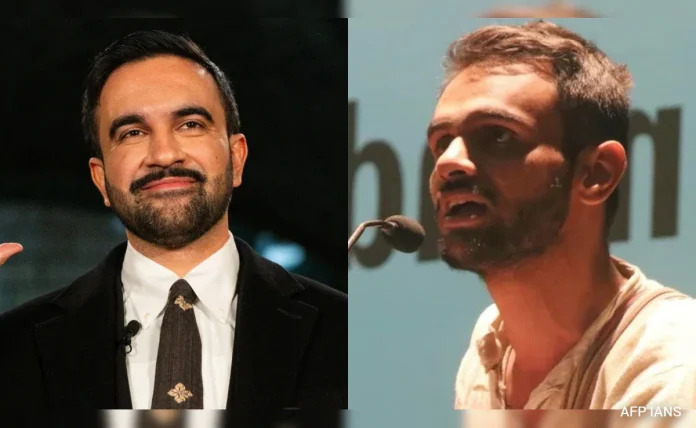
Public figures are often judged not only by the causes they champion but also by the silences they maintain. In recent political discourse, support of Zohran Mamdani expressed for Umar Khalid has triggered sharp debate, particularly among those who view Khalid as a deeply polarising figure associated with radical political positions. Critics argue that Mamdani’s stance reflects a troubling pattern of selective outrage that raises serious questions about ideological alignment, moral consistency, and political responsibility.
Umar Khalid has long been a controversial name in Indian political discourse. His critics accuse him of endorsing separatist narratives related to Kashmir, expressing sympathy for Burhan Wani who is designated by the Indian state as a terrorist, and of being linked through speeches and associations to events that preceded the Delhi riots. While Khalid and his supporters deny these accusations and frame his activism as dissent, a large section of Indian society views his politics as destabilising and divisive. It is within this contested backdrop that Zohran Mamdani’s support has been interpreted by critics as more than an act of solidarity, and instead as an ideological endorsement.
Those critical of Mamdani argue that supporting a figure like Khalid inevitably places him within a broader ecosystem of radical activism that often blurs the line between dissent and extremism. In their view, this ecosystem thrives on selectively amplifying certain injustices while remaining conspicuously silent on others. Mamdani’s public statements in defence of Khalid are seen as aligning with narratives that question India’s sovereignty over Kashmir and minimise or ignore the violence inflicted by Islamist extremism.
What has intensified this criticism is Mamdani’s perceived silence on the persecution of Hindus in Bangladesh. Over the years, numerous reports by human rights groups, journalists, and civil society organisations have documented attacks on Hindu minorities in Bangladesh, including instances of mob violence, destruction of temples, forced displacement, and targeted intimidation. Critics argue that while Mamdani readily speaks on issues involving Muslim identity and state power, he has not used his platform to condemn or even acknowledge the suffering of Hindu minorities across the border.
This asymmetry, critics claim, reveals a deeper ideological bias. They argue that human rights, if they are to have moral meaning, must be universal rather than conditional on religious or political identity. The failure to speak against violence faced by Hindus in Bangladesh, while vocally supporting figures accused of inciting unrest in India, is seen as undermining the credibility of Mamdani’s commitment to justice and pluralism.
The issue, therefore, extends beyond one individual or one statement. It touches upon a broader pattern in global progressive politics where causes are often filtered through ideological lenses. Certain narratives receive immediate attention and solidarity, while others are ignored because they complicate a preferred worldview. Critics argue that Islamist violence and minority persecution in Muslim majority countries are frequently downplayed or rationalised, whereas similar or even lesser issues elsewhere are magnified.
Supporters of Mamdani counter these accusations by stating that silence on one issue does not imply endorsement of injustice, and that political actors cannot comment on every global conflict. They also argue that Khalid’s case should be viewed through the lens of civil liberties and free speech. However, critics remain unconvinced, pointing out that Mamdani has actively chosen to speak on specific issues and figures, making his silences politically meaningful.
In a time of increasing polarisation, public figures wield significant influence over narratives and perceptions. With that influence comes responsibility. Critics insist that supporting controversial activists without acknowledging the full spectrum of violence and extremism risks normalising radical positions and deepening societal divides. They argue that moral consistency demands condemning violence and persecution irrespective of the victim’s religion or the perpetrator’s ideology.
Ultimately, the debate surrounding Zohran Mamdani’s support for Umar Khalid and his silence on the plight of Hindus in Bangladesh reflects a larger crisis of credibility in political activism. It raises uncomfortable questions about selective empathy, ideological blind spots, and the use of human rights as a political tool rather than a universal principle. For many observers, the issue is not merely about disagreement, but about whether justice can survive when outrage becomes conditional and silence becomes strategic.