


















This year’s Republic Day flypast stood out not just for its scale, but for the strategic messaging it conveyed. Conducted after Operation Sindoor, the flypast featured a special “Sindoor formation” comprising Rafale, MiG-29, Su-30MKI and Jaguar fighter aircraft. Alongside the live display, the Indian Air Force (IAF) also showcased pre-recorded footage, parts of which have triggered renewed discussion within the defence and strategic community.
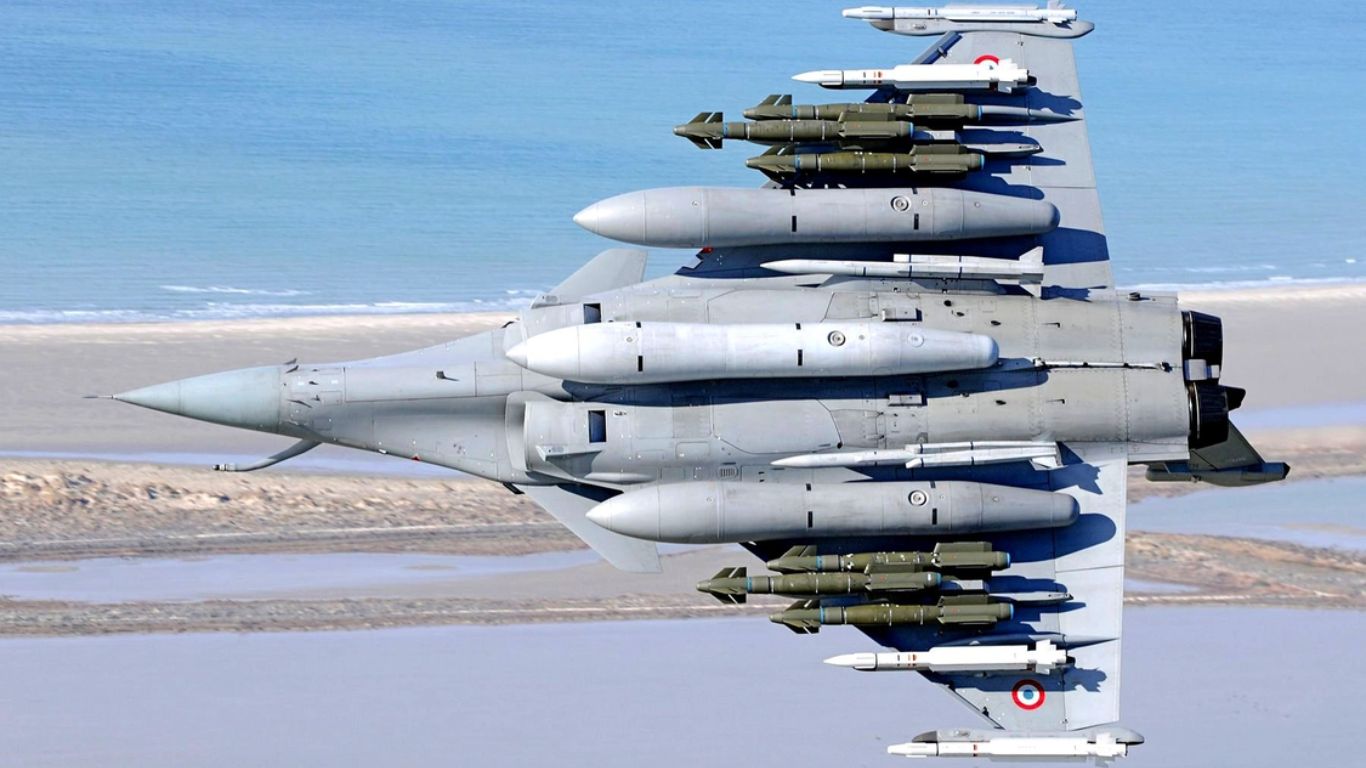
The most significant takeaway emerged from a short clip showing a Rafale fighter carrying an air-to-air weapon. Visual indicators strongly suggest that the aircraft was loaded with the Meteor beyond-visual-range (BVR) missile. The missile’s structure, the clearly visible air intake and its placement on the fuselage hardpoint align closely with the known design of the Meteor. Rafale typically carries the Meteor on this central hardpoint, whereas the MICA missile differs noticeably in shape and configuration.
This sighting challenges a long-running debate that questioned whether India actually possesses Meteor missiles or whether they have been fully integrated on Indian Rafales. While it is true that the Meteor has never been publicly displayed on Indian Rafales during air shows or official exhibitions in India, Indian Rafales armed with the missile have been photographed earlier in France. In addition, multiple reports and procurement-related disclosures over time have pointed to the existence of the Meteor in India’s inventory.
However, the obvious question remains: why was the Meteor not used during Operation Sindoor? No official operational details are available, but several plausible explanations exist. During repeated briefings, the Indian Air Force clearly stated that the operation did not aim to engage military targets. The focus remained strictly on pre-identified objectives, which also explains why SEAD and DEAD missions were not conducted.
Moreover, available information suggests that when Indian aircraft launched their weapons, they encountered no direct aerial resistance from the Pakistani side. This indicates that the mission progressed as planned up to the weapon-release phase. Reports of debris linked to Pakistani PL-15 air-to-air missiles and surface-to-air missiles suggest that launches may have occurred later, possibly when Indian aircraft were already disengaging and returning. This assessment, however, remains a hypothesis based on limited observable facts.
Defence analysts caution against the assumption that the Meteor went unused due to a lack of capability or integration. Air-to-air combat does not operate on simple logic where longer range automatically guarantees a kill. Mission objectives, tactics and the broader operational environment play decisive roles. Technologically, the Meteor remains superior to the PL-15 due to its ramjet propulsion, which allows the missile to sustain energy throughout its flight and deliver strong end-game performance. Notably, India is incorporating similar technology into its indigenous Astra missile variants.
Another important detail from the flypast involved a Rafale bearing the serial number BS022. This aircraft holds significance because Pakistan previously claimed it had shot down four Rafales and even circulated specific serial numbers. One such claim was amplified through an article written by a foreign author, lending it international visibility. The Republic Day flypast, however, showed BS022 flying normally.
Significantly, the Indian Air Force did not highlight this fact through any official statement. Instead, the detail emerged through independent visual analysis. This approach aligns with the IAF’s long-standing practice of not responding to every claim or piece of misinformation. In many cases, ambiguity itself serves as a strategic advantage. If an adversary believes it has downed Rafales or assumes India lacks Meteor missiles, that miscalculation could prove costly in a future conflict.
This confidence is also reflected in India’s continued push to acquire additional Rafale aircraft, including the naval variant for the Indian Navy. Such decisions indicate broad satisfaction with the platform’s performance. That said, the aircraft is not without shortcomings. Two issues remain particularly critical: the integration of Indian weapons and the integration of Indian data links with other IAF platforms, capabilities that were absent in the initial batch of 36 Rafales and are now being treated as non-negotiable requirements.
Some gaps have already been addressed, though not always on time. For instance, Dassault integrated the X-Guard system on the Rafale, but the required components from Israel were not delivered in time. Had these systems been available during Operation Sindoor, the aircraft’s effectiveness could have increased further.
Claims about poor Rafale availability rates also lack documentary support. On the contrary, reports suggest availability levels of around 90 percent, a figure echoed by both the Hellenic Air Force and the French Air and Space Force after the introduction of performance-based logistics.
Ultimately, discussions around combat aircraft and missile systems demand a fact-based approach. Creating negative perceptions without evidence is as flawed as ignoring genuine shortcomings. The Republic Day flypast underscored a clear message: the Indian Air Force remains focused on its mission, and it understands how to use strategic silence as a force multiplier.