
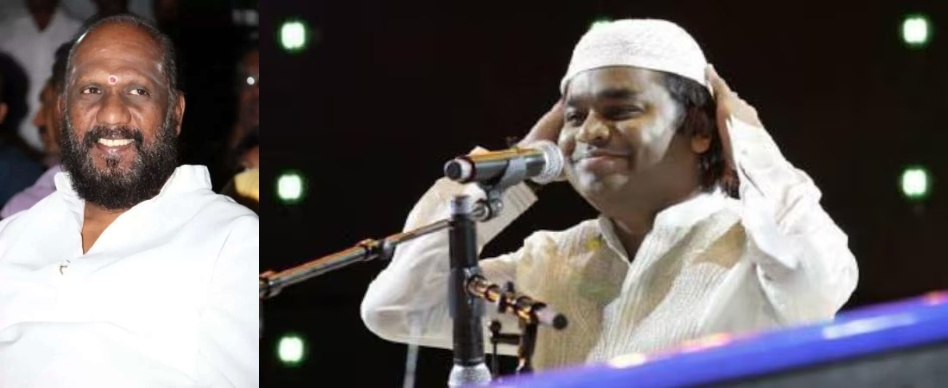
An incident shared by legendary Tamil poet and lyricist Piraisoodan about his interaction with A R Rahman and Rahman’s mother has sparked deep reflection on the relationship between religion, cultural identity, and basic human courtesy. The episode is not merely about a personal slight or an awkward meeting. It raises larger questions about how faith shapes behavior, how cultural values are transmitted or lost, and why traditions such as respect for guests hold enduring importance in Indian society.
According to Piraisoodan, A R Rahman once expressed great admiration for his work. Rahman reportedly spoke warmly about their earlier collaborations and conveyed his desire to work together again. As part of this renewed interest, Rahman invited Piraisoodan to his home to discuss ideas for a new song. For any poet, especially one of Piraisoodan’s stature, such an invitation would have seemed both natural and respectful, rooted in mutual appreciation and professional camaraderie.
What followed, however, left a lasting scar. When Piraisoodan arrived at Rahman’s residence, he was stopped at the door by Rahman’s mother. Instead of welcoming him inside, she allegedly asked him to remove the Vibuthi and Kumkum Tilak from his forehead. Only if he complied, she said, would he be allowed to enter the house. For Piraisoodan, this was not a small or negotiable request. The Tilak was not a fashion accessory but a marker of faith and identity, worn with dignity and conviction.
Piraisoodan refused to remove the Tilak. His refusal was not confrontational but principled. In that moment, the issue transcended personal pride and became about self respect. What made the incident even more painful was that A R Rahman reportedly witnessed the exchange and chose to remain silent. For Piraisoodan, the silence was as hurtful as the demand itself. Being invited to someone’s home and then humiliated at the threshold for one’s religious identity struck him as a profound insult.
In Indian culture, the idea of hospitality is deeply ingrained. The ancient maxim Atithi Devo Bhava, which means the guest is akin to God, is not a mere slogan but a moral code. It teaches that a guest should be welcomed with respect regardless of differences in belief or background. By this standard, asking a guest to erase visible signs of his faith before granting entry is seen by many as a violation not only of courtesy but of civilizational values.
The incident against Piraisoodan has also drawn attention to the personal history of Rahman’s family. Rahman’s mother was born a Hindu named Kasturi Shekhar and later converted to Islam, taking the name Kareema Beegum. A R Rahman himself was born as Dileep Kumar before embracing Islam. Conversion, in itself, is a personal choice and a right. However, critics of the incident argue that the problem lies not in conversion but in the apparent abandonment of cultural ethics that once emphasized mutual respect and accommodation.
For many observers, the episode illustrates a broader concern. Religion is not only a matter of belief in the divine but also a carrier of cultural norms, social etiquette, and moral frameworks. When a religion changes, especially across civilizational traditions, cultural practices often change with it. If the transition is not accompanied by a conscious effort to preserve universal values like respect for others, friction and intolerance can emerge.
This is why many argue that religion remains important even in a modern, secular society. It anchors individuals to a set of values passed down through generations. In the Indian context, Hindu traditions have long emphasized pluralism, coexistence, and reverence for diversity. Symbols like Vibuthi and Kumkum are not just ritual marks but expressions of an identity that has historically accommodated countless paths to the divine.
The Piraisoodan episode resonates because it reflects a fear shared by many. When religious identity becomes rigid and exclusionary, cultural grace erodes. The loss is not limited to one individual being insulted. It represents a breakdown of dialogue, empathy, and shared space. Asking someone to deny or hide who they are as a condition for basic interaction undermines the very idea of a harmonious society.
Ultimately, this incident serves as a cautionary tale. It reminds us that artistic greatness or global fame does not automatically translate into moral sensitivity. It also underscores that religion and culture are deeply intertwined. When one is discarded or replaced, the other often shifts as well. The challenge lies in ensuring that, regardless of faith, values like dignity, hospitality, and respect remain intact.
This story of Piraisoodan is not just about the past. It is a mirror held up to the present, urging society to reflect on how identity, belief, and culture intersect. In that reflection lies an uncomfortable but necessary question. If we lose the ability to welcome a guest without conditions, what part of our humanity have we truly abandoned.