
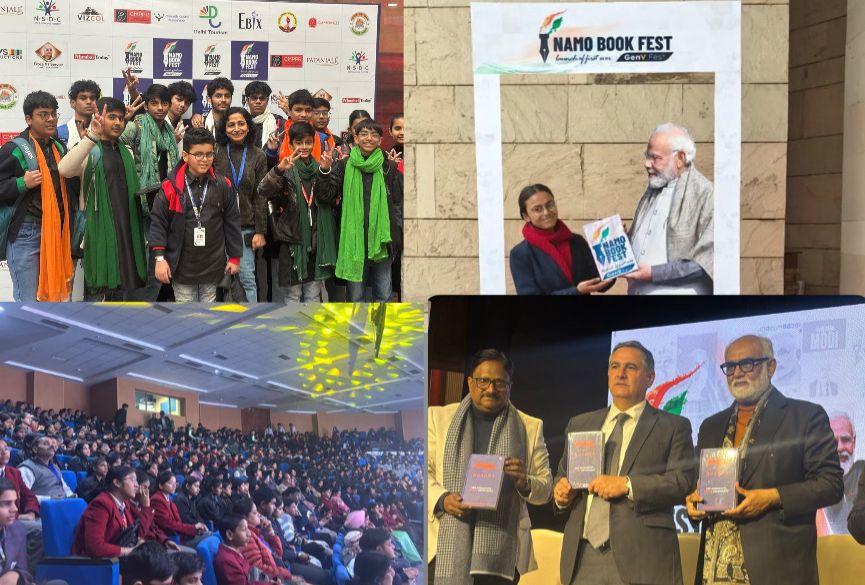
The second day of the NAMO Book Festival has been drawing enthusiastic participation from students across the country and highlighting the growing interest among youngsters in the vision of Viksit Bharat.
Organised by the Centre for Media Policy and Research (CMPR), the two-day festival is being held at the Ambedkar International Centre, New Delhi.
The event features more than 400 books based on the life, leadership, and policies of Prime Minister Narendra Modi, positioning itself as a major national platform highlighting his global intellectual footprint.
A key highlight of the ongoing festival is the unveiling of a special anthology written by school students from across India. The book brings together essays by young students on themes such as ‘Pariksha Pe Charcha’ and the vision of Viksit Bharat, reflecting the aspirations of young India.
Adding an international perspective, a book authored by Australian writer Salvatore Babones on Prime Minister Modi has also been unveiled during the festival.
The festival features multiple sessions with eminent thinkers and scholars from India and abroad, who are sharing their perspectives on Prime Minister Modi’s policies and governance approach.
Speakers include Sunil Deodhar, Vinay Sahasrabuddhe, Shehzad Poonawalla, and Gaurav Vallabh. The first day saw addresses by Union Minister Jitendra Singh, Ram Madhav, and Tuhin Sinha.
The strong turnout of students throughout the event underscores how the younger generation is engaging with Prime Minister Modi’s leadership and the vision of a developed India.
A Celebration of Ideas, Books and Youth Engagement
The NAMO Book Festival 2026, held alongside the GEN V Fest, opened on January 16 as a two-day celebration of ideas, books, and youth engagement in the national capital. The festival brought together authors, policymakers, diplomats, and thought leaders for a packed programme of discussions and book launches.
The event was inaugurated by Delhi Chief Minister Rekha Gupta along with cabinet minister Kapil Mishra, while the GEN V Fest was launched by Union Minister of State Jitendra Singh. Organisers said more than 40 prominent writers, political commentators, and scholars participated, with an expected footfall of over 10,000 visitors.
The first day featured thematic sessions examining Prime Minister Modi’s impact on culture, security, and diplomacy. A panel on “Modi & Cultural Renaissance” saw Acharya Pramod Krishnam, Francois Gautier, Sachchidanand Joshi, and Sadhvi Pragya Bharati in conversation with moderator Mouni Deepa.
National security was discussed by Aditya Raj Kaul, Anshul Saxena, and Major (retired) Gaurav Arya, while a high-profile diplomacy session brought together ambassadors Pankaj Saran and Ruchira Kamboj, Ram Madhav, and strategic affairs experts.
Day two focused on governance and economics through book releases and discussions, featuring speakers such as Maria Wirth, Salvatore Babones, Vinay Sahasrabuddhe, Gautam Chikermane, and Shashi Shekhar Vempati.
Youth-Centric Engagement and GEN V Vision
Alongside panel discussions, the festival hosted curated book exhibitions, student debates, and youth idea challenges, creating a vibrant space for dialogue on leadership, policy, and India’s evolving narrative. Over 450 books by and about the Prime Minister were displayed across 10 categories.
The launch witnessed participation from more than 800 students from over 30 colleges, along with engagement from over 200 schools.
A defining moment of Day 1 was the launch of the GEN V Festival, a concept that reimagines India’s Gen Z as Gen V—a generation aligned with the vision of Viksit Bharat. It was introduced through a short film.
“The idea positions young Indians as builders focused on nation-making and long-term contribution, rather than disruption alone,” an official said.
The festival, organised by the Council for Media and Public Policy Research (CMPPR) in collaboration with Niswarth Kadam and the Delhi Tourism Corporation, saw participation from over 30 authors and thinkers.
Youth engagement continued through focused interactions with national institutions. Shivkumar Kalyanaram, CEO of the Anusandhan National Research Foundation, spoke to students about the importance of scientific temper, research-led growth, and institutional discipline.
This was followed by a session on skills and employability by Arunkumar Pillai, CEO of the National Skill Development Corporation, who outlined India’s path to Net Zero by 2070.