
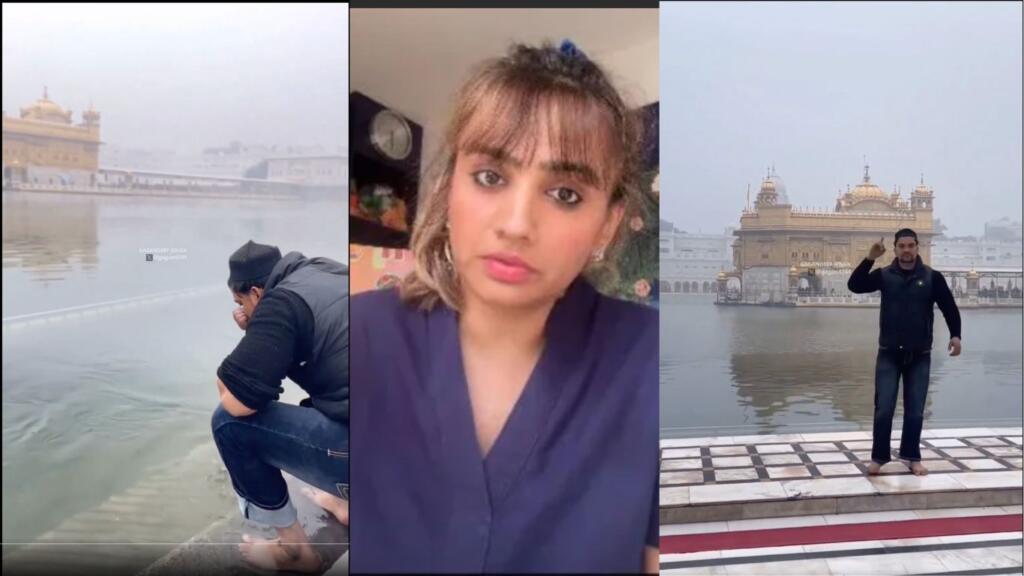
A recent video showing a Muslim man entering the Golden Temple premises wearing a skull cap, rinsing his mouth with Sarovar water, washing his hands and feet, and making the Tawhid sign has triggered a fresh debate on selective outrage and institutional silence. The individual later posted the video on Instagram with an Islamic victory song, drawing criticism from several quarters for violating the sanctity of the Sikh shrine.
However, despite the provocative nature of the act, the response from Sikh religious bodies, political leaders, and prominent influencers has remained largely muted. So far, there has been no public statement from the Shiromani Gurdwara Parbandhak Committee (SGPC), no police complaint, and no visible disciplinary action against staff responsible for maintaining religious protocol at the shrine.
Recently, a Muslim entered the Golden Temple premises wearing a skull cap, rinsed his mouth with Sarovar water, washed his hands and feet in it, and made the “Tawhid sign,” and posted the video on insta with an Islamic victory song.
Grave provocation by any standards, but… pic.twitter.com/88715sdgbT
— THE SKIN DOCTOR (@theskindoctor13) January 17, 2026
This silence stands in sharp contrast to the events of 2024. At that time, a Hindu girl performed yoga inside the Golden Temple complex. The SGPC swiftly wrote to the Police Commissioner, following which authorities registered an FIR. Officials suspended employees, imposed fines, and issued strong statements to the media. Moreover, the incident triggered widespread outrage online, accompanied by targeted attacks and threats against the girl.
Also Read: Sholingur Temple Vellore, Timings, History and Travel Guide
Observers now question why similar standards did not apply in the latest case. Critics argue that religious institutions appear hesitant to act when the offender belongs to a particular community, mainly Muslim, even when the act involves clear religious transgression. As a result, they say, the principle of equality before religious law gets compromised.
Meanwhile, commentators have also flagged a broader pattern. In recent years, similar symbolic acts by Islamist individuals have surfaced at temples and other non-Islamic religious sites. Yet, authorities often downplay or ignore these incidents, allegedly to avoid controversy.
As debates grow louder, many now demand clarity and consistency. They argue that respect for religious spaces must remain non-negotiable, regardless of identity. Without uniform enforcement, they warn, silence itself risks becoming a message—and not a neutral one.