
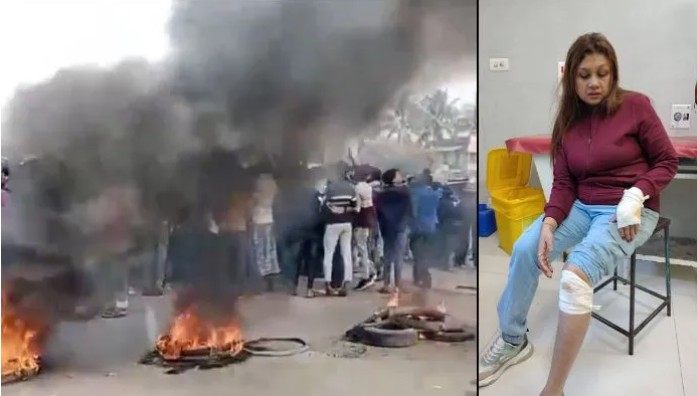
Beldanga town in West Bengal’s Murshidabad district witnessed fresh unrest over two days following protests linked to the deaths and alleged assault of migrant workers. The violence saw arson, stone pelting, attacks on journalists, disruption of rail and road traffic, and damage to public and private property.
On Friday (January 16), a large mob blocked National Highway-12 in Beldanga for nearly six hours following the death of a migrant worker, Alauddin Seikh (34), a local resident who had travelled to Daltonganj in Jharkhand to work as a hawker around ten days earlier. His body was found hanging in his rented room on Thursday.
According to allegations, Seikh had spoken to his mother before his death and expressed concerns over a “Hindu-Muslim divide”. After his body was brought back to Beldanga, protesters placed it on NH-12, bringing traffic to a complete standstill. Several trains on the Sealdah–Lalgola route were also halted.
As the crowd swelled, protesters allegedly burnt tyres, pelted stones, and stopped private buses, trucks and SUVs on both sides of the highway.
Assault on Journalists while on Coverage
Several reporters and photojournalists were assaulted while covering the protest. Among them was Zee 24 Ghanta journalist Soma Maiti, who was attacked in full public view.
She was allegedly punched, kicked and sexually assaulted on the road, and chased when she tried to escape and is currently undergoing treatment at a nearby hospital.
Speaking about the incident, Maiti said, “I went to work there, but the way I was beaten cannot be expressed in words. In all these years of my journalism, I never had such a disturbing experience. 2 people grabbed my legs, one was pulling my hair while another was pulling my clothes.”
The attacks took place despite a significant police presence. Initially, no arrests were reported, though police later said the main accused, Matiur Rahman, who allegedly instigated the violence, had been arrested. Three others were also taken into custody in connection with the assault on the journalist.
Police statements on Friday described the crowd as “co-operative” and “not aggressive”. SP (Murshidabad) Kumar Sani Raj initially stated that there were no injuries.
He expressed regret over the attacks on journalists and said, “I would humbly request media persons to exercise caution while covering volatile situations and ensure their own safety.”
He further advised journalists to be wary of public sentiment and avoid “provoking the mob”, adding, “Any loose statement by you can make someone take it in a negative direction. Remember, the mob has no direction.”
Fresh Violence over Assault of Another Migrant
Unrest resurfaced on Saturday (January 17) near Barua crossing in Beldanga, following allegations that another migrant worker, Anisur Rahman, had been assaulted in Bihar.
Rahman reportedly returned home from Majhyampur with injuries and claimed, “A group of people kicked me, beat me up with sticks after they checked my ID in Bihar on Friday.”
Protesters allegedly vandalised railway signalling equipment at Beldanga station and damaged a railway gate, forcing authorities to suspend train services between Krishnanagar and Lalgola. A large contingent of the Railway Protection Force (RPF) was deployed.
Police said the violence appeared pre-planned and involved the same accused, including Matiur Rahman. “From uprooting railway signal posts to attacking government buses, there was a conspiracy to spread chaos in every instance,” police said.
A government bus was vandalised and stone pelting injured five passengers. Police resorted to tear gas and lathi-charge to restore order within 30–35 minutes. Around 30 people were arrested from the spot.
The Chief Electoral Officer of West Bengal, Manoj Agarwal, has sought a report on the incidents.
Political Reactions and Allegations
BJP leader Suvendu Adhikari shared videos of the unrest and alleged that Hindu homes and businesses were targeted during the violence. He said,
“This is no spontaneous outrage, it’s a calculated replay of the horrific violence that engulfed Murshidabad during the Anti-CAA and Anti-Waqf Amendment Act protests…”
He accused the police of inaction and demanded an NIA probe into the incidents. Earlier, he had written to Governor CV Ananda Bose seeking prohibitory orders in the district, stating,
“Over the last 48 hours, rioters have unleashed terror, vandalizing properties and even assaulting Journalists of Zee 24 Ghanta and ABP Ananda who were simply reporting the truth. This is a direct assault on Democracy and the Rule of Law.”
Trinamool Congress leader Abhishek Banerjee, however, alleged that the violence in Murshidabad was politically motivated and blamed the BJP and a “gaddar” for instigating unrest.
Meanwhile, the state government announced Rs 2 lakh compensation for the family of Alauddin Seikh and a government job for his wife.
Murshidabad’s Recent History of Communal Unrest
Murshidabad, particularly Beldanga, has witnessed repeated episodes of violence in recent months. In November 2024, clashes erupted during Kartik Puja celebrations following allegations of blasphemy, leading to arson and stone pelting. BJP leaders had then raised concerns over attacks on Hindu homes and businesses.
Earlier last year in April, Murshidabad district witnessed large-scale violence during protests against the newly enacted Waqf Amendment Act. The unrest, concentrated in the Suti and Samserganj areas, escalated after Friday prayers and involved vandalism, arson and targeted attacks on members of the Hindu community.
According to reports, shops and homes were damaged as protests turned violent. A sweet shop owned by a Hindu couple was vandalised and looted.
There were also reports of attacks on Hindu temples and idol desecration. In a video aired by Republic Bangla, Trinamool Congress MP Khalilur Rahaman admitted that a temple had been vandalised in the Jangipur area.
India Today reported that several homes belonging to Hindu families were targeted during the violence. “Several houses of Hindu families in the minority-dominated district were targeted and shops were attacked,” the report said.
The violence also engulfed emergency services. “The protesters didn’t even spare an ambulance that got caught in the violence and set it ablaze. The driver of the ambulance was brutally thrashed before the vehicle was set on fire,” the report further stated.
The situation deteriorated to such an extent that thousands of Hindu families were reportedly forced to flee Murshidabad, with many crossing the river by boat to take shelter in neighbouring Malda district.