
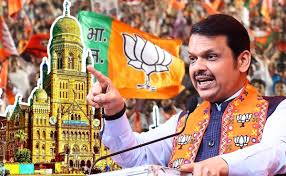
The results of Maharashtra’s municipal corporation elections mark more than a routine electoral victory for the BJP . With the BJP and its allies securing control in 23 out of 27 municipal corporations, the verdict signals a deeper political realignment across urban Maharashtra. What was once considered a fragmented and unpredictable urban electorate has, over the past decade, steadily moved towards a clearer ideological preference which rooted in Hindutva combined with governance and development.
Nowhere is this shift more visible, or more politically symbolic, than in Mumbai.
For nearly three decades, Mumbai functioned as the unchallenged power base of the Thackeray family. Control over the Brihanmumbai Municipal Corporation was not merely administrative; it was political capital of the highest order. The BMC’s enormous annual budget turned Matoshree into a parallel power centre, shaping not just city politics but the broader narrative of Maharashtra.
That era has effectively come to an end.
The electoral understanding between Uddhav Thackeray and Raj Thackeray, projected as a consolidation of Marathi sentiment, failed to resonate with voters. The rejection was not marginal; it was decisive. Mumbai’s electorate chose the BJP–Shiv Sena (Shinde faction) combine, signalling that political legacy without ideological clarity and governance credibility no longer commands loyalty.
At the heart of this transformation lies the dismantling of what was once Balasaheb Thackeray’s most powerful political construct. Balasaheb had successfully forged an enduring alliance between the Marathi Manus and Hindutva—an identity-based yet ideologically cohesive formula that dominated Mumbai’s politics for decades. That coalition turned the Shiv Sena into a force that transcended municipal politics and defined Maharashtra’s political culture.
The split in the Shiv Sena fundamentally altered that equation. The Marathi identity vote, long presumed to be inseparable from the Thackeray surname, largely migrated towards Eknath Shinde, who positioned himself as the inheritor of the original Sena’s organisational and emotional core. The Hindutva and saffron plank, meanwhile, was firmly occupied by the BJP, leaving no ideological vacuum to be exploited by the Thackeray brothers. Together, this alliance did not merely challenge Balasaheb’s legacy but it replaced its functional relevance in contemporary politics.
Uddhav Thackeray’s political decline cannot be explained solely by organisational splits. His decision to abandon the BJP after two-and-a-half years in power and align with the Congress and the NCP was widely perceived as an act driven by expediency rather than conviction. In doing so, he diluted the ideological clarity that once defined the Shiv Sena. The shift away from Balasaheb’s Hindutva line towards a politics of accommodation and appeasement alienated the party’s traditional voter base, particularly in Mumbai’s middle-class and Marathi neighbourhoods. The municipal verdict suggests that voters viewed this departure not as pragmatism, but as political drift.
Raj Thackeray’s campaign followed a different trajectory but met a similar fate. His attempt to revive aggressive Marathi asmita politics, often marked by confrontations with non-Marathi speakers, particularly North Indians—failed to find acceptance in an increasingly aspirational and economically mobile Mumbai. The city’s voters, it appears, have little patience for identity politics that offers neither governance nor economic opportunity. The rejection of this confrontational regionalism underscores a broader shift in urban political priorities.
Beyond Mumbai: A Statewide Pattern
The trends visible in Mumbai were echoed elsewhere. In Pune, the much-discussed political alignment between Sharad Pawar and Ajit Pawar also failed to arrest the BJP’s rise. Despite their combined experience and influence, the NCP factions were unable to offer a coherent political alternative. The BJP emerged stronger not merely because of organisational strength, but because it projected a clearer political narrative at a time when opposition alliances appeared transactional and confused.
The BJP’s municipal success was reinforced by the leadership of Devendra Fadnavis, whose campaign consistently linked Hindutva with development. At the national level, the leadership of Narendra Modi, the ideological backing of the Sangh, and the sharper political messaging articulated by leaders like Yogi Adityanath contributed to consolidating the BJP–Shiv Sena (Shinde) vote base across urban Maharashtra.
Fragmentation of the Minority Vote and Congress’s Dilemma
Another noteworthy development has been the performance of AIMIM in Muslim-dominated wards. The steady rise of Asaduddin Owaisi as a credible political choice for Muslim voters poses a long-term challenge to the Congress. As AIMIM expands its footprint beyond its traditional strongholds, it risks fragmenting the opposition vote further—a reality the Congress can ill afford to ignore.
Mumbai’s verdict, however, comes with its own set of expectations. The city’s chronic problems—corruption, infrastructure delays, and governance inefficiencies, persist despite the BMC’s massive financial resources. Having broken a decades-old political monopoly, the BJP now faces the responsibility of delivering measurable change. Ending corruption and restoring administrative credibility in India’s financial capital will be the true test of its urban governance model.