
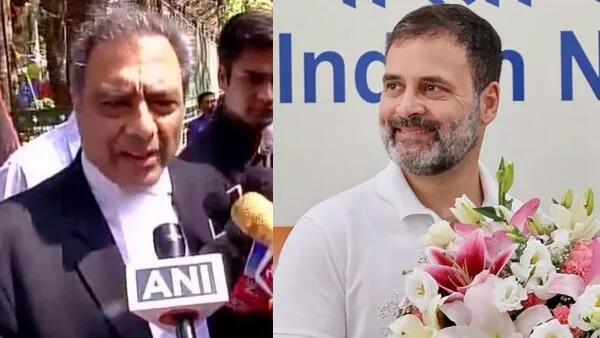
Senior advocate and Bharatiya Janata Party Member of Parliament Mahesh Jethmalani recently launched a sharp critique of Congress leader Rahul Gandhi, using social media to challenge what he described as a misleading and damaging narrative about India’s economy. His comment was aimed squarely at Rahul Gandhi’s repeated assertion that India is now a “dead economy,” a phrase that has drawn strong reactions from government leaders, economists, and constitutional experts alike.
Jethmalani’s post was short but pointed. With clear sarcasm, he remarked that someone should urgently inform the International Monetary Fund that India is supposedly a dead economy. The reference was not incidental. By invoking the IMF, Mahesh Jethmalani was underlining the gap between Rahul Gandhi’s political rhetoric and the assessments of global financial institutions, which continue to project India as one of the fastest growing major economies in the world.
Rahul Gandhi has repeatedly used the phrase “dead economy” in speeches and social media posts to criticise the Narendra Modi government’s economic policies. According to Gandhi, decisions such as demonetisation, the introduction of the Goods and Services Tax, and what he calls policy mismanagement have destroyed small businesses, employment, and consumer confidence. These claims have been central to the Congress party’s political attack on the ruling BJP, especially during election campaigns and parliamentary debates.
Jethmalani’s response fits into a broader pushback from the BJP and its supporters against this narrative. As a senior lawyer and parliamentarian, Mahesh Jethmalani brings a legal and constitutional tone to the debate, arguing that such sweeping statements harm India’s credibility at a time when the country is actively seeking global investment and strategic partnerships. His sarcasm was intended to expose what he sees as the disconnect between facts and political messaging.
Supporters of Jethmalani’s position point to international data to counter Rahul Gandhi’s claims. Institutions such as the IMF and the World Bank have consistently ranked India among the world’s top growth performers. Even during periods of global slowdown, India has maintained growth rates significantly higher than those of most developed economies. For critics of Rahul Gandhi, calling such an economy “dead” is not merely inaccurate but irresponsible.
The BJP has frequently accused the Congress leadership of undermining national interest for political gain. Jethmalani’s post reflects this sentiment. By framing Rahul Gandhi’s comment as something that would surprise the IMF, he implies that the Congress leader is either ignoring global economic assessments or deliberately misrepresenting them to suit his political narrative. This accusation has resonated strongly with BJP supporters on social media, where remark of Mahesh Jethmalani was widely shared.
At the same time, Rahul Gandhi’s defenders argue that his criticism is not about headline GDP growth alone but about lived economic realities. They point to unemployment concerns, inflation pressures, and the struggles of small traders and farmers as evidence that growth numbers do not tell the whole story. From this perspective, Gandhi’s “dead economy” phrase is intended as political hyperbole to draw attention to structural problems rather than a literal economic diagnosis.
However, figures like Mahesh Jethmalani reject this defence. They argue that political leaders must exercise responsibility in their language, especially when speaking about the nation’s economy on international platforms. According to this view, exaggeration can damage investor confidence, weaken India’s negotiating position globally, and provide ammunition to hostile foreign narratives. Jethmalani’s legal background adds weight to this argument, as he often frames political speech in terms of its broader constitutional and national consequences.
The exchange also highlights the increasingly sharp tone of economic debate in Indian politics. Rather than nuanced discussions about reform and redistribution, slogans and labels have taken centre stage. Intervention of Mahesh Jethmalani was meant to puncture one such slogan by confronting it with external validation from respected global institutions. His use of irony was deliberate, aiming to ridicule what he sees as an unserious and factually weak claim.
Beyond the immediate political clash, the episode reveals how economic discourse has become a proxy battlefield between the BJP and the Congress. For the BJP, India’s growth story is a key achievement of the Modi years and a symbol of national resurgence. For Rahul Gandhi, attacking the economy is a way to question the government’s competence and priorities. Jethmalani’s tweet represents the BJP’s broader attempt to delegitimise this line of attack by framing it as disconnected from reality.
Ultimately, Mahesh Jethmalani’s criticism of Rahul Gandhi is not just about one phrase or one tweet. It is about competing visions of how India should be portrayed to its own citizens and to the world. While Rahul Gandhi emphasises economic distress and inequality, Mahesh Jethmalani insists that facts, global data, and institutional assessments matter. The clash underscores a fundamental divide in Indian politics between narrative driven critique and data driven defence, a divide that is likely to deepen as economic debates remain central to the country’s political future.