
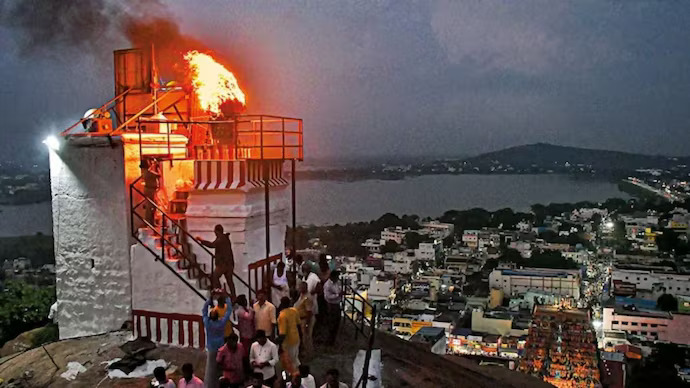
The Madras High Court Madurai Bench delivered a landmark verdict on Tuesday, January 6, 2026, upholding a single judge’s directive to light a lamp at a stone pillar atop the Thiruparakundram hills in Tamil Nadu. This ancient site, revered by Hindus as a sacred rock pillar linked to Lord Muruga, sits adjacent to a prominent dargah dedicated to Islamic saint Hazrat Nathar Shah. The ruling reinforces Hindu claims to the pillar’s religious significance while navigating communal sensitivities in a region rich with shared sacred spaces.
The dispute traces back years, rooted in the hill’s layered history. Thiruparakundram, one of the six abodes of Lord Muruga in Tamil Nadu, draws pilgrims for its rock-cut temple at the base. The hilltop pillar, known locally as “Kottai Malai Kallu” or fort rock stone, features carvings some devotees interpret as Shaivite symbols. Hindu groups argued that a traditional evening lamp-lighting ritual (deeparadhana) had been discontinued, allegedly due to objections from dargah caretakers. They approached the court seeking revival of this practice, claiming it as an age-old custom essential to their worship.
A single judge of the Madras High Court, in an earlier order, sided with the petitioners. The judge directed local authorities to facilitate the lamp-lighting, emphasizing that the pillar’s Hindu character warranted such rituals without encroaching on the neighboring dargah. Dargah management appealed, contending the activity could inflame tensions and disrupt the site’s syncretic harmony. They highlighted the hill’s use by both communities for centuries, warning of potential law-and-order issues.
The Division Bench at Madras High Court, comprising Justices GR Swaminathan and PB Balaji, dismissed the appeal with costs. Delivering the judgment, Justice Swaminathan observed that the pillar’s location outside the dargah precincts left ample space for Hindu rituals. “The right to worship at one’s sacred site cannot be denied merely on apprehensions,” the bench noted, directing police to ensure peaceful conduct. The court imposed conditions: no loudspeakers, no processions, and strict adherence to timings from 6 PM to 6:30 PM daily. This balanced approach underscores judicial pragmatism in faith-based conflicts.
The verdict of Madras High Court resonates deeply in Tamil Nadu’s socio-religious landscape. The state, under DMK rule, has faced accusations of minority appeasement, particularly in managing temple-mosque overlaps. Similar disputes dot the region – from the Sanatan Dharma row in Madurai to encroachments at Palani temple hills. Hindu outfits like Hindu Munnani hailed the ruling as a victory for “temple rights,” with leader K Veera Pandian calling it a rebuke to “secular hypocrisy.” They plan celebrations, vowing to light the lamp that evening under police watch.
Critics, including some Muslim leaders, expressed dismay. Tamil Nadu Waqf Board chairman Abdul Rahman questioned if the order prioritized one faith over coexistence. “Thiruparakundram symbolizes unity; this could divide us,” he said, hinting at a potential Supreme Court appeal. Progressive voices urged dialogue, pointing to successful models like the shared management at Erwadi dargah nearby.
Historically, Thiruparakundram exemplifies India’s pluralistic heritage. The Murugan temple, dating to the 8th century, hosts weddings symbolizing Shiva-Parvati’s union. The hilltop dargah, attributed to 11th-century Sufi saint Syed Baba Nathar, attracts devotees for its healing powers. Legends intertwine: Nathar is said to have subdued a demon here, aligning with Muruga lore. Colonial records and pre-Independence photos show Hindus performing rituals at the pillar, lending credence to revival claims.
This case at Madras High Court mirrors national trends in religious site disputes. The Supreme Court’s Ayodhya verdict (2019) and Gyanvapi proceedings in Varanasi have emboldened claims over contested spaces. In Tamil Nadu, the HR&CE Department’s 2023 audits revealed over 1,000 temple-adjacent structures under Waqf boards, sparking litigation. Chief Minister MK Stalin’s government, balancing Dravidian secularism with electoral pressures, faces scrutiny. BJP Tamil Nadu chief K Annamalai praised the court, accusing DMK of delaying justice.
Legal experts view the ruling as procedurally sound. It invokes Article 25 of the Constitution, guaranteeing religious freedom subject to public order. Precedents like the 2021 Sabarimala review affirm courts’ role in protecting practices without majoritarian overreach. Justice Swaminathan, known for bold interventions in social justice cases, has previously ruled on temple entry for Dalits and anti-superstition measures.
As dusk fell on January 6, a small group of Hindu devotees ascended the 500-odd steps to the pillar, igniting the lamp amid chants of “Muruga Muruga.” Police presence ensured calm, with no reported incidents. Local residents watched warily, hoping for sustained peace.
The decision of Madras High Court sets a template for resolving syncretic disputes: affirm rights, enforce boundaries, prioritize amity. Yet challenges persist. Will it inspire copycat claims elsewhere? Can communities sustain dialogue? For now, the flickering lamp atop Thiruparakundram symbolizes not just devotion, but a judiciary committed to equitable faith.