
With the long-pending India–US trade deal once again in limbo, pulses, or dal have emerged as an unexpected flashpoint.
Two American senators recently wrote to President Donald Trump urging him to pressure India into rolling back what they described as “unfair” tariffs on US pulses.
Their concern extends beyond the tariff itself to the manner in which it was imposed—quietly and without public signalling.
In their January 16 letter, Senators Kevin Cramer of North Dakota and Steve Daines of Montana flagged that India imposed a 30 per cent import duty on US yellow peas on October 30, which came into effect on November 1.
The move, they argued, placed American farmers at a disadvantage in one of the world’s largest pulse markets.
“India announced on October 30 that it will impose 30 per cent tariff on yellow peas imported from the US. The tariff went into effect on November 1. As a result of the unfair Indian tariffs, US pulse crop producers face a significant competitive disadvantage when exporting their high-quality product to India,” the senators wrote.
The development largely escaped public attention in India, underscoring New Delhi’s careful balancing act amid strained trade ties with Washington. But outside India, the move is increasingly being interpreted as a quiet retaliation for the punitive tariffs imposed by the Trump administration last year.
“That means India did retaliate to US tariffs by raising tariffs on imported pulses to 30 per cent, which went into effect in October 2025,” author and geopolitical expert Navroop Singh tweeted.
The issue matters deeply to US agricultural states such as North Dakota and Montana, which are major producers of peas and pulses. India, meanwhile, is the world’s largest consumer of pulses, accounting for roughly 27 per cent of global consumption.
“The most commonly consumed pulse crops in India are lentils, chickpeas, dried beans and peas. Yet, they have levied substantial tariffs on American pulse crops,” the senators said.
This is not the first time the issue has surfaced. The senators noted that during Trump’s first term, they had raised similar concerns after India was removed from the Generalised System of Preferences in 2019.
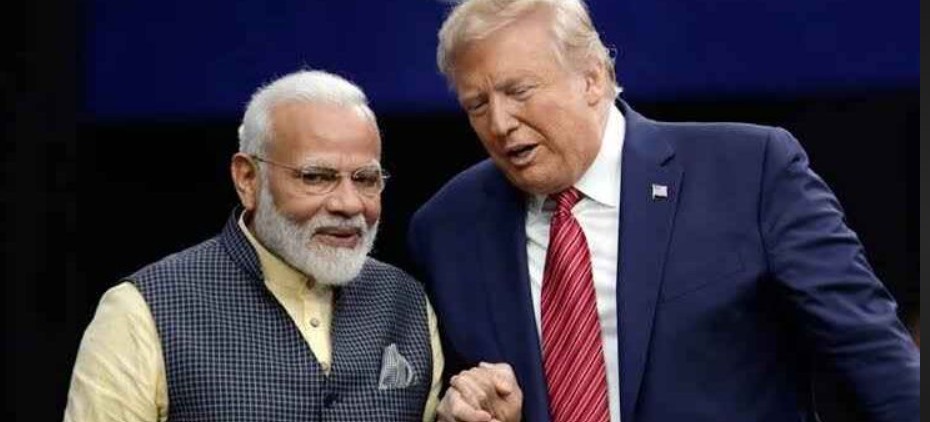
Trump had even “hand-delivered” their letter to Prime Minister Narendra Modi during the 2020 trade negotiations, a period marked by the optics-heavy “Namaste Trump” event in Ahmedabad.
Since then, India appears more prepared to draw firm red lines in its trade negotiations. A key sticking point in the trade talks remains Washington’s demand for wider access to India’s agricultural and dairy markets—sectors that are politically and economically sensitive.
“Indian farmers are a red line. If a trade deal demands opening India’s pulse market at the cost of domestic producers, there will be no trade deal,” an expert said.
India’s stance is hardly unusual. The UK and the European Union have both sought deeper agricultural access in their respective trade negotiations with India. In each case, New Delhi pushed back firmly, and those partners adjusted expectations, recognising India’s structural dependence on agriculture and the livelihoods it supports.
India is an agricultural economy. It is under no obligation to import what it does not need, or to destabilise domestic farmers to accommodate foreign political pressures.
Temporary duty waivers on certain pulses ahead of the 2024 Lok Sabha elections—aimed at curbing food inflation—were policy choices, not permanent concessions.
The development appears to have unsettled Washington not because of protectionism, but due to India’s refusal to negotiate on someone else’s terms.
Trump, it seems, lost the privilege of assuming automatic compliance—and this time, India did not feel the need to announce it.
Unlike the United States’ persistent pressure for broader access to India’s agricultural markets, other trading partners have engaged New Delhi in a markedly different way.
As per reports from AP News, India recently concluded a landmark free trade agreement with the United Kingdom after years of negotiations, under which more than 95% of farm and processed food tariff lines will enter the UK duty-free while still protecting sensitive sectors such as dairy and cereals, reflecting a calibrated approach that balanced market access with domestic safeguards.
Similarly, in talks with the European Union, New Delhi and Brussels have reportedly agreed on significant portions of a comprehensive trade pact, with sensitive items like dairy and rice deliberately excluded to address India’s food-security and farmer-livelihood concerns—an outcome the EU accepted as part of respectful bilateral negotiation.
By contrast, US officials have repeatedly pressed for deeper openings of India’s farm and dairy sectors as a precondition for a trade deal, even as Indian negotiators have maintained agriculture as a red line to protect millions of rural livelihoods, drawing criticism in New Delhi that Washington’s tactics amount to arm-twisting rather than mutual accommodation.