




















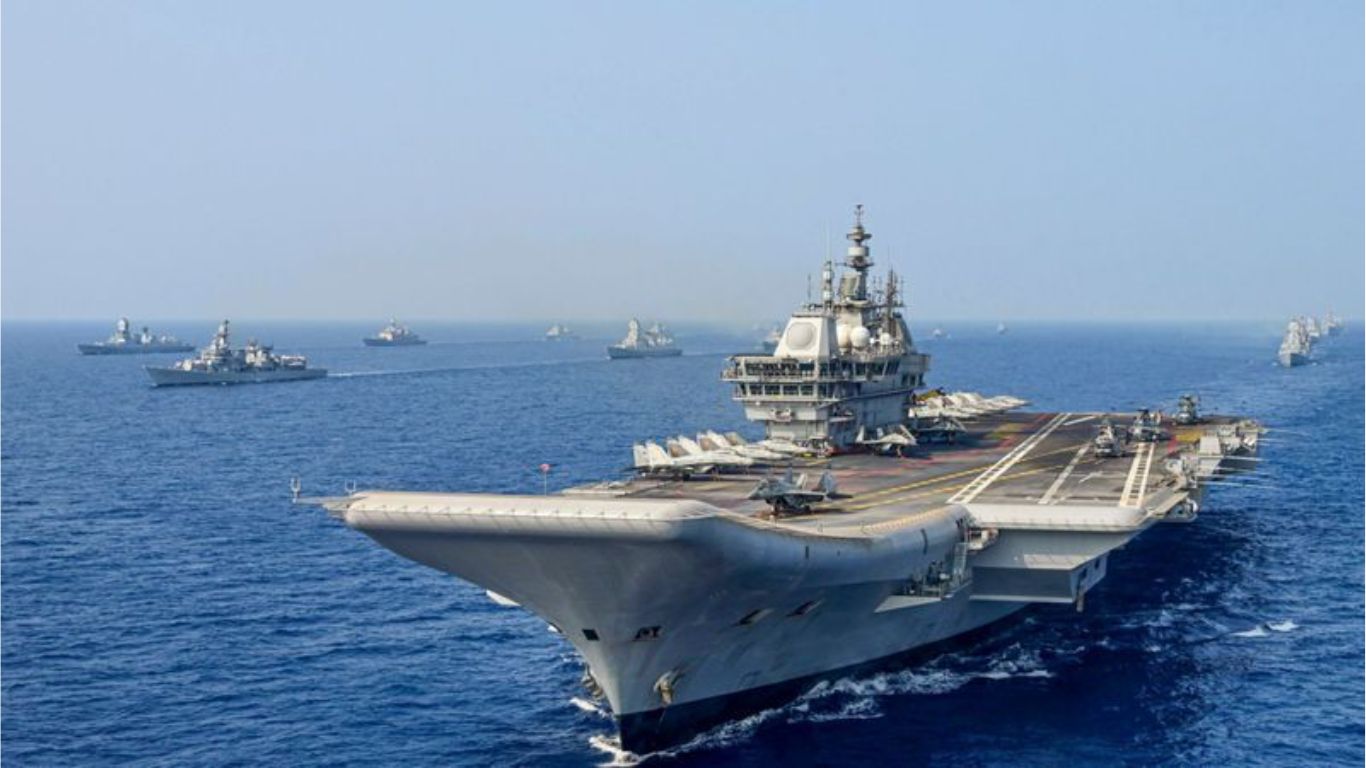
The Indian Navy is on course to commission 19 warships in 2026, marking the largest force accretion in a single year. By comparison, the Navy commissioned 14 vessels in 2025, including a submarine. This sharp rise reflects an unprecedented production tempo and highlights the growing maturity of India’s domestic shipbuilding ecosystem. According to official sources, 2026 will represent the peak year of naval expansion.
Drivers of Expansion and Strategic Context
To begin with, a major contributor to this expansion is the induction of additional Nilgiri-class multi-role stealth frigates. The lead ship entered service in January 2025. Subsequently, INS Himgiri and INS Udaygiri joined the fleet in August 2025. At least two more frigates from this class are expected to be commissioned in 2026.
In addition, the Navy will induct specialised platforms, including an Ikshak-class survey vessel and a Nistar-class diving support vessel. These ships will enhance undersea operations, hydrographic capability, and fleet sustainment.
Moreover, the record commissioning schedule stems from the adoption of integrated construction techniques. Shipyards now build vessels in 250-tonne modular blocks, covering the hull, superstructure, and internal systems. These blocks allow precise alignment of cables and pipelines during assembly. As a result, construction timelines have shortened significantly.
Furthermore, artificial intelligence and advanced design software now guide shipbuilding sequences, material sourcing, and production schedules. Software also predicts machinery layout, equipment placement, and fluid dynamics. Because of these innovations, Indian shipyards now deliver warships in six years, compared to the earlier eight to nine years. The Ministry of Defence initiated this shift toward integrated construction a decade ago, and the results are now visible.
The Navy is on a course to commission 19 warships in 2026, making it the biggest force accretion in a year. Last year, the Navy had commissioned 14 vessels, including a submarine.
Sources said the production tempo was unprecedented in history and demonstrated the maturity of the… pic.twitter.com/j5mB4DXXVa— idrw (@idrwalerts) January 7, 2026
Strategically, this expansion supports India’s goals in the Indo-Pacific. The Navy aims to counter China’s naval growth, safeguard freedom of navigation across critical sea lanes, strengthen cooperation with Quad and ASEAN partners, and project power across the region.
However, India’s expansion still trails China’s scale. Although Beijing does not release official figures, US estimates suggest that China’s navy reached 395 ships and submarines by the end of 2025, up from 370 the previous year. A May 2025 US Congressional report further projects China’s fleet to grow to 435 ships by 2030.
In conclusion, while India cannot match China numerically, the 2026 commissioning surge signals a decisive qualitative leap. It demonstrates industrial maturity, technological integration, and strategic intent. Most importantly, it marks a critical step toward a more capable and regionally influential Indian Navy.