

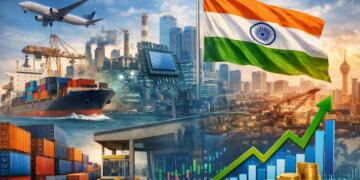




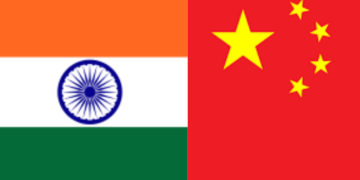

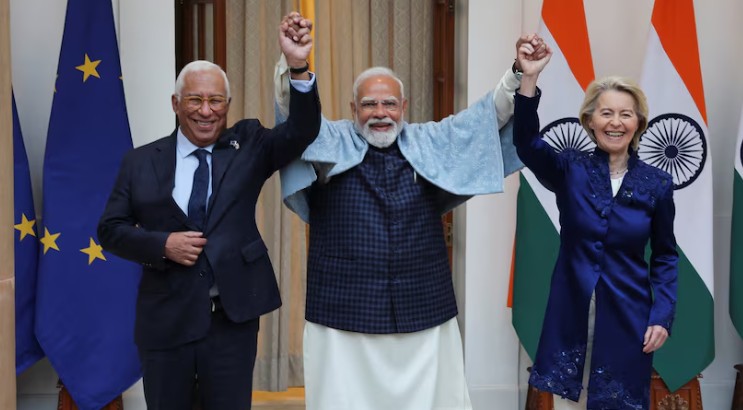
In a landmark development, India and the European Union on Tuesday finalised what is being called the “mother of all” trade deals.
The signing and exchange of the political declaration marking the conclusion of negotiations for the India-EU Free Trade Agreement took place in the presence of Prime Minister Narendra Modi, the President of the European Commission Ursula Von Der Leyen, and the President of the European Council António Luís Santos da Costa.
Taking to X (formerly Twitter), Ursula Von Der Leyen shared, “Europe and India are making history today. We have concluded the mother of all deals. We have created a free trade zone of two billion people, with both sides set to benefit. This is only the beginning. We will grow our strategic relationship to be even stronger.”
Prime Minister Modi, speaking virtually at Indian Energy Week, described the pact as a historic milestone, noting that India and the EU together account for about 25% of global GDP and nearly one-third of world trade.
“This is an excellent example of coordination between two economies of the world. This agreement represents 25 per cent of the global GDP and one third of the global trade. I am informing you about a big development…kal hee Bharat aur European Union ke beech ek bahut bada agreement hua hai (yesterday a very big agreement has been reached between India and the European Union),” PM Modi said.
India-EU FTA: What We Know So Far
The India-EU Free Trade Agreement (FTA) is expected to deliver extensive economic benefits. For Indian consumers, European cars, beer, and several food items are set to get cheaper. The EU has announced that tariffs on 96.6% of its goods exports to India will be removed or reduced, resulting in potential savings of up to 4 billion euros annually on European products.
The agreement also removes tariffs on EU exports such as fruit juices and processed foods, cuts duties on olive oil, margarine, and other vegetable oils, and lowers tariffs on spirits to 40%.
Additionally, the EU has pledged 500 million euros over the next two years to assist India in reducing greenhouse gas emissions, highlighting the deal’s economic and climate dimensions. Tariffs on 90% of European optical, medical, and surgical equipment will be removed, and almost all EU aircraft and spacecraft exports to India will also see duty elimination.
The deal also addresses machinery, chemicals, and pharmaceuticals, largely scrapping tariffs of up to 44%, 22%, and 11% respectively. The EU expects this to deepen market access and potentially double its exports to India by 2032. Bilateral trade in goods between India and the EU currently stands at roughly $136 billion.
India is likely to receive duty-free access for several key exports, including textiles, leather, and marine products, in exchange for offering tariff concessions in sectors such as automobiles, wines, and spirits.
The push to conclude the deal gained momentum amid reciprocal tariffs imposed by the US under former President Donald Trump, prompting both India and the EU to negotiate more decisively while accommodating sensitivities in areas like agriculture and dairy.
Commerce Secretary Rajesh Agrawal described the pact as “a balanced, forward-looking deal for better economic integration with the EU” and said it is expected to significantly boost trade and investment flows between the two sides. Negotiations for the agreement have been ongoing for over 18 years, with renewed momentum from 2024.
While the negotiations are complete, the agreement will take several months for ratification and is likely to come into force in early 2027. Both sides will work on producing a streamlined, finalised version of the text over the next fortnight, followed by legal scrutiny over the next five to six months.
The deal will move to the European Parliament for ratification. Officials clarified that approval from individual governments across the 27-member EU is not required, as the agreement does not fall under “mixed competence.”
As per TOI, European Commissioner for Trade and Economic Security Maroš Šefcovic highlighted the broader strategic objectives of the FTA, stating that it aims to secure full or partial tariff elimination on 97 to 99% of traded goods while considering sensitive sectors such as agriculture and dairy.
He noted that although India is a smaller market than the EU, it is rapidly expanding, with the automotive sector being particularly significant.
“We are looking at the way which would help us find solutions, create new supply chains and make an even better business case for European car makers, while opening new possibilities for cooperation,” Šefcovic said.
He further emphasized that the free trade agreement will strengthen supply chains, reduce exposure to risky dependencies, and generate employment in both India and the EU, reflecting a shared vision for long-term strategic and economic partnership.





