
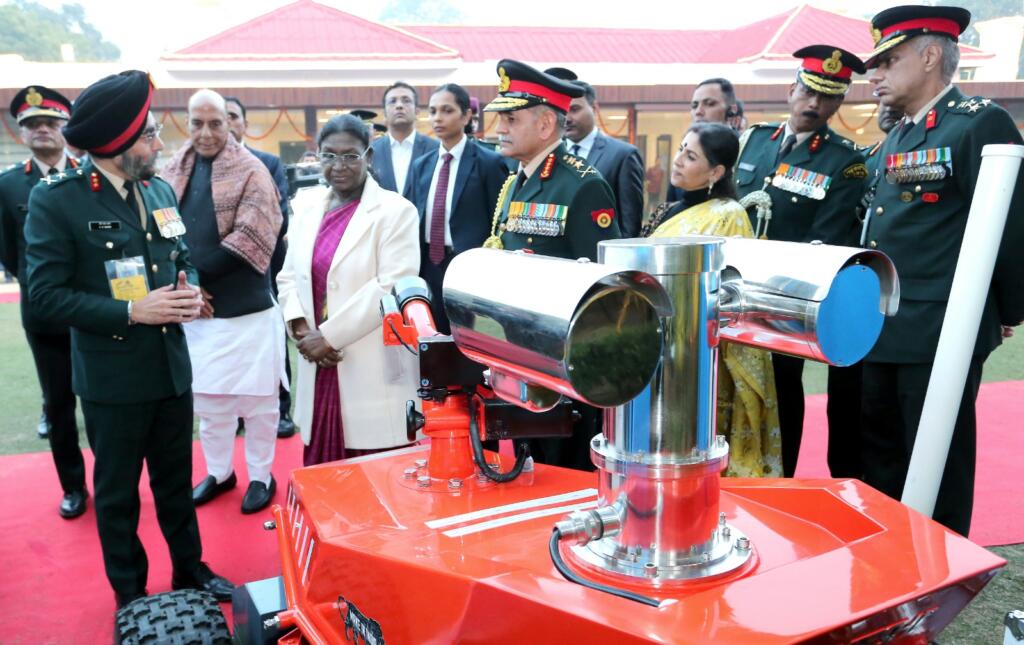
In a pioneering move that underscores deeper tri-Service integration and strengthens India’s indigenous defence innovation ecosystem, the Indian Army has signed a contract to procure an iDEX firefighting robot originally developed for the Indian Navy.
The move marks a historic cross-Service acquisition under the Innovations for Defence Excellence (iDEX) initiative and reinforces India’s commitment to Atmanirbhar Bharat in defence technology.

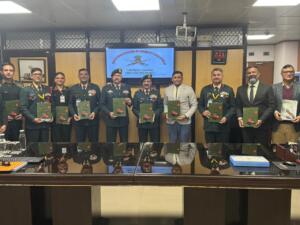
On January 13, the Army’s Directorate of Capability Development signed a Rs 62-crore contract with Ahmedabad-based defence start-up Swadeshi Empresa Pvt Ltd.
Under the agreement, the Army will procure 18 Fire Fighting Robots (FF BOTs), which will be deployed at ammunition depots and other high-risk installations across multiple cantonments. Induction of the systems is scheduled to begin in the first week of April.
What is the iDEX Firefighting Robot?
The iDEX firefighting robot is a compact unmanned ground vehicle designed for fire suppression and emergency response in environments where human entry is unsafe.

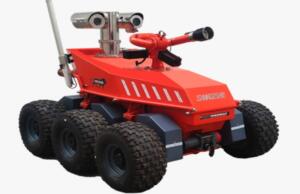
Equipped with advanced sensors, thermal cameras, remote navigation and integrated fire suppression systems, the robot is capable of operating in conditions involving extreme heat, toxic smoke, ammunition depot fires, fuel storage accidents and confined industrial spaces within military infrastructure.
Its remote operation allows firefighting teams to remain at a safe distance while the robot enters high-risk zones during the critical initial stages of a fire, significantly reducing danger to personnel.
iDEX Firefighting Robot Deal: Historic Cross-Service Acquisition
The defining feature of the deal is that the firefighting robot was originally developed for the Indian Navy under the iDEX framework and is now being inducted by the Army through the Single Stage Composite Trial (SSCT) mechanism. This marks the first instance of a system developed and tested for one Service being procured by another without undergoing a fresh cycle of development and trials.
Officials said the cross-Service adoption represents a significant step in inter-Service technology transfer, helping avoid duplication, reduce procurement timelines and accelerate the deployment of proven indigenous systems.
Strengthening Defence Start-up Ecosystem
The acquisition also highlights the expanding role of defence start-ups under the iDEX initiative, which was launched by the Ministry of Defence in 2018 to connect innovators with the armed forces.
With over Rs 1,500 crore allocated and more than 300 contracts facilitated so far, iDEX has emerged as a key driver of defence indigenisation.
Swadeshi Empresa Pvt Ltd represents a growing cohort of Indian defence innovators. Officials said the company successfully scaled the firefighting robot from a Naval platform to one suitable for Army use, demonstrating the adaptability and maturity of indigenous defence technologies developed through sustained trials and collaboration with defence agencies.
Traditionally, defence procurements involve prolonged, multi-stage evaluation processes. The Single Stage Composite Trial consolidates prototype demonstration, user trials and validation into a single streamlined phase, reducing acquisition timelines from years to months.
Officials said the use of SSCT not only accelerates capability induction but also encourages start-ups to innovate without being hindered by bureaucratic delays.
Strategic Importance for India’s Defence Posture
Fire incidents have historically posed serious risks to military assets and personnel in forward areas, workshops and storage depots.
With the induction of the FF BOTs, the Army is expected to significantly enhance its emergency response capability by improving firefighter safety, reducing response times during critical incidents and minimising the risk of human casualties at frontline and logistic installations.
At a strategic level, the procurement of an indigenous, Navy-tested system reduces dependence on foreign equipment, strengthens domestic industry and improves supply-chain resilience—key objectives under India’s Atmanirbhar Bharat vision.