
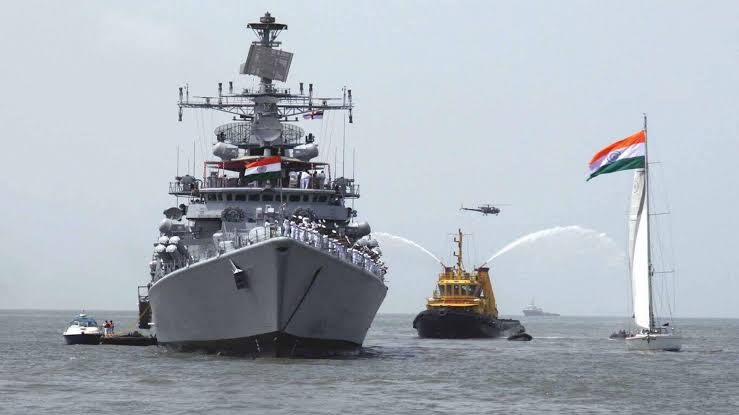
For decades, naval roles have traditionally been defined as military, policing and diplomatic. Moving beyond conventional diplomacy, the Indian Navy has embraced the role of a ‘First Responder.’
This role was tested to its limit in early 2025, when a catastrophic cyclone struck Sri Lanka in December, the response wasn’t measured in days of diplomatic deliberation.
However, in hours of operational grit, under Operation Sagar Bandhu, the ship INS Gharial was underway within hours. It carried with it over 1000 tonnes of life-saving supplies.
This speed isn’t just a logistical achievement. It is in fact a diplomatic statement. It tells every neighbour that in their darkest hour, India’s presence is a promise of stability and not a threat of dominance.
The concept of “Preferred Security Partnership” represents a strategic shift in naval diplomacy. It redefines India’s role in the Indian Ocean.
Historically, security arrangements in the region were often characterised by a “patron-client” relationship–the larger nations provided security in exchange for influence, creating a power imbalance that could alienate smaller countries. The term “Preferred Security Partner” flips this dynamic.
Instead of imposing control, India now focuses on building capacity and offering support as a peer. This new approach emphasises partnership and mutual respect, with India helping its neighbours strengthen their own security capabilities.
When New Delhi gifts the INS Kirpan to Vietnam or sends Fast Interceptor Crafts to Mozambique, it isn’t just handing over ships, it is empowering those nations to secure their own futures. It is the difference between giving a man a fish and helping him build a fleet.
The year 2025 serves as a masterclass in this multi-layered engagement. While one arm of the Navy was delivering aid in and in Myanmar under operation Brahma, another was engaging in high-stakes, omnidirectional diplomacy.
In March, the French Carrier Strike Group and the Indian Navy conducted Exercise Varuna off the coast of Goa, practicing complex anti-submarine drills.
Almost simultaneously, the fleet was working with the Russian Federation in Exercise INDRA and preparing for MILAN 2024, a massive gathering of 50 nations in Visakhapatnam.
This ability to operate at the highest levels of technical sophistication with competing global powers shows that a Navy that is comfortable in its own skin and also capable of speaking every strategic language on the planet.
But perhaps the most compelling part of this story happens in the small, unscripted moments that never make the evening news.
In April 2025, the INS Trikand was patrolling the coast of Oman when a distress call came from an Iranian dhow. A Pakistani sailor had suffered a horrific fracture that likely would have led to an amputation.
The Navy’s medical team performed a three-hour surgery in the middle of the ocean, saving the man’s hand. Earlier that year, the INS Kirch provided fuel to a Malaysian vessel with a Chinese crew. On the high seas, the Indian Navy operates on a frequency of maritime chivalry that transcends the borders of the land.
Ultimately, this entire strategy is anchored in the vision of SAGAR—Security and Growth for All in the Region. It is a recognition that the Indian Ocean is a shared home.
By conducting hydrographic surveys for smaller neighbours and commissioning projects like the Maritime Rescue Coordination Centre in Sri Lanka, India is weaving a safety net that benefits everyone. Even as it manages the growing competition with China, the Navy’s focus remains on being a stabilising force.
It is showing the world that true power isn’t just about the ability to project force; it’s about the willingness to be the first to arrive when things go wrong and the most reliable partner when things go right.