













As the 2026 FIFA World Cup approaches, a sense of fear is looming over football fans, both domestic and international. The tournament, set to be hosted across the United States, Mexico, and Canada, promises to be the largest in history, featuring 48 teams and 104 matches, drawing more than 7 million spectators.
Yet, behind the excitement of the games, there is growing apprehension about safety, security, and the political climate in the United States. This fear is rooted in recent events that have unsettled many.
The killing of Renee Good by an Immigration and Customs Enforcement (ICE) agent during a migration operation in north Minneapolis has sparked outrage and anxiety across communities.
It is emblematic of a broader climate of tension surrounding US immigration policy. The Trump administration’s strict anti-immigrant stance, including a travel ban affecting 19 countries—two of which, Haiti and Iran, have teams participating in the tournament—has intensified concerns that foreign visitors might not be welcome.
As the World Cup and the Olympics are both set to predominantly take place in the US this summer, international fans and Americans alike are calling for a complete boycott of the events.
One of the most striking responses came from Mohamad Safa, a Lebanese diplomat and executive director of PVA Patriotic Vision, a nongovernmental organization accredited as a consultant to the United Nations on economic, social and environmental issues.
“The ICE may decide that I am a gang member, and I’ll be locked in prison for a year with no charges, no hearing, no trial, no right to consult a lawyer, no phone call. The US is not safe to visit,” Safa said.
In a message posted on his X account, Safa said he had canceled the tickets he had purchased for the 2026 World Cup, fearing that ICE could label him a “dangerous” individual because of his background.
His comments referred to the anti-immigration drive unleashed by Donald Trump’s second administration since January 2025, as well as allegations of potential human rights violations associated with those policies.
Another user, echoed the sentiment and said, “Cancel your World Cup tickets, cancel your travel plans to the US. Embargo the f*** out of US. Sanction our athletes, our businesses. Do whatever you gotta do, world.”
“Boycott the US. Do not attend the World Cup. Do not set foot in the US. Do not give money to the US,” said another.
A fourth user stated, “Truly, the world needs to boycott the World Cup and the Olympics. The US is not a safe country for visitors.”
“Imagine travelling to the US for the World Cup 2026 and ending up being shot by ICE or deported to CECOT in El Salvador. Just imagine that for a brief moment. For your own safety, BOYCOTT this s***,” wrote another.
Activists like Ajamu Baraka and organizations such as Human Rights Watch and Amnesty International have also raised alarms, questioning the militarization of public security and the treatment of immigrants, often without due process, in the context of hosting one of the largest sporting events on the planet.
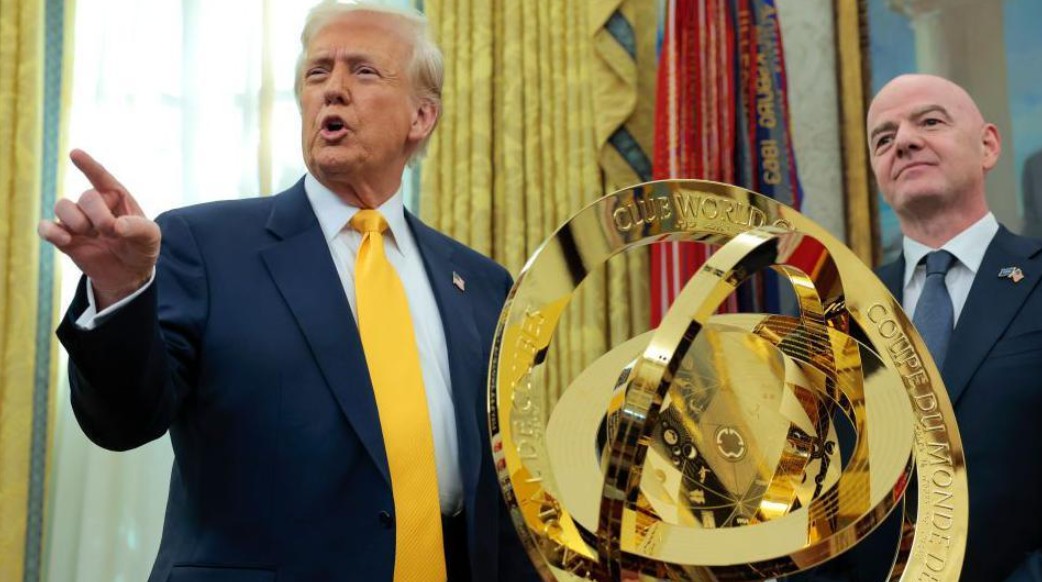
Compounding this fear is Donald Trump’s deep entanglement with sports since 2025. Described as the self-declared hardest working president in US history, Trump has spent a remarkable amount of time attending stadiums, arenas, golf courses, and race tracks, making his presence almost inescapable.
As 2026 approaches, there is growing concern that the American presidency will not merely intersect with sport but threaten to subsume it entirely.
Reports suggest Trump plans to continue his ubiquitous presence across sporting events, including the World Cup, the Olympics, and even a UFC card on the White House lawn, with his fondness for jumbotrons transforming into what some perceive as a dependency.
Security concerns for the World Cup are unprecedented. Eleven US cities—from Seattle to Miami—will host matches, demanding coordination across federal, state, and local agencies.
The United States also marks its 250th birthday in July, adding additional stress on law enforcement already managing the largest World Cup ever. Major sports events have long been considered prime terrorist targets, and outdated coordination systems, visa backlogs stretching to 18 months, and complex security demands further exacerbate fears.
For many fans, the combination of a hyper-politicized sporting environment, stringent immigration policies, and Trump’s inescapable presence has transformed what should be a celebration of football into a source of apprehension.
The online discourse reflects a widespread sentiment: that attending the 2026 World Cup could be unsafe, and that the United States, once proud of welcoming the world, might now feel more like an obstacle course than a hospitable host.
The 2026 World Cup is thus poised to be a test—not just of America’s organizational capacity, but of its ability to reassure the world that visitors will be safe and welcome.
Amidst the roar of stadiums and the spectacle of global competition, fear and uncertainty are palpable, coloring what should be a historic sporting moment with the shadow of political tension and social unrest.
The 2026 FIFA World Cup is set to kick off on June 11, 2026, marking the beginning of the largest tournament in the history of the sport. The matches will be held across 16 cities spanning the United States, Mexico, and Canada, showcasing iconic stadiums and vibrant urban centers.
In the United States, venues range from MetLife Stadium near New York City, which will host the final, to cities like Seattle, Miami, and Los Angeles, each preparing to welcome tens of thousands of fans.