
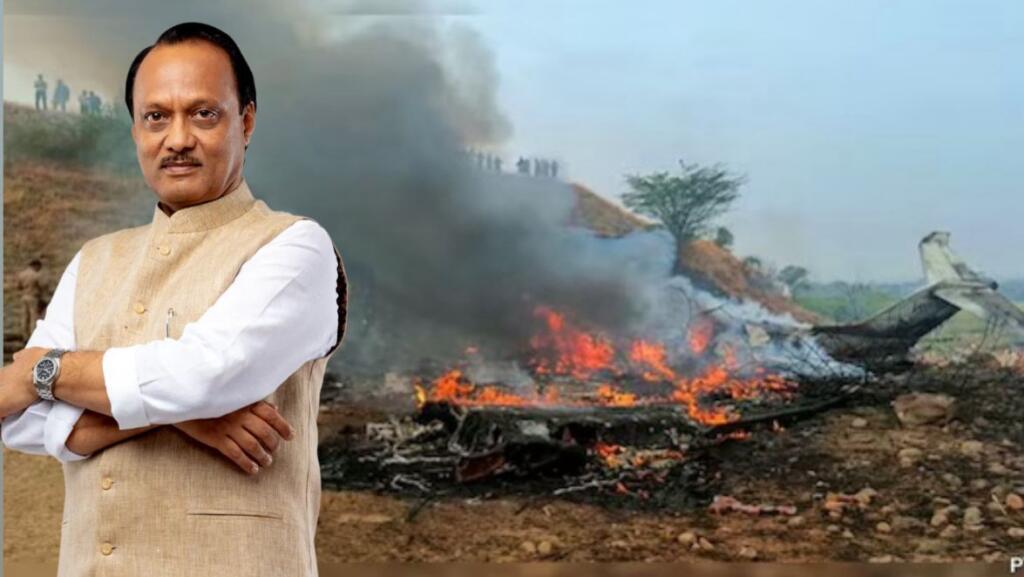
Maharashtra Deputy Chief Minister Ajit Pawar and four others were killed after the aircraft carrying them crashed in Pune district early on Wednesday morning.
According to the Directorate General of Civil Aviation (DGCA), the crash occurred around as the aircraft was attempting to land in Pune’s Baramati, killing all those on board.
As per Flight Radar, the flight took off from Mumbai at 8.10 am and it disappeared from radar around 8.45 am. Superintendent of Police, Sandip Singh Gill, confirmed that the aircraft crashed at 8:50 am.
The aircraft was identified as a Learjet 45 operated by Delhi-based charter company VSR, the regulator said.
The DGCA said that Ajit Pawar was on board the aircraft along with two accompanying personnel—a Personal Security Officer (PSO) assigned to his protection and an attendant—as well as two crew members, comprising the Pilot-in-Command (PIC) and the First Officer (FO).
As per initial information, no person on board has survived the crash.
Reports said that locals who witnessed the crash stated that the NCP leader was taken to a hospital shortly after the incident.
Pune Police said that the administration and security agencies reached the spot to access the situation.
Emergency services and rescue teams were deployed immediately after the crash to manage the aftermath of the charter flight’s failed landing attempt amid the smoke and debris.
Visuals from the spot showed the aircraft’s wreckage strewn across the area, with flames and thick smoke billowing from it.
The Maharashtra Deputy CM was heading to Baramati to attend a public rally in connection with the upcoming Zilla Parishad elections and the visit was part of his political engagements in his home turf, reported Times of India.
Earlier, Ajit Pawar was in Mumbai on Tuesday where he attended a meeting of the Maharashtra Cabinet Committee on Infrastructure chaired by CM Devendra Fadnavis. Maharashtra Minister Chandrashekhar Bawankule, and concerned officials were also present.
A Shocking Start to the Year
This plane crash in Pune district on January 28, 2026 that killed Maharashtra Deputy Chief Minister Ajit Pawar and four others is one of the first major tragedies of the year.
The deadly accident has sent shockwaves through the state and the nation. Officials confirmed there were no survivors among those on board.
This is a significant loss not just because of the sudden death itself, but because Ajit Pawar was one of the most influential and high-profile political leaders in Maharashtra. His passing will have immediate and long-term political implications.
Ajit Pawar’s Role in Maharashtra Politics
Ajit Pawar was one of Maharashtra’s senior most political figures, serving as Deputy Chief Minister multiple times under different state governments. He was known for his deep roots in state governance and for being a key player in shaping government policies.
Over decades, Pawar had served in high-level roles — handling major portfolios like finance, water resources, irrigation, and planning. These departments are crucial in a state where agriculture, industry, urban development and water management are daily priorities for millions of people.
Politically, he was a bridge between several parties and alliances, having worked with Congress, Shiv Sena, and the Bharatiya Janata Party at different times. His ability to navigate shifting alliances made him one of Maharashtra’s most enduring politicians.
Losing a leader of his experience and influence is likely to impact governance and party dynamics in the state. It could reshape political equations, particularly in the upcoming local and state elections, as parties now reassess leadership and strategy without him at the helm.
Early Life and Entry into Politics
Ajit Anantrao Pawar was born on 22 July 1959 in Deolali Pravara in Ahmednagar district in Maharashtra. He started in politics through the cooperative movement, which plays a huge role in rural Maharashtra, especially in sugar and agricultural sectors.
His early career was marked by steady growth. In 1982, he entered public life through a cooperative sugar board. By 1991, he was elected as chairman of the Pune District Cooperative Bank, a post he held for many years.
That same year, he also won election to the Lok Sabha (India’s lower house of Parliament) from Baramati, a political stronghold he continued to represent — later becoming an MLA in the state assembly.
Over the years, Pawar took on key ministerial responsibilities in Maharashtra. He became Deputy Chief Minister several times under different governments — a record few others have matched. He was known for his deep involvement in administrative decisions and policy planning.
Party Dynamics and Leadership
Ajit Pawar belonged to the Nationalist Congress Party (NCP), a regional power in Maharashtra. In 2023, a major split in the NCP saw him lead one faction and align with the ruling alliance in the state, a move that further solidified his leadership role.
This realignment also helped him secure the official party name and symbol for his faction in 2024, which was a significant political milestone.
Despite often being termed a “career deputy” for never becoming Chief Minister himself, Pawar was widely recognised as a key strategist and administrator whose influence extended far beyond his official title.