
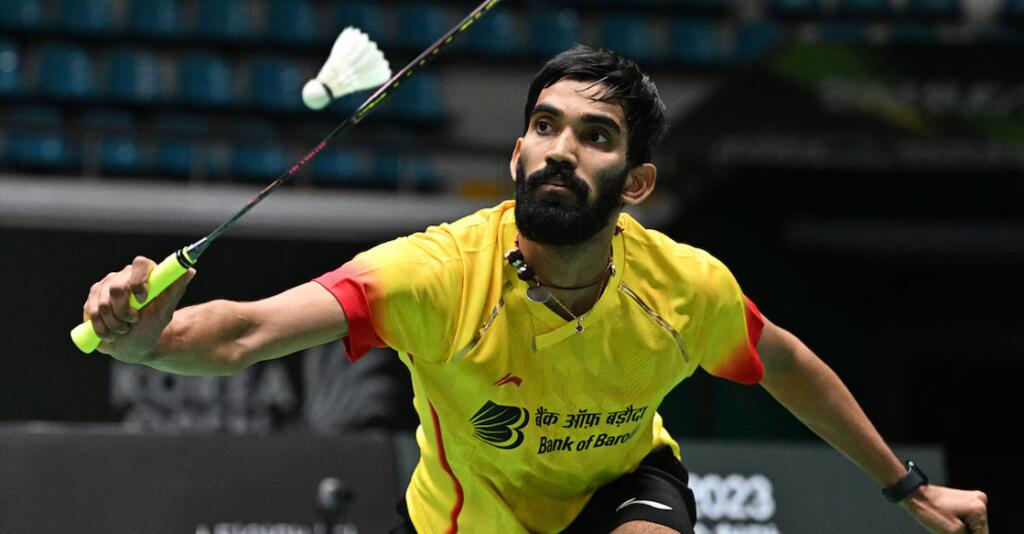
Former world No 1 Kidambi Srikanth on Tuesday defended the playing conditions at the India Open in New Delhi, and pushed back against criticism from Denmark’s Mia Blichfeldt, who claimed she encountered unhygienic training facilities in the capital.
Blichfeldt caused controversy by criticizing the conditions at the Indira Gandhi Stadium complex, describing the environment as “unhealthy” and calling for the Badminton World Federation (BWF) to intervene ahead of the World Championships later this year at the same venue.
Responding to the remarks, Srikanth said such operational shortcomings are part of international sport and not unique to India and urged players to adopt a more balanced view instead of singling out one host nation.


“Frankly I haven’t read about what she spoke, but with my experience, I haven’t really seem any bad things that has happened. The conditions are totally fine here and I don’t understand the hue and cry over it… I had to wait an hour in Denmark for my match during the 2016-17 season because the lights went out. So these kind of things happen. Prannoy (HS) told me that he played one game on the subsequent day and the other set the next day, so such things happen. No country does these things intentionally as everyone wants to give their best at it,” Srikanth said.
Srikanth also brushed aside concerns over the chilly conditions in the capital, saying players must be prepared to adapt to challenging environments.
The India Open was shifted this year from the KD Jadhav Indoor Hall to the larger Indira Gandhi Indoor Stadium, with several players noting faster shuttle movement and sideways drift despite the absence of air conditioning.
“I don’t know. Every country has its own conditions. If you go to Singapore, there will be a lot of drift. If you go to Malaysia, there will be less drift. Indonesia, they have renovated the stadiums, but earlier, it used to be compact and really fast. I am just very happy to be playing here again,” Srikanth said.
After Blichfeldt’s remarks, Badminton Association of India (BAI) swiftly rejected the claims. BAI general secretary Sanjay Mishra said Blichfeldt’s remarks reflected her personal sensitivities and did not pertain to the main Indira Gandhi Indoor Stadium.
He clarified that her comments largely referred to the warm-up area at the older KD Jadhav Stadium and stressed that the primary competition venue was clean and bird-free. Notably, Blichfeldt had earlier also questioned conditions last year at the KD Jadhav Indoor Hall.
The debate intensified further after Danish world No 2 Anders Antonsen withdrew from the tournament, citing “extreme pollution” in New Delhi. Antonsen said the conditions were not suitable for a top-tier event and revealed that the Badminton World Federation (BWF) fined him USD 5,000 for pulling out of the competition.
The controversy sparked by Blichfeldt over conditions at the India Open has once again exposed a familiar pattern in international sport — selective outrage when it comes to India, and conspicuous silence when similar or worse issues surface elsewhere.
Blichfeldt’s remarks triggered a wave of commentary portraying India as an unfit host, reinforcing long-standing stereotypes rather than offering a balanced critique.
What went largely unacknowledged, however, is that athletes across sports have endured — and openly spoken about — far worse conditions in so-called “developed” sporting nations, without those countries being subjected to the same sweeping condemnation.
Take the Paris Olympics, wherein Belgian triathlete Jolien Vermeylen publicly slammed organisers after swimming in the Seine River, describing it as “dirty” and unsafe during the women’s race, where she finished 24th. Recalling her 1500-metre swim, Vermeylen said she could physically feel debris in the water.
“While swimming under the bridge, I felt and saw things that we shouldn’t think about too much,” she told Belgian TV channel VTM.
She also raised serious health concerns after ingesting large amounts of polluted water during the race. “We’ll know tomorrow if I’m sick or not,” Vermeylen said, adding, “It doesn’t taste like Coca-Cola or Sprite, of course.”
Despite repeated reports of dangerous bacteria levels in the Seine, Olympic officials greenlit the event, insisting the water was safe. Yet the narrative around Paris never escalated into calls for stripping hosting rights or branding the city as “unfit” for global sport.
Cricket offers another glaring example of this double standard. The Boxing Day Test between Australia and England ended within two days, sparking brief debate but little sustained outrage. Former India batter Aakash Chopra highlighted the hypocrisy in how such incidents are framed depending on geography.
“When the match ended in Ahmedabad in two days, a BBC report said, ‘death of Test cricket.’ Here, they say it’s actually not bad, that two-day Test matches are also great. Hypocrisy much. Something there and something else here,” Chopra said on his YouTube show.
His point was blunt and uncomfortable: when matches finish quickly in India, pitches are labelled dangerous and the integrity of the sport is questioned. When the same happens in Australia or England, it is rationalised, contextualised, or even romanticised.
Against this backdrop, Blichfeldt’s remarks appear less like constructive criticism and more like part of a recurring pattern where India is singled out and publicly shamed for issues that are neither unique nor intentional.
As Kidambi Srikanth rightly pointed out, logistical and operational challenges are part of global sport. Power failures, poor facilities, pollution, weather disruptions — athletes have faced them everywhere from Europe to Australia.
No country sets out to offer substandard conditions. Hosts invest heavily to stage international events, and occasional shortcomings — whether in Delhi, Paris, Melbourne or Copenhagen — should be addressed with fairness, context and accountability, not weaponised for narrative-building. Criticism is valid. Hypocrisy is not.