
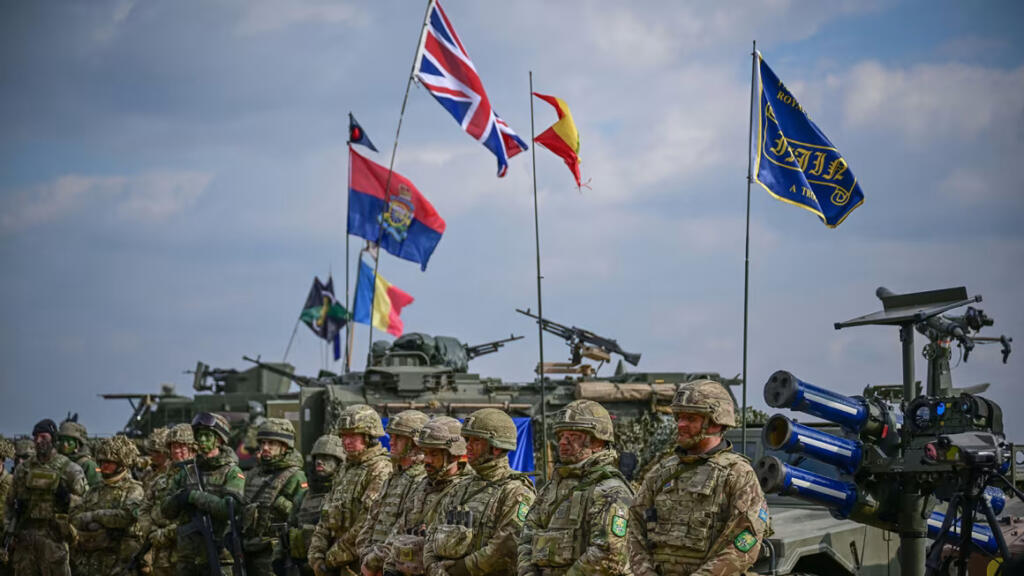
As debates swirl over the future of transatlantic security, European leaders and strategic analysts are confronting a stark reality: the prospect of a NATO without the United States is no longer a distant theory but a pressing concern with monumental financial and strategic consequences. Recent developments in global geopolitics have pushed this discussion from academic think-tanks into the corridors of power in Brussels and European capitals, where experts warn that Europe could face an almost unimaginable financial burden if it were forced to replace U.S. military contributions to the alliance.
The idea of a NATO without the United States emerged amid rising tensions between Washington and its European allies over defense priorities and strategic commitments. At the center of this debate is the U.S. administration’s shift toward prioritizing security interests in other regions, leaving European members to question how sustainable the existing security architecture truly is. President Donald Trump’s controversial remarks about the strategic importance of Greenland and ambiguous comments on U.S. defense commitments underscore these growing divisions within the alliance. European nations, historically reliant on American military support, see such rhetoric as a signal that Europe may increasingly need to fend for itself.
In response to this uncertainty, the London-based International Institute for Strategic Studies (IISS) published a comprehensive report examining the cost and implications of a NATO landscape absent U.S. participation. Their findings are sobering. The report estimates that to fully replace the military capabilities currently provided by the United States, European members would need to invest around $1 trillion over the next 25 years. This ambitious figure reflects one-time procurement costs and the lifecycle expenses of personnel, maintenance, and support systems necessary to replicate U.S. military contributions.
The scale of investment needed to sustain a transatlantic alliance without American support highlights the extensive gaps in Europe’s defense industrial base. The United States currently provides a significant share of joint NATO capabilities, including advanced aircraft, naval assets, strategic intelligence, and command and control infrastructure. Should the U.S. reduce its involvement or withdraw entirely, Europe would have to develop or acquire these capabilities independently. That challenge extends far beyond simple financial expenditure; it would demand a complete overhaul of defense production, procurement processes, and military integration across diverse national forces.
Europe’s defense industrial sector, while significant, faces systemic hurdles in scaling up to meet such demands. Unlike the United States, where defense contracts are often centralized and produced at scale, European military procurement is fragmented, with orders split between numerous national firms and disparate standards. This fragmentation limits production speed and increases costs. Even with coordinated investment, analysts warn that Europe’s defense industry might struggle to deliver the volume of equipment needed within a reasonable timeframe.
Beyond the technical challenges of building military hardware, the human element adds another layer of complexity. The IISS report suggests that Europe would need to increase its active military personnel by hundreds of thousands to fill the operational gaps left by U.S. forces. Integrating these personnel into a cohesive force capable of conducting sustained defense operations against a resurgent Russian military or other modern threats would require years of training, joint exercises, and structural reform across NATO member states.
The financial implications of a NATO without the United States extend beyond mere military hardware. European nations would also need to invest heavily in intelligence, surveillance, and reconnaissance systems. Currently, the United States provides key strategic capabilities in satellite communications, space-based sensors, airborne warning systems, and early warning defense networks. Without these assets, European defense planners would be forced to either develop equivalent systems from scratch or procure them at significant expense, further driving up the overall cost beyond the initial $1 trillion estimate.
Political realities also complicate this transition. European governments have already taken steps toward boosting their defense budgets, with some agreeing to temporarily relax budgetary constraints and increase military spending. Nonetheless, achieving the levels of investment needed across all member states remains contentious. Many governments face economic pressures at home, and the idea of directing vast sums toward defense rather than social welfare or infrastructure remains unpopular with parts of the electorate.
Despite these challenges, some European leaders believe that the current strategic moment could catalyze long-overdue reform within NATO. For years, critics have argued that European members relied too heavily on the United States to carry the bulk of the alliance’s defense burden. A shift toward greater European responsibility could, in theory, strengthen the alliance by fostering deeper integration and self-sufficiency. Yet, such a transformation would require unprecedented levels of cooperation, political will, and sustained investment.
Critics of the “NATO without America” scenario argue that such discussions are exaggerated and potentially harmful to alliance cohesion. Many contend that the United States remains committed to NATO, pointing to continued participation in joint exercises, shared intelligence agreements, and ongoing military cooperation. Moreover, proponents of sustained transatlantic engagement argue that the alliance’s strength lies in its ability to adapt and evolve rather than fragment.
Nonetheless, the debate highlights a fundamental tension at the heart of modern collective defense: how to balance shared burdens and responsibilities in an era of shifting geopolitical priorities. Whether Europe ultimately embraces a more autonomous defense posture or recommits to deeper cooperation with the United States, the conversation spurred by the possibility of a NATO without America is reshaping strategic thinking across the alliance. The financial stakes are clear, and the political implications will shape European security for decades to come.