

















The Enforcement Directorate raid at the residence of Indian Political Action Committee, IPAC chief Prateek Jain in Kolkata has triggered a political storm whose impact extends far beyond West Bengal. Taking place amid an ongoing probe into the coal scam, the January 8, 2026 operation has once again brought to the forefront a larger national debate on the use of central investigative agencies, the balance of federal power and the resilience of India’s democratic institutions. What might have appeared as a routine enforcement action has rapidly evolved into a confrontation with implications for governance, political freedom and Centre state relations across India.
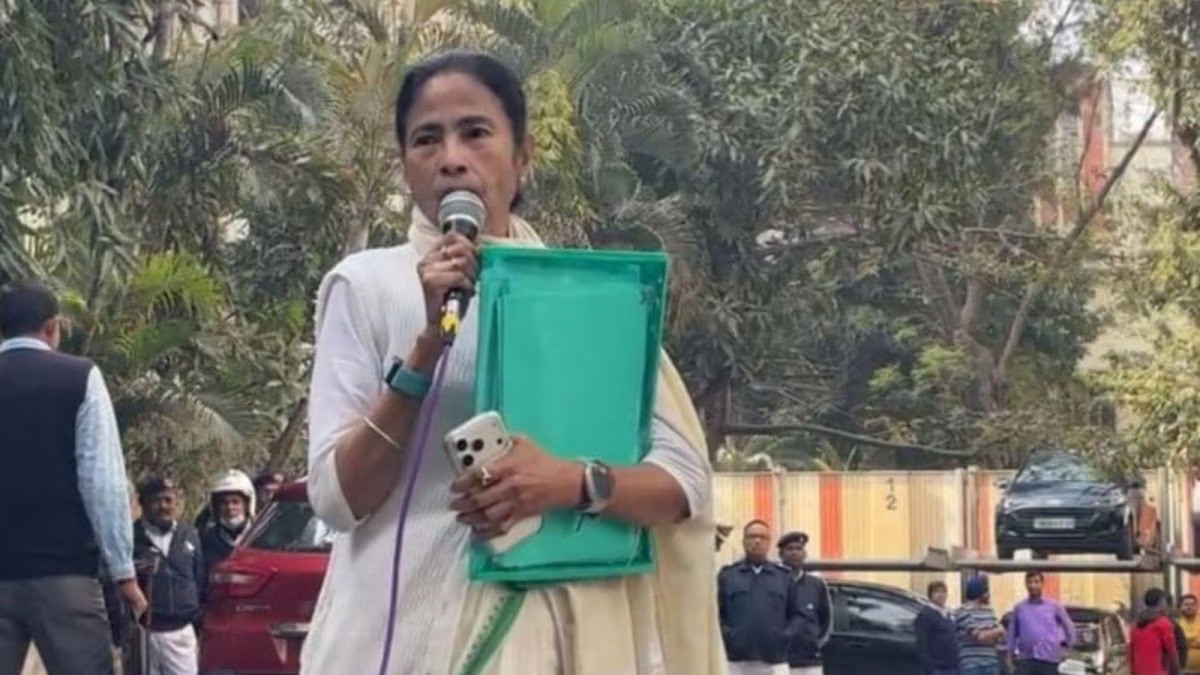
The situation escalated dramatically when West Bengal Chief Minister Mamata Banerjee arrived at the IPAC office shortly after the raid began. Her presence at the site, combined with her decision to speak directly to the media, transformed the episode into a high profile political confrontation. Banerjee alleged that the raid was politically motivated and carried out at the behest of the Union Home Minister. By stating that information about her party was being collected, she framed the action as an attempt to weaken the Trinamool Congress through institutional pressure rather than electoral competition.
This accusation strikes at the heart of a long standing concern in Indian politics regarding the perceived misuse of central agencies against opposition ruled states. Over the past decade, similar allegations have emerged from multiple states governed by non BJP parties, creating a widespread perception that investigative agencies are increasingly being drawn into political battles. The West Bengal episode of IPAC reinforces this narrative and strengthens the argument that federal institutions are under strain, with states feeling vulnerable to central authority.
Banerjee’s visit to the IPAC office was not merely symbolic. It was a calculated political message asserting that the Trinamool Congress would not retreat in the face of pressure. By emphasizing that her party is a registered entity that pays income tax, she sought to underline its legitimacy and autonomy. Her challenge to the BJP to fight politically rather than through what she described as money power or force resonated with opposition parties nationwide, many of whom see parallels with their own experiences.
The Trinamool Congress’s decision to raise the issue in both state and national forums further elevates the matter from a regional dispute to a national concern. By doing so, the party is positioning itself as a defender of federalism and democratic norms. This strategy could influence the broader opposition landscape, potentially encouraging greater coordination among parties that feel targeted by central agencies. In this sense, the raid has the potential to reshape opposition politics in India, uniting disparate forces around the issue of institutional independence.
The response from the Bharatiya Janata Party, however, reflects a sharply contrasting interpretation. BJP leader Suvendu Adhikari accused Mamata Banerjee of violating the Constitution by interfering in the functioning of a central agency to raid IPAC office. By framing her actions as obstruction of justice, the BJP has attempted to shift the focus from the conduct of the Enforcement Directorate to the conduct of the Chief Minister herself. This counter narrative seeks to portray the central agency as acting within its legal mandate while depicting the state leadership as undermining the rule of law.
Adhikari’s reference to Banerjee’s earlier protest outside the CBI office in 2021 reinforces the BJP’s argument that she has a history of confronting investigative institutions. From the BJP’s perspective, such actions are unacceptable for a Chief Minister, who is constitutionally obligated to uphold the law. The assertion that the Enforcement Directorate may take appropriate action against her further intensifies the confrontation, raising the stakes of an already volatile political situation.
For India as a whole, this episode at IPAC office highlights a deepening trust deficit between the Centre and opposition ruled states. The frequent clashes over the role of investigative agencies risk eroding public confidence in institutions that are meant to function independently. When law enforcement actions are perceived as politically motivated, their credibility suffers, regardless of the legal merits of individual cases. This has long term consequences for governance, as institutions lose the moral authority required to enforce accountability.
The incident also underscores the growing personalization of political conflict in India. Rather than remaining confined to policy disagreements, disputes are increasingly centred on individuals and institutions. This personalization amplifies political polarization and reduces the space for constructive dialogue. In the West Bengal case, the confrontation between Mamata Banerjee and the BJP leadership mirrors a broader national trend where politics is framed as a battle between personalities rather than ideologies.
Ultimately, the ED raid on IPAC office and its aftermath represent more than a single investigation. They reflect the tensions inherent in India’s federal structure at a time when political competition is intense and institutions are under scrutiny. How this episode unfolds will influence perceptions of democratic fairness, the autonomy of states and the integrity of investigative agencies. For a country as diverse and complex as India, maintaining the delicate balance between accountability and political freedom is essential. The developments in West Bengal serve as a reminder that when this balance is disturbed, the impact is felt not just in one state but across the nation.