
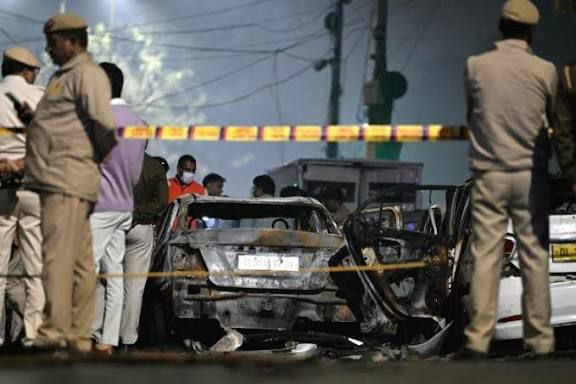
Central agencies investigating the car blast near Delhi’s Red Fort have uncovered a larger terror plan.
As many as 15 people died and dozens were injured when an explosive-laden Hyundai i20 detonated near Delhi’s Red Fort on November 10, 2025.
Sources told India Today TV that the accused viewed the brand as symbolising Jewish influence, as it was once headed by a Jewish chief executive during its global expansion.
The proposed strikes were reportedly intended to send a political message linked to Israel’s military operations in Gaza.
The angle emerged during sustained interrogations of eight accused, including three medical professionals — Muzamil Ahmad Ganaie and Adeel Ahmed Rather from Jammu and Kashmir, and Shaheen Saeed from Uttar Pradesh.
The doctors told officials that there had been sharp disagreements within the module over target selection.
Sources said several members opposed hitting civilian establishments and wanted any action restricted to security forces in Jammu and Kashmir.
However, Umar-un-Nabi, identified by agencies as the car-borne attacker killed in the blast, allegedly pushed for high-visibility targets outside the Valley to increase the strike’s impact.
Officials believe Umar-un-Nabi and his associates viewed attacks on coffee chain outlets in metropolitan cities as a way to internationalise their message and highlight what they described as “perceived injustices” against Muslims, particularly in Gaza.
Seven days after the blast, the National Investigation Agency (NIA) arrested Jasir Wani, reportedly recruited for his technical expertise. Wani was allegedly tasked with modifying drones into weaponised platforms and was involved in discussions around executing Hamas-style strikes, potentially preceded by coordinated car bombings across multiple cities.
During questioning, Wani disclosed that Umar-un-Nabi initially tried to radicalise him into becoming a suicide bomber. Wani reportedly resisted but later agreed to join the module in a supporting operational role.
Sources also said the accused were linked to the banned terror outfit Ansar Ghazwat-ul-Hind (AGuH) and were driven by propaganda narratives tying local terror actions to global conflicts. Officials believe Umar-un-Nabi aimed to carry out a major strike around December 6, the anniversary of the Babri Masjid demolition.
The Red Fort explosion followed a nearly three-week investigation by Jammu and Kashmir Police into a suspected “white-collar terror module” linked to two banned outfits — Jaish-e-Mohammed (JeM) and AGuH.
The probe began after security agencies recovered a JeM pamphlet in Srinagar on October 19, 2025, triggering heightened surveillance and intelligence gathering to trace the network. The case has since been taken over by the NIA, with nine people arrested so far, including three doctors.
During the initial phase, J&K Police also recovered a video clip of about 1 minute 20 seconds from Umar-un-Nabi’s phone, in which he is allegedly seen speaking about carrying out a suicide attack.
Central agencies are now investigating whether the plan to target the coffee chain moved beyond internal discussions, including whether reconnaissance was conducted or specific outlets were identified.
Further investigation is underway.