
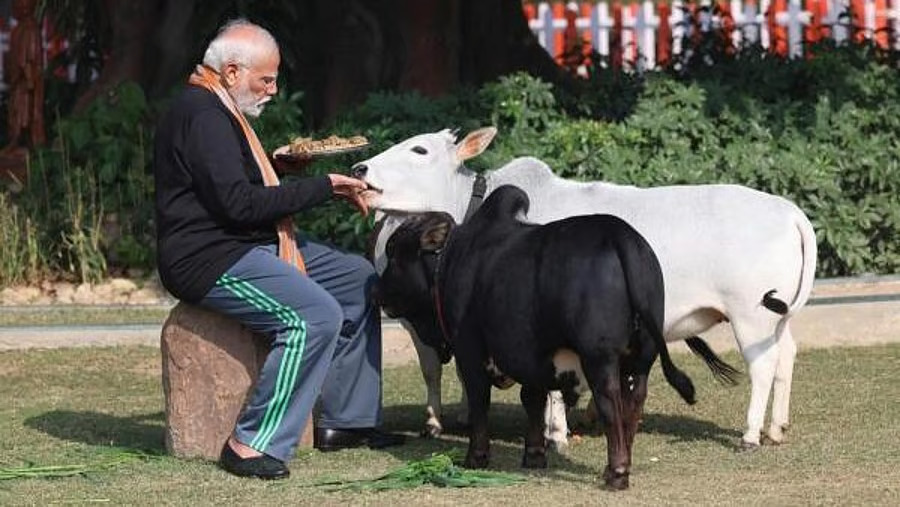
On 14th January, on the auspicious occasion of Makar Sankranti, Prime Minister Narendra Modi was seen feeding and caring for cows at his official residence at Lok Kalyan Marg. The images, which quickly went viral, showed the Prime Minister surrounded by cows, gently feeding them and expressing visible affection towards Gaumata. Beyond the symbolism and warmth of the moment, the pictures carried a deeper message about India’s indigenous cattle heritage. The cows seen with the Prime Minister were not ordinary cattle, but belonged to a rare and distinctive indigenous breed known as the Punganur cows.
The Punganur cow is an indigenous cattle breed native to Andhra Pradesh and is considered one of the smallest Bos indicus cattle breeds in the world. These dwarf cows originate from Punganur town in the Chittoor district of Andhra Pradesh, from which they derive their name. Once found commonly in the region, the breed had faced a severe decline over the decades due to neglect, crossbreeding and the increasing preference for high yielding exotic breeds. At one point, Punganur cows were on the brink of extinction, prompting conservation efforts by scientists, farmers and state authorities.
One of the most striking features of the Punganur breed is its size. The average height of a Punganur cow ranges between 70 to 90 centimetres, roughly 2.3 to 3 feet, making it remarkably compact. Despite its small stature, the cow is robust and well adapted to local conditions. The average body weight ranges from 115 to 200 kilograms, which is significantly lower than most other Indian cattle breeds. This small size translates into lower maintenance costs, making it an ideal breed for small and marginal farmers.
The milk of Punganur cows is another defining characteristic that sets the breed apart. While the average milk yield per lactation is around 546 kilograms, which is modest compared to commercial dairy breeds, the quality of the milk is exceptional. The milk has a high fat content ranging from 5 percent to as high as 8 percent, whereas most commonly used breeds produce milk with fat content between 3 and 3.5 percent. This high fat content makes Punganur milk particularly suitable for producing ghee and other traditional dairy products, which are highly valued in Indian households and rituals.
Beyond fat content, the milk of Punganur cows is traditionally believed to have medicinal benefits. Many practitioners of traditional medicine and indigenous knowledge systems regard this milk as beneficial for digestion and overall health. While modern scientific research on these claims is ongoing, the cultural and nutritional importance of such indigenous breeds remains undeniable.
In appearance, Punganur cows display a wide range of body colours. These include white, grey, light brown, dark brown and red. In some cases, the animals show a mix of white with patches of red, brown or even black. The breed is characterised by a broad forehead and short, crescent shaped horns. In males, the horns tend to curve backward and forward, while in females they generally extend laterally and forward. These physical traits contribute to the breed’s distinctive and easily recognisable look.
Adaptability is one of the strongest advantages of Punganur cows. They are highly drought resistant and can survive on dry fodder feeding, which is especially important in regions prone to water scarcity. The breed is well suited to the South Indian climate and shows strong resistance to many common cattle diseases. Its ability to thrive on low quality feed and withstand adverse environmental conditions makes it a resilient and reliable choice for sustainable livestock farming.
The temperament of Punganur cows is generally docile, which makes them easy to manage. The bullocks of this breed are traditionally used for agricultural operations, particularly in light soil, and for pulling carts used in transportation. In some regions, Punganur bullocks are also used in special local races, reflecting their strength and endurance despite their small size.
An often overlooked but crucial aspect of Punganur cows is their contribution to organic and eco friendly farming. The dung and urine of this breed are rich in nutrients and are widely used as natural fertilisers and pest control agents in organic agriculture. This reduces dependence on chemical inputs and supports environmentally sustainable farming practices.
The Punganur cow is also considered eco friendly due to its low resource requirements. It needs less water, less feed, smaller grazing areas and smaller sheds compared to larger cattle breeds. As a result, it produces lower amounts of methane gas, contributing less to greenhouse gas emissions. In an era where climate change and sustainable agriculture are major global concerns, such traits make indigenous breeds like Punganur increasingly relevant.
Prime Minister Modi’s Makar Sankranti interaction with Punganur cows was therefore not merely a festive gesture. It brought national attention to an endangered indigenous breed and highlighted the importance of conserving India’s rich cattle diversity. The moment served as a reminder that protecting native cows is not only about tradition and culture, but also about sustainability, rural livelihoods and ecological balance.