




















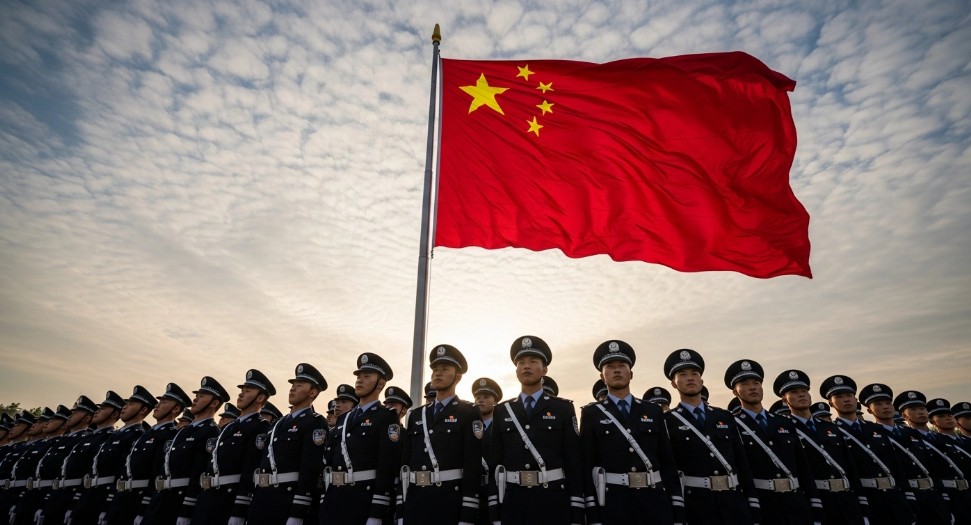
China observed its sixth Chinese People’s Police Day on January 10, 2026, a national observance dedicated to recognizing the contributions of its police force.
Several activities were held across the country to honor the public security guardians, highlighting their role in maintaining social stability and safeguarding citizens.
It is a date that commemorates the emergency hotline 110 that citizens dial during crises, however, the bitter irony cannot be ignored. While the Chinese Communist Party honours its security apparatus, it is that very machinery that enforces systematic persecution across Tibet and Xinjiang, transforming what should be the symbol of protection into instruments of coercion and cultural genocide.
From Lhasa’s detention centres to Xinjiang’s surveillance grid, and extending through overseas police outposts targeting dissidents globally, Beijing’s authoritarian reach tightens. Yet beneath this repression, defiance persists, a testament that whilst surveillance can monitor movements, it cannot extinguish the human spirit.
Prisons Bared During Celebrations
Whilst Police Day commemorations unfolded with official fanfare, the reality inside Tibet’s detention facilities exposed the regime’s brutality.
Dorje Tashi, a 51-year-old Tibetan businessman imprisoned on fabricated fraud charges, was beaten twice by fellow inmates at Chushur Prison in Lhasa, first in April 2021, then again in April 2025, leaving visible marks on his forehead.
Prison authorities his denied family visiting rights, citing spurious rule violations. Subsequently, his sister, Gonmo Kyi, tried to kill herself by jumping from a hotel in Lhasa while in police custody in August 2025, as a result of the family’s ongoing harassment.
Such targeted violence shows such practices where authorities assault political prisoners with impunity.
Such repression extends far beyond individual cases. In July 2025, ahead of the Dalai Lama’s 90th birthday, authorities detained two Tibetans in Chentsa County without explanation and their whereabouts remain unknown to this day.
Armed security personnel swarmed Lhasa and surrounding regions, whilst traditional Sangsol rituals faced government bans. This intensified crackdown accompanies China’s 30-year forced disappearance of Gedhun Choekyi Nyima, recognised as the 11th Panchen Lama by the Dalai Lama in 1995 when he was merely six years old. Beijing abducted the child, now the world’s longest-held political prisoner, to assert control over Tibetan Buddhism’s succession processes.
Xinjiang’s detention architecture operates on an industrial scale. Since 2017, over one million Uyghurs and other Turkic Muslims have been imprisoned in what Beijing euphemistically terms vocational education centres.
Although China claims that many of its camps closed in 2019, independent verification identified 380 suspected facilities still operating. Survivors describe patterns of torture, rape, forced sterilisation, and ideological indoctrination confirmed by the United Nations in 2022.
The Chinese government reported 3.2 million labour transfers in 2023 alone, embedding coercive labour programmes throughout global supply chains. Simultaneously, authorities demolished over 100 mosques since 2016, including the 15th-century Kargilik Grand Mosque, whilst removing Islamic architectural features—domes, minarets, crescent moons—from countless others.
Overseas Police Outposts Silence Exiles, Threatening Taiwan Next
Beijing’s repression refuses to respect international borders. Data suggests that between 2016 and 2022, four Chinese public security bureaus established 102 overseas police stations which spanned 53 countries across five continents.
These outposts work outside normal diplomatic rules and often ignore the host country’s authority. On paper, they offer basic services, but they are also used to watch, pressure, and scare critics in the Chinese diaspora. In 2022, a Chinese dissident in the Netherlands said he received calls from people linked to one such station, telling him to return to China.
Spanish authorities reported similar “pressure-to-return” efforts, where Qingtian prosecutors worked with a Madrid-based station to push fugitives back.
In the United States, the Department of Justice arrested two men in April 2023 for allegedly running a hidden station in Manhattan’s Chinatown. Prosecutors said it was tied to campaigns aimed at activists, including some based in California.
At least 14 countries—including Canada, the United Kingdom, Germany, Ireland, and Japan—have opened investigations, concluding these stations can act as tools of cross-border repression.
Taiwan now sits on the front line of this wider threat. In January 2026, Chinese state media and linked social media accounts doxed Democratic Progressive Party legislator Puma Shen, sharing satellite images of his home and workplace and warning he could be arrested for “secession.”
Taiwan’s Ministry of Foreign Affairs condemned this digital authoritarianism as transnational repression designed to create fear and undermine democratic society. President Lai Ching-te warned in December 2025 that Beijing accelerates military preparations for forced unification by 2027 whilst escalating legal, psychological, and opinion warfare to erase Taiwan’s sovereignty.
The National Security Council established permanent task forces to counter Beijing’s attempts to impose China’s jurisdiction over Taiwan and protect citizens from transnational suppression. As one Taiwanese official put it, the Communist Party wants to trap a free, prosperous Taiwan in an authoritarian cage called “Taiwan, China.”
As China marked its Police Day celebrations, the international community must recognise this commemoration for what it truly represents: a tribute to mechanisms enforcing cultural genocide.
The prisons of Lhasa and Xinjiang, the overseas police stations targeting dissidents in democratic nations, and the surveillance networks monitoring every prayer and protest form an integrated architecture of repression. Facing threats that transition from shadow to substance–Taiwan stands as the next target.
However, history provides ample evidence that authoritarian regimes expending such vast resources to suppress populations reveal that it fears its own citizens.
The defiance persisting amongst Tibetans, Uyghurs and all who resist Beijing’s coercion proves that whilst chains can bind bodies, they do not imprison the spirit.
Democratic nations must move beyond expressions of concern to concrete action–closing overseas police stations, sanctioning surveillance technology exports, supporting victims of transnational repression and standing resolutely with Taiwan.
Otherwise, we validate the cynical calculation that repression, sufficiently funded and technologically advanced, can succeed.