
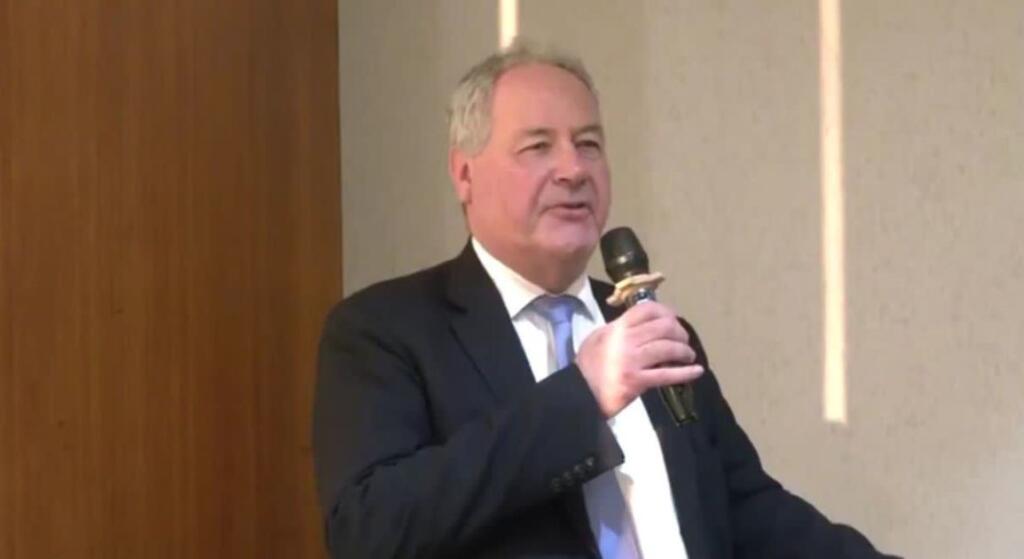
British Conservative MP Bob Blackman on Sunday reiterated his consistent support for India’s position on Jammu and Kashmir, asserting that the entire Union Territory must be reunited with India. Importantly, he clarified that his advocacy predates the Narendra Modi government’s 2019 decision and instead traces back more than three decades.
Speaking at a Hi-Tea Programme at the Constitutional Club in Jaipur, Blackman emphasised that his stance was not shaped by recent political developments. Rather, he said, it was rooted in the early 1990s, particularly the forced exodus of Kashmiri Pandits from the Valley.
“I didn’t just call for the abrogation of Article 370 when Prime Minister Modi included it in the manifesto and implemented it. Instead, I had already called for this back in 1992, when Kashmiri Pandits were driven out of Jammu and Kashmir,” Blackman stated.
Moreover, recalling his activism during that period, the British MP said that several initiatives were undertaken in the UK to draw attention to what he described as a grave injustice against the displaced community.
“At the time, we organised a massive meeting to tell people that this was wrong and unjust, because individuals were being forced out of their ancestral homes solely due to their religion and background,” he said.
Condemnation of Terrorism and Pakistan’s Role
Additionally, Blackman said he has consistently condemned terrorism in Jammu and Kashmir and sharply criticised Pakistan’s control over parts of the region.
“Not only have I condemned the terrorism that continues to take place, but I have also condemned Pakistan’s illegal occupation of parts of the erstwhile princely state of Jammu and Kashmir,” he remarked.
#WATCH | Jaipur, Rajasthan | At a Hi-Tea Programme at the Constitutional Club, British MP Bob Blackman said, “…. I didn’t just call for the abrogation of Article 370 back when Prime Minister Modi put it in the manifesto and implemented it. I called for this back in 1992, when… pic.twitter.com/n7IJ4zVYsQ
— ANI (@ANI) January 5, 2026
Reiterating his core position, he added, “From the very beginning, I have maintained that the entire princely state of Jammu and Kashmir should be reunited under the crown of India.”
Furthermore, Blackman’s remarks align with his earlier statements from July 2025, when he strongly condemned the terrorist attack in Pahalgam that killed 26 people.
In a post shared on X at the time, he said, “I remain appalled by the terrorist attack in Pahalgam a few months ago, which claimed 26 innocent lives.”
While welcoming the temporary calm that followed, he also warned against complacency. “I am relieved that peace has held for now; however, the truce remains fragile. As India strengthens its security ties with the West, I urged the government to stand firmly with India against terrorism,” he stated.
Subsequently, while speaking in the UK Parliament, Blackman referred to India’s response to the attack, saying, “We witnessed the horrific terrorist attack in Pahalgam and India’s subsequent counter-terrorism response, ‘Operation Sindoor’. I remain deeply appalled and saddened by the barbaric attack on innocent tourists that took 26 lives.”
At the same time, although he welcomed the pause in hostilities between India and Pakistan, Blackman cautioned that the situation could deteriorate again. “That truce remains extremely fragile and could easily slip back into war,” he warned.
Finally, highlighting Pakistan’s alleged role in cross-border terrorism, Blackman asserted, “As someone who has stood with the Kashmiri Pandits and their right to return to the Kashmir Valley, and with India’s sovereign right to defend its people and territory, it is outrageous that Pakistan-sponsored terrorism continues in Jammu and Kashmir.”
During the Operation Sindoor Global Outreach in June, he also described Pakistan as a “failed state” and questioned its civil-military balance, asking pointedly, “Who is really in charge there—the democracy or the generals?” He concluded by stating that it was “quite clear that terrorism is encouraged from Pakistan into sovereign India.”