
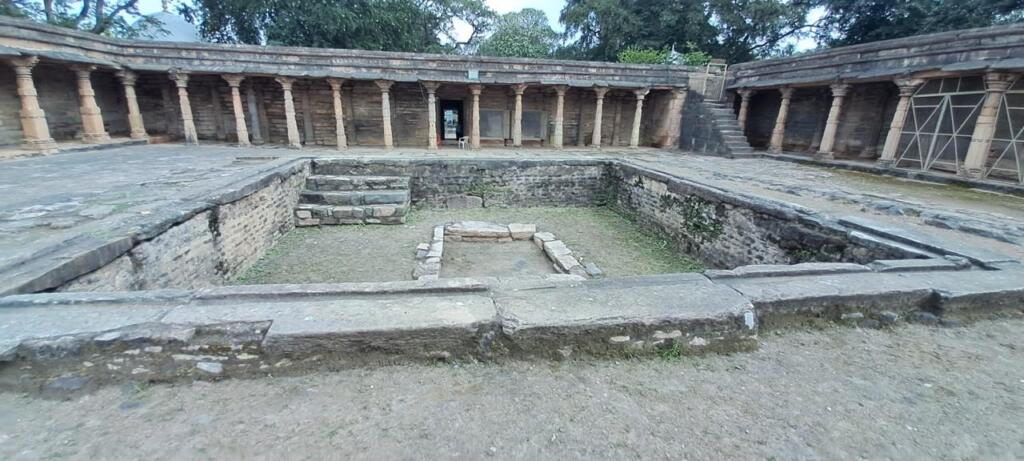
The Bhojshala is back in focus as Basant Panchami (Saraswati Puja) and Friday prayers (Jumma Namaz) fall on the same day, reviving attention on the long-standing dispute.
Basant Panchami prayers commenced on Friday at the 11th-century disputed Bhojshala–Kamal Maula Mosque complex in Madhya Pradesh’s Dhar district amid heavy security arrangements.
A day earlier on Thursday, the Supreme Court passed an important order fixing separate timings for worship and namaz at the site.
A bench headed by Chief Justice Suryakant directed that the Hindu community will be allowed to perform prayers from sunrise to sunset on Basant Panchami, while the Muslim community may offer Jumma namaz between 1:00 pm and 3:00 pm.
As per reports, in view of the sensitivity of the matter, the administration has deployed nearly 8,000 security personnel, including police, Rapid Action Force (RAF), and Central Reserve Police Force (CRPF) units. The entire complex is under surveillance through over 200 CCTV cameras and 10 drones.
To maintain law and order, the administration had sought a prior list of namaz attendees. According to officials, separate entry and exit gates have been designated for both communities. Dhar Collector Priyank Mishra said that both sides have agreed to the arrangements.
This coincidence of the puja and namaz falling on the same day has occurred several times in the past as well. Whenever Basant Panchami has coincided with a Friday according to the Hindu calendar, Hindu–Muslim tensions have risen proportionally. On several occasions, disputes over prayers and namaz at Bhojshala have even escalated into riots.
The court has also instructed the administration to demarcate separate areas within the same Bhojshala so that both worship and namaz can take place.
Experiencing Bhojshala Through the Naked Eye
Can worship and namaz really take place in the same complex? This question kept circling in my mind throughout my journey from Indore to Dhar.
In 2023, while traveling extensively across Madhya Pradesh during the assembly elections, I couldn’t resist the temptation to visit Dhar and see the Bhojshala for myself.
Located about two and a half hours from Indore, Dhar is a calm and beautiful town that silently preserves several glorious chapters of history within its folds—Bhojshala being one of them, albeit a disputed one.
Historians associate Bhojshala with the illustrious Parmar king Bhoj, who turned Dhar into a major center of education and culture in the 11th century.
Many scholars believe that a vast educational complex—similar to a Saraswati Sadan or gurukul—once existed here, where the Vedas, grammar, philosophy, and scriptures were taught.
This is why Hindus continue to worship Goddess Vagdevi (Saraswati) as the presiding deity of this site.
Bhojshala is currently under the control of the Archaeological Survey of India (ASI), and visitors can enter after purchasing a ticket.

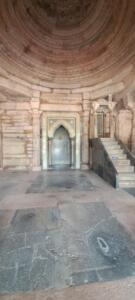
The moment one steps inside, the structure appears unmistakably temple-like. Especially the main baradari—where both worship and namaz take place—its walls, pillars, and mandap seem to narrate their history without uttering a word.
A closer look reveals carved symbols, motifs, and figures etched into the stone, clearly indicating the tradition this site once belonged to.
One can spot symbols of Shiva, inscriptions of ‘Om,’ and words like ‘Ram.’ The entire structure bears the architectural imprint of the Parmar era.

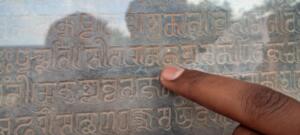
The space identified by the Muslim side as the mihrab or qibla does appear to be a later addition. Even here, looking upwards at the grand dome and its artwork dispels lingering doubts about the site’s original identity.
Spending just a little time within this compact complex makes it easy to understand what the original nature of this site might have been.
These basic facts—visible to the naked eye—have also been scientifically confirmed by the Archaeological Survey of India. Yet, unfortunately, the site remains disputed.
ASI Survey Confirmed What Hindus Have Been Saying for Years
In March 2023, the Madhya Pradesh High Court ordered the ASI to conduct a scientific survey of Bhojshala to determine its original nature. In 2024, ASI carried out a 98-day-long survey, which has now emerged as the most concrete basis in the temple-versus-mosque debate.
The ASI report submitted to the High Court states that the present structure of Bhojshala was constructed using parts of pre-existing temples. During the survey, ASI documented around 1,700 archaeological remains, including 94 idols, fragments of idols, pillars, old beams, plaster, and inscriptions.
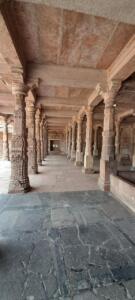
According to the ASI report, “Four-armed deities were carved on windows, pillars, and beams that were reused in the present structure. These include Ganesh, Brahma with his consorts, Narasimha, Bhairava, various goddesses, along with human and animal figures. Animal depictions include lions, elephants, horses, dogs, monkeys, snakes, turtles, swans, and birds…”
The report also notes that many human and animal figures carved on pillars were later chiseled off, as such imagery is not permitted in mosques. However, several elements like kirtimukhas and small figures of deities remain intact—perhaps overlooked.
The ASI states that based on the decorative pillars and plasterwork, “it can be concluded that these elements were part of earlier temples and were reused to construct the mosque colonnade.”
Regarding the western baradari—where both worship and namaz are performed—the ASI report observes that the mihrab was added later and that its construction material differs from the rest of the structure, a distinction easily noticeable even to a layperson.
The report concludes, “Based on scientific investigation, surveys, archaeological excavations, study and analysis of recovered remains, architectural remnants, sculptures, inscriptions, art, and craftsmanship, it can be stated that the existing structure was constructed using parts of earlier temples.”
On the structure’s nature and age, the ASI report notes, “Architectural remains, sculptural fragments, large inscriptions containing literary texts, and Nagkarnika inscriptions on pillars indicate that a vast structure associated with literary and educational activities once existed at this site.”
It further states that based on scientific analysis, this earlier structure can be attributed to the Parmar period.
Khilji’s Invasion and the Destruction of Bhojshala
Historians state that Alauddin Khilji attacked Malwa (Dhar) during his 13th-century expansion campaigns. It is believed that his forces destroyed numerous temples in the region, including Bhojshala. Despite this destruction, Hindu faith in Bhojshala endured, and worship continued.
Later, in 1514, during the reign of Mahmud Khilji II, the Kamal Maula Mosque was constructed within the Bhojshala complex.
The Muslim side maintains that Bhojshala has always been the Kamal Maula Mosque and that namaz has been offered there for centuries.
However, the ASI’s findings once again raise fundamental questions—Can later religious use alter the original character of a site? And if the evidence is so clear—visible even to the naked eye—why does the dispute still persist?