
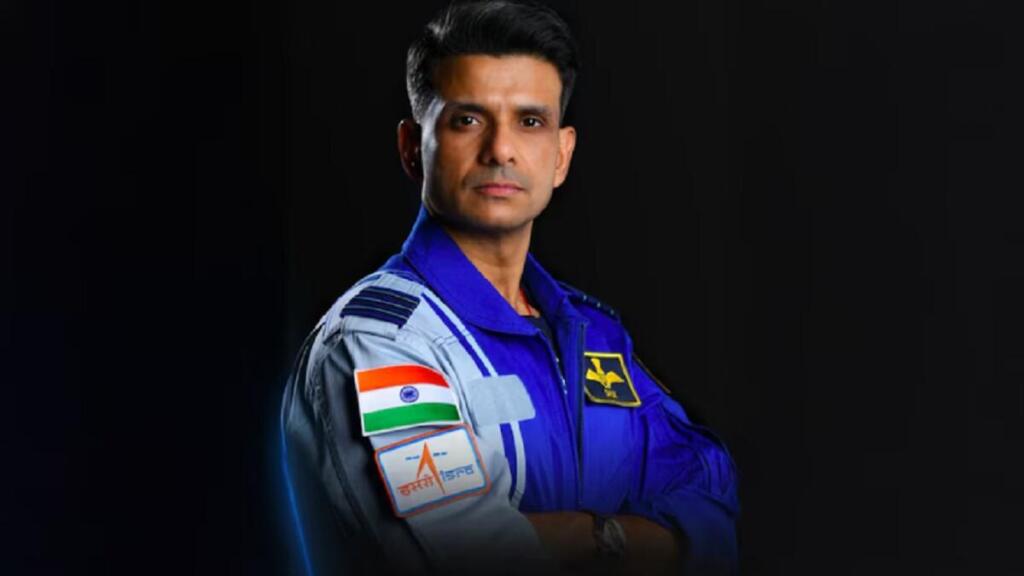
India has witnessed a historic moment this Republic Day as Group Captain Shubhanshu Shukla has been honoured with the Ashok Chakra, the nation’s highest peacetime gallantry award. With this recognition, he joins an exceptionally rare group of Indians whose service has gone beyond conventional battlefields—extending India’s courage, discipline, and strategic vision into outer space.
Group Captain Shukla is India’s second astronaut to travel to space and the first Indian to visit the International Space Station (ISS). His achievement represents a defining milestone in India’s human spaceflight journey and highlights the powerful convergence of military excellence, scientific innovation, and national ambition.
Before him, Squadron Leader Rakesh Sharma, the first Indian to go to space, was awarded the Ashok Chakra for his extraordinary service to the nation. With this honour, Group Captain Shukla becomes the fourth officer from the Indian Air Force to receive the Ashok Chakra, further underscoring the IAF’s pivotal role in shaping India’s aerospace and strategic future.
A Mission Beyond Symbolism
Group Captain Shukla was awarded the Ashok Chakra following his historic 18-day mission to the International Space Station in June 2025 as part of the Axiom-4 mission. During his time aboard the ISS, he conducted critical microgravity experiments directly linked to India’s ambitious Gaganyaan human spaceflight programme.
These experiments produced vital data on human endurance, biological responses, and technological performance in low Earth orbit—data that will form the backbone of future Indian crewed missions. His work significantly reduced uncertainties associated with long-duration spaceflight, strengthening India’s readiness for independent human space missions.
Far from being a ceremonial flight, Shukla’s mission demanded extreme endurance, precision, and technical mastery—qualities that lie at the very heart of the Ashok Chakra.
Military Discipline Meets Scientific Progress
Traditionally awarded for acts of exceptional bravery in peacetime, the Ashok Chakra in Shukla’s case represents the evolving definition of national service. Courage is no longer limited to land, sea, or air—it now extends into space.
As a Group Captain in the Indian Air Force, Shukla embodies the legacy of military aviators who consistently push technological and operational frontiers. His achievement demonstrates that military discipline, risk management, and operational excellence remain indispensable even in the most advanced scientific environments.
This fusion of defence and science sends a clear strategic message: India’s space ambitions are inseparable from its quest for strategic autonomy.
Strengthening India’s Strategic Space Posture
Shukla’s role in the Axiom-4 mission carried profound strategic importance. By operating within a complex multinational space ecosystem, India demonstrated its capability to integrate with global partners while firmly safeguarding national interests.
His collaboration with NASA and other international agencies enhanced India’s standing as a credible, responsible, and capable spacefaring nation. More importantly, the mission strengthened pathways of cooperation essential for India’s long-term goals—ranging from Gaganyaan and deep-space missions to the eventual establishment of an independent Indian space station.
Inspiring a New Generation
Beyond science and strategy, Group Captain Shukla’s journey has inspired millions across India. His presence aboard the ISS became a moment of national pride, motivating young Indians to pursue careers in science, technology, engineering, and defence.