














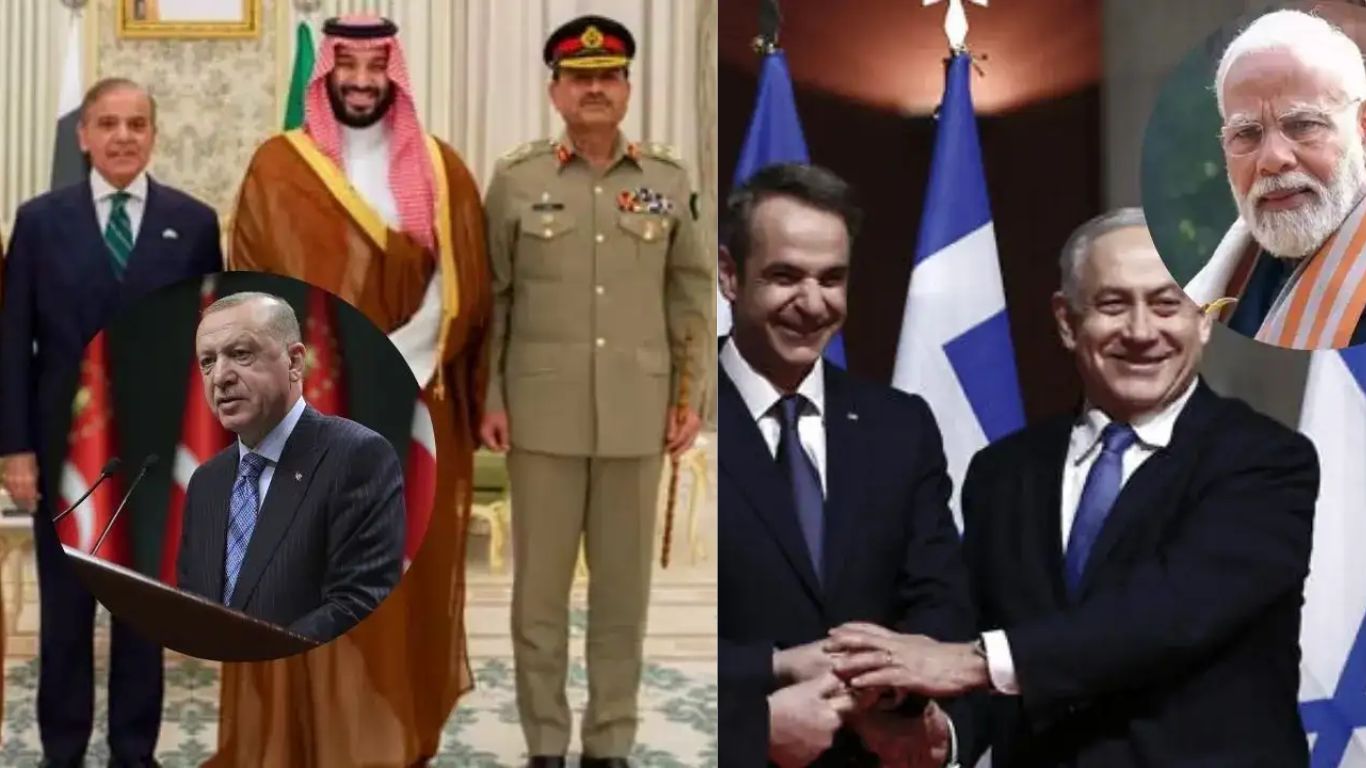
As UAE President Mohamed bin Zayed Al Nahyan prepares to visit New Delhi, India finds itself at the intersection of multiple geopolitical tremors. West Asia is in flux. Iran faces sustained internal unrest while Washington openly debates coercive options. Saudi Arabia and the UAE, once described as “Iron Brothers,” now stand on opposite sides of the Yemen conflict. Turkey, driven by President Erdoğan’s ambition to lead the Islamic world, is exploring entry into the Saudi–Pakistan Strategic Mutual Defence Agreement (SDMA).
Together, these developments raise a sharp question for New Delhi: should India remain content with strategic autonomy, or is the moment ripe for a more structured security alignment—especially as a counterweight to a possible “Islamic NATO”?
The Emerging Axis: SDMA, Turkey, and Nuclear Signalling
The SDMA between Saudi Arabia and Pakistan marks a qualitative shift in regional security thinking. By committing to collective defence, both states signal intent to deter threats through mutual assurance. Western media speculation that Pakistan’s nuclear capability could indirectly extend to Saudi Arabia has only intensified anxieties. Turkey’s proposed entry adds another layer of complexity.
Turkey already enjoys deep defence cooperation with Pakistan, ranging from naval shipbuilding to aerospace and drone technologies. Ankara also maintains improving ties with Riyadh after years of rivalry. If Turkey joins SDMA, the arrangement could stretch from South Asia to the Eastern Mediterranean. Azerbaijan’s proximity to this axis further strengthens it.
For India, the concern is not rhetorical. Pakistan gains strategic depth and diplomatic confidence. Turkey’s hostility toward India, especially on Kashmir, remains explicit. Saudi Arabia may not act against Indian interests directly, yet the consolidation of a Pakistan-centric security bloc alters the regional balance. Moreover, Turkey’s ambition to lead the Islamic world gives this grouping ideological weight, not just military coherence.
At the same time, India’s relations with the UAE remain exceptionally strong. Abu Dhabi has invested heavily in India and cooperates closely on intelligence and counter-terrorism. However, rising Saudi-UAE friction creates uncertainty. New Delhi must now manage parallel friendships without appearing partisan.
The Mediterranean Opportunity: Toward a New Strategic Geometry
Against this backdrop, a quieter but important development has unfolded in the Eastern Mediterranean. In December 2025, Israel, Greece, and Cyprus signed a Trilateral Military Cooperation Plan for 2026. The agreement focuses on joint air and naval exercises, unmanned systems, electronic warfare, and structured strategic dialogue.
Importantly, India has received a formal invitation to join this framework in a “3+1” format. This matters. India already shares strong defence and political ties with all three countries. New Delhi and Tel Aviv enjoy one of India’s deepest defence partnerships, built on co-development, technology transfer, and operational trust. Greece and Cyprus have emerged as reliable partners, with India conducting naval exercises and air drills in the Mediterranean and the Aegean.
This trilateral alignment sends a clear signal to Turkey. Israel, Greece, and Cyprus see Ankara as a disruptive force in the Eastern Mediterranean. India does not share their geography, but it shares their concerns about revisionist behavior, maritime insecurity, and coercive diplomacy.
Here lies India’s strategic opening. Rather than joining a rigid military alliance, India can deepen issue-based security cooperation in the Mediterranean. Participation in joint exercises, intelligence exchanges, and defence-industrial collaboration would enhance India’s reach without diluting autonomy. A stronger Mediterranean presence also complements India’s energy security interests and protects sea lanes connecting Europe, West Asia, and the Indo-Pacific.
Also Read: ‘Islamic NATO’: Is It Possible? What is the Concept and Constraints
Should India Enter a Formal Alliance?
India’s strategic culture remains cautious of treaty-bound alliances. History and geography both argue for flexibility. Yet flexibility does not mean passivity. The rise of bloc politics in West Asia and Eurasia forces India to think in terms of countervailing coalitions, even if informal.
A formal military alliance may still be premature. It could constrain India’s diplomacy with the Arab world and complicate relations with Iran and Russia. However, a structured strategic framework—focused on maritime security, defence technology, and intelligence—appears both necessary and achievable.
The I2U2 grouping already provides a template. It brings together India, Israel, the UAE, and the United States without formal defence obligations. A Mediterranean extension, anchored by Israel, Greece, and Cyprus, could evolve on similar lines. Such an arrangement would balance Turkey-Pakistan cooperation without framing the region into civilizational camps.
In conclusion, India does not need an alliance in the traditional sense. It needs strategic density. By expanding defence cooperation in the Mediterranean, strengthening ties with Israel and Greece, and sustaining trust with the UAE, India can hedge against emerging threats. The answer to an “Islamic NATO” is not a mirror image alliance, but a smart, networked security posture—one that protects Indian interests while preserving strategic autonomy.