
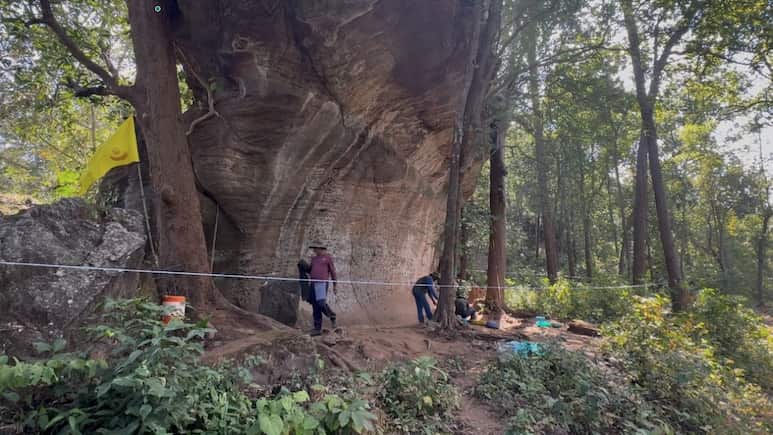
In a remarkable development for the study of ancient human history in India, the Archaeological Survey of India (ASI) has commenced a careful excavation in the state of Odisha that could shed light on one of the oldest known human settlements in the region. This ambitious exploration began after researchers uncovered compelling signs that a civilisation potentially dating back around ten thousand years may lie beneath the surface in the Bhimmandali hills near Redakhol in Sambalpur district. If confirmed through scientific analysis, this discovery of this civilisation could predate many known civilisations and significantly enrich our understanding of early human life on the Indian subcontinent.
The site was first brought to scholarly attention when rock-cut paintings and a variety of ancient tools of an unknown civilisation were unearthed in the Bhimmandali mountains. These initial finds include stone blades and scrapers that appear to have been used for leatherwork, as well as needles and arrow fragments that suggest a sophisticated level of material culture among the people who once inhabited the area. The motifs in the paintings and the wide distribution of tools across the site have led researchers to believe that this settlement was not a temporary camp but rather a place of sustained human activity.
One of the most fascinating aspects of the site is the rock art. Spread across more than forty shelters on the hills, the natural pigments used in the paintings tell stories of daily life in prehistoric times. Scholars have observed depictions of forest scenes, animals, and human figures that provide visual testimony to how early humans in this region perceived their world and interacted with their environment. These artistic expressions could offer unprecedented insight into the cognitive and cultural development of human civilisation in this part of India.
Excavation work is being conducted with great care by ASI teams, who are primarily using manual digging techniques instead of heavy machinery. This painstaking approach is meant to preserve the fragile artefacts and ancient features that might be uncovered, and progress is slow, often advancing at only about a centimetre a day. The ASI’s emphasis on meticulous documentation and careful preservation reflects the archaeological significance of the site and the need to protect any evidence that may emerge during the dig.
This excavation is not the work of the ASI alone. It includes collaboration with academic institutions like Gangadhar Meher University and the Indian National Trust for Art and Cultural Heritage (INTACH), which are contributing scholarly expertise to help analyse the artefacts and contextualise the findings within the broader scope of South Asian prehistory. This interdisciplinary effort underscores the importance of the site and the potential it has to enhance scientific knowledge about early human settlement and technological development.
One of the intriguing possibilities raised by these discoveries is that they could predate well-known ancient civilisations such as the Indus Valley settlements of Mohenjo-daro and Harappa. These sites, which flourished around five thousand years ago, have long been considered among the earliest examples of organised urban life in South Asia. If the Bhimmandali site indeed dates to around ten thousand years ago, it would push back the timeline of organised human civilisation or habitation in this region by several millennia and could have implications for how archaeologists interpret the spread of early human cultures across the subcontinent.
Despite the excitement around these early results, it is important to note that the term “civilisation” is used cautiously by scholars during initial reports. Some experts argue that many early human settlements may best be described as complex hunter-gatherer communities rather than full-fledged civilisations, which typically exhibit features such as urban planning, writing systems, and stratified social structures. As discussions on academic platforms indicate, there is ongoing debate about what criteria define “civilisation” in prehistoric contexts and how best to interpret archaeological evidence from such ancient sites.
Locals in the surrounding areas have shown great interest and pride in the discoveries. Members of the Bhimmandal Sangha and other community organisations have advocated for the site to be recognised as a National Heritage Monument. They believe that the findings not only have scientific importance but also cultural and educational value for the people of Odisha and the nation as a whole. Their support highlights how archaeological work can strengthen regional identity and bring attention to the deep historical roots of local communities.
Another notable aspect of this excavation is the broader context it provides for human history in India. Other recent archaeological research in different parts of the country has revealed evidence of human civilisation, habitation long before the rise of established civilisations. For example, discoveries in Gujarat and Karnataka have documented early human activity dating back thousands of years, showing that the Indian subcontinent was home to a variety of cultures and settlements in prehistoric times. These findings collectively contribute to a more nuanced understanding of human evolution and cultural development in the region.
As carbon dating and other scientific analyses proceed, archaeologists hope to establish a more precise chronology for the Bhimmandali site. Radiocarbon dating will help determine the age of the artefacts and pigmentation used in the rock art, providing critical evidence to substantiate claims about the age of the settlement. This process can take considerable time, but it is essential for placing the discoveries within a broader timeline of global human history.
In the months ahead, continued excavation and study at the Bhimmandali site will likely reveal more about the lifeways, technologies, and artistic expressions of the people who once lived there. Whether or not the site ultimately satisfies all scholarly definitions of an ancient civilisation, it undoubtedly represents a significant archaeological find that deepens our appreciation of human heritage in Odisha and beyond.
Overall, this emerging chapter in India’s archaeological record promises to enrich the narrative of prehistoric life and spark further research into the complex tapestry of human history on the subcontinent.