
















A recent account shared by an Indian man living in the United States comparing healthcare experiences in the United States has drawn widespread interest and sparked a significant discussion.
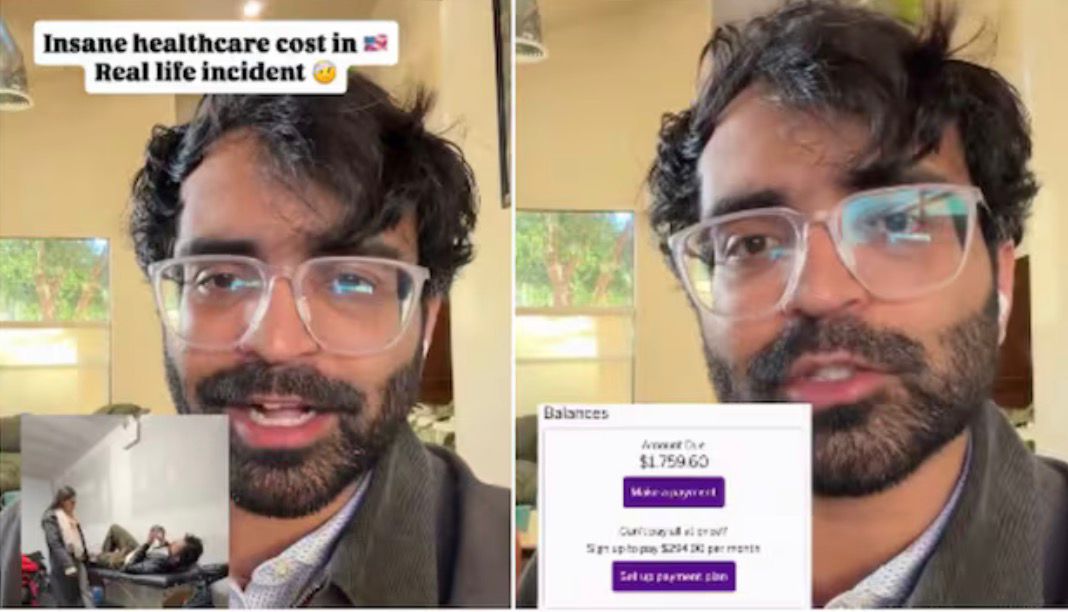
In his now-viral video, “Insane healthcare cost in US. Real life incident,” Parth Vijayvergiya shed light on the high cost of healthcare, offering insight into why the United States is often viewed as a costly place to live.
“Many people say that America is very expensive. I will explain with examples how expensive it actually is. I live here,” he said.
Recalling an incident, he said he sustained a knee injury injury on December 25 while he was ice-skating in New York with his wife and sister.
“While ice-skating, someone hit my knee very hard, which caused severe pain. I thought I had injured my knee or suffered a fracture,” he could be seen saying in the video.
Vijayvergiya further said that he avoided calling an ambulance due to the high costs and instead took a taxi of his own.
He further claimed that he spent about 1.5 hours in the emergency room, where doctors conducted an X-ray, examined his knee and applied a crepe bandage for what was diagnosed as a muscle injury before discharging him.
However, the financial impact of the visit became clear weeks later. “After three weeks, my insurance company informed me that I had to pay $1,800 {approximately Rs 1.5 lakh]),” he stated.
He also claimed that apart from his own payment of $1,800 (around Rs 1.5 lakh) for the brief emergency visit, his insurance provider paid an additional $4,000–$4,500 (approximately Rs 3.3–Rs 3.7 lakh) to the hospital, with the total bill amounting to roughly $5,800–$6,300 (around Rs 4.8–Rs 5.2 lakh).
“This is why America is so expensive and salaries are so high here,” he said in the video, which also included clips from inside the hospital and images of the medical bills.
The video became viral, with many users taking to the comments section and comparing the healthcare costs in the US to those in India.
“This is why healthcare affordability matters more than technology, because a simple injury should not feel like a financial punishment,” a user on X said.
Another commented, “It’s true. I literally had to go to India for a wisdom tooth removal, and the entire trip plus procedure cost less than what they were charging here.”
“That’s the reality of the US healthcare system — world-class treatment, but shockingly expensive. A simple X-ray and bandage shouldn’t cost a small fortune,” another user said.
Some users called America “notorious for looting money on healthcare,” while others contrasted it with India’s relatively affordable medical system.
“India may lack a lot of things, but it is very affordable, especially when it comes to healthcare and public transport,” one comment read.
“In terms of availability and affordability of healthcare facilities, we Indians are much more blessed than we care to admit,” another added.
High Cost of Advanced Healthcare in US
The United States boasts some of the world’s most advanced medical infrastructure and cutting-edge technology, but these benefits often come with a staggering financial price. For both residents and immigrants, even minor medical issues can result in significant expenses, intensifying concerns about affordability within one of the most expensive healthcare systems globally.
These concerns are reflected in findings from a recent Commonwealth Fund survey, which highlights the widespread financial strain caused by medical costs. The study reveals that 41 percent of working-age Americans—approximately 72 million people—are either struggling to pay medical bills or are carrying medical debt, a sharp increase from 34 percent in 2005.
When elderly adults are included, the picture becomes even more troubling: an additional 7 million older Americans face similar challenges, bringing the total number of people affected by medical bill or debt problems to 79 million nationwide.
Together, these figures underscore the growing burden of healthcare expenses in the US and raise serious questions about long-term affordability and access, despite the country’s medical advancements.
India’s Affordable Alternative
In sharp contrast to the high costs and complexities of the US healthcare system, India has emerged as a far more accessible and affordable option for medical treatment.
India combines skilled doctors, modern hospitals, and significantly lower treatment costs, making quality healthcare attainable for a wider population.
As a result, thousands of Non-Resident Indians (NRIs) and Americans travel to India each year for procedures ranging from routine surgeries and dental care to complex treatments such as cardiac surgery, orthopaedics, and oncology, often at a fraction of US costs and with minimal waiting times.
Ironically, many Indians who migrate to the United States in search of better opportunities later find themselves struggling with insurance gaps, high premiums, and unexpected medical bills, issues they rarely faced back home.
This growing contrast has led many to reassess the assumption that more expensive care is necessarily better, positioning India as a global hub for efficient, affordable, and patient-centric healthcare.
Long waiting
In the US, patients often face long delays—weeks for a general physician, months for specialists, and several months for non-emergency surgeries. India offers much faster access, with same-day GP visits and specialist appointments typically available within a week.
Cost of medical consultations
Doctor visits in the US are expensive, often costing hundreds of dollars per appointment. In contrast, consultations in India are far more affordable, costing only a small fraction of US prices.
Hospitalisation expenses
Hospital stays in the US can be financially overwhelming, with a single night costing thousands of dollars. In India, hospitalisation is significantly cheaper, keeping inpatient care within reach for a broader population.
Medical insurance
While insurance is common in the US, high premiums and out-of-pocket costs remain a major burden. India offers much lower insurance costs while still maintaining accessible and effective healthcare services.
Affordability vs innovation: Which one stands out?
The US leads in medical innovation and advanced treatments, but high costs limit access. India prioritises affordability and accessibility, offering faster and more cost-effective care, despite challenges such as overcrowding and uneven rural infrastructure.





