


















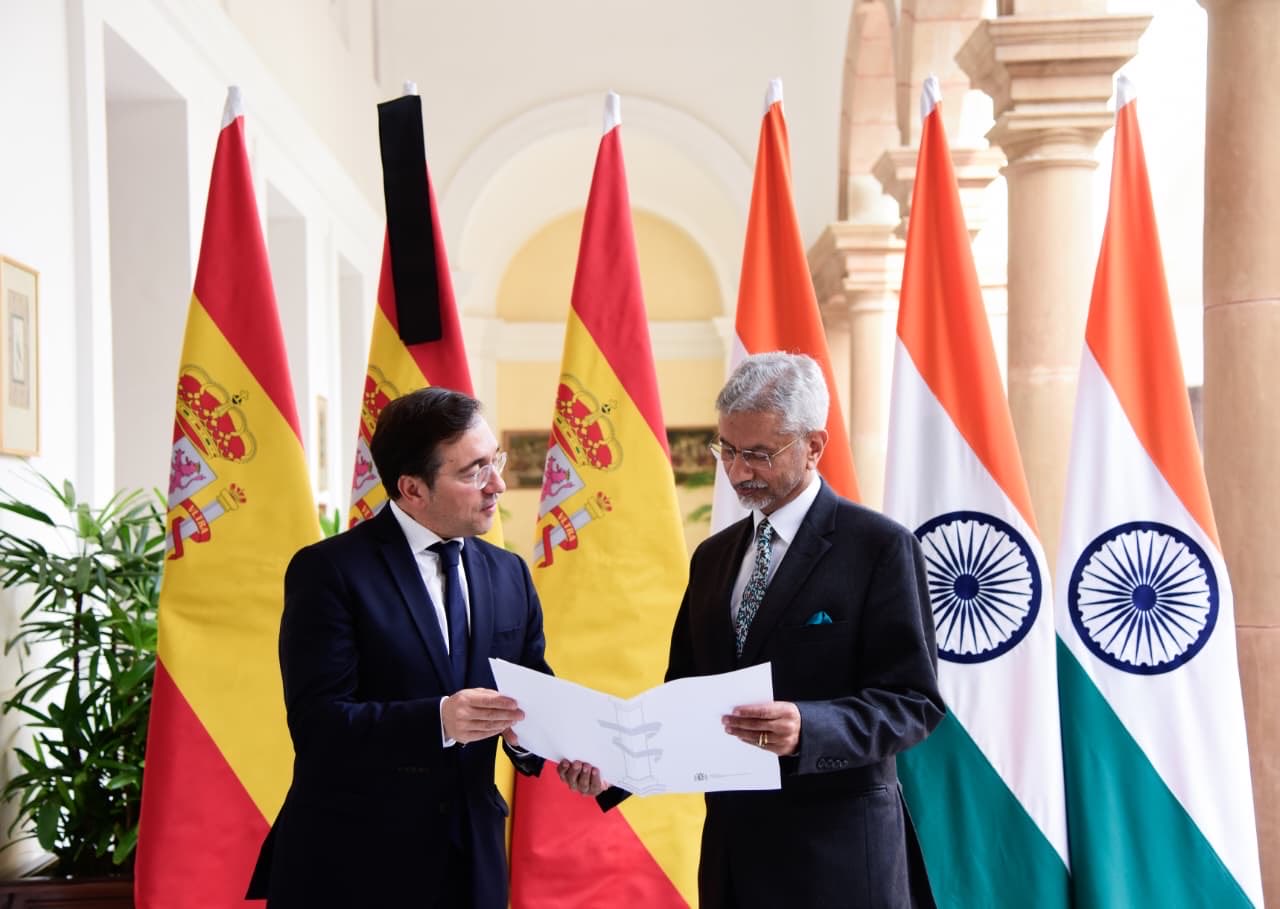
Spain’s decision to join the Indo-Pacific Oceans Initiative (IPOI) and elevate ties with India to a full strategic partnership is a diplomatic upgrade. It signals a quiet but important recognition that India is no longer just present in the Indo-Pacific—it is shaping the rules of engagement.
By becoming a part of the IPOI, Spain is effectively acknowledging India’s natural leadership in its own maritime neighbourhood. For New Delhi, this is not about prestige. It is about trust—and trust at sea is hard-earned.
From philosophy to policy
This outcome did not materialise overnight. Its roots go back to 2015, when India articulated SAGAR—Security and Growth for All in the Region. At a time when maritime power was still largely framed around dominance and spheres of influence, SAGAR offered security as a shared responsibility rather than an imposed order.
That philosophy took institutional shape in 2019 with the launch of the IPOI. Unlike traditional alliances, IPOI avoided rigid commitments and exclusionary blocs. It was designed to let countries cooperate without surrendering strategic autonomy.
By 2026, this thinking has evolved further into MAHASAGAR—a broader and more ambitious vision that stretches from the African coastline to the Pacific Islands. What began as a neighbourhood-first approach is now a genuinely transoceanic framework.
Why Spain chose to join the IPOI
Spain has a technologically advanced navy with aircraft carrier capability and deep experience in multilateral maritime operations.
So why does a Western European power like Spain find this model attractive? Because IPOI is not about choosing sides—it is about choosing causes.
It is neither a military pact nor a geopolitical club. Built around seven pillars—maritime security, the blue economy, environmental protection, disaster response, science, trade, and capacity building—it allows partners to contribute where they are strongest. Participation is voluntary, modular, and practical.
In a global environment marked by opaque military deals and debt-driven influence, India’s transparent, law-based approach—anchored firmly in UNCLOS—offers a credible alternative. For Spain, this matters.
The Navy as a “preferred partner”
India’s credibility is not theoretical; it has been tested at sea. The Indian Navy is widely regarded as the region’s first responder–a reputation reinforced during the rescue of MV Ruen in March 2024. In a high-risk, 40-hour operation, Indian naval forces tracked the hijacked vessel, neutralised 35 pirates, and rescued all 17 crew members without a single casualty.
The episode demonstrated something important–India has the operational muscle to back its diplomatic messaging. Today, many countries trust India to help keep critical sea lanes open, which is arguably the strongest form of maritime soft power.
How India and Spain are already working together ?
India–Spain naval cooperation has been building steadily for years.
In June 2021, the Indian Navy’s INS Trikand conducted exercises with the Spanish frigate Navarra under the EU NAVFOR framework in the Gulf of Aden.
This cooperation has only deepened. By August 2024, the two navies were conducting regular Maritime Partnership Exercises, which included the drills between INS Tabar and the Spanish Navy ship Atalaya in the Mediterranean.
A major joint exercise in June 2025—featuring the Spanish frigate Reina Sofía—tested coordinated responses to simulated pirate attacks.
These engagements built confidence long before Spain formally joined IPOI.
Why this matters ?
Spain’s entry into IPOI reinforces that the Indo-Pacific is not merely a chessboard for great-power rivalry–it is a shared maritime space where middle powers can collaborate without coercion.
India’s success lies in offering a framework that invites participation rather than demands alignment. Spain’s decision validates that approach—and strengthens the idea that cooperative security, not dominance, is the future of the world’s oceans.





